
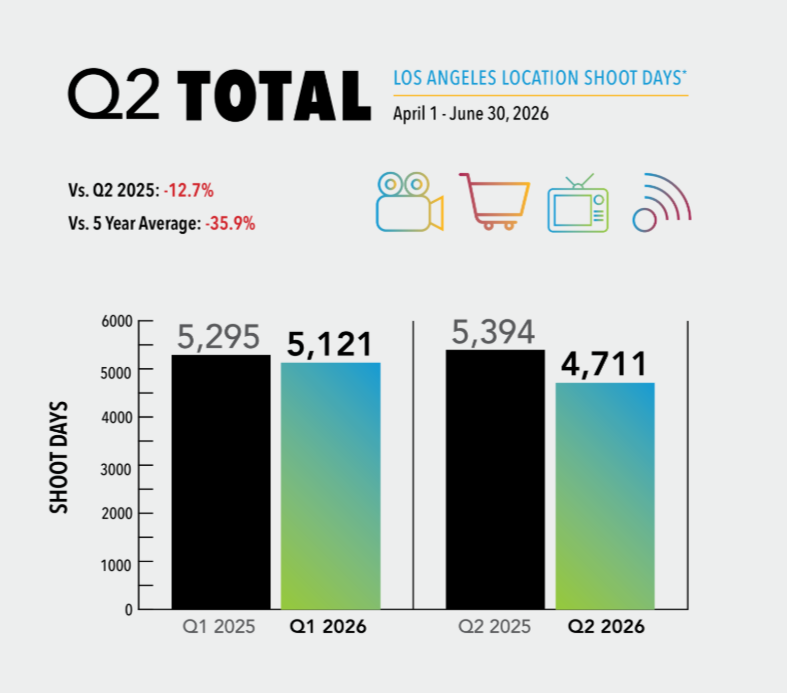
Though California’s expanded production tax credit has brought 170 films and TV shows to the Golden State in the past year, that hasn’t halted the decline in on-location shooting in Los Angeles as the number of shoot days in the second quarter of 2026 fell 12% year-over-year in FilmLA’s latest report as reality TV’s continued exodus fueled the drop.
Only 4,711 shoot days were recorded this past quarter, down from the 5,394 recorded in the second quarter of 2025 and the 5,121 recorded in the previous quarter. In all, the quarter remains a steep 36% below the five-year average. For a comparison beyond that average, 8,632 shoot days were recorded in the second quarter of 2019, a year that at the time had been a five-year low for on-location shooting in L.A.

It’s worth noting that the on-location report only surveys a portion of the total production work going on in Los Angeles and doesn’t show the complete impact of the tax credit program on local shooting and employment. HBO’s “The Pitt,” for example, is filmed primarily on soundstages at the Warner Bros. backlot in Burbank and would not be included in FilmLA’s study. The vast majority of TV comedies, including many approved for the tax credit, are also soundstage productions.
FilmLA CEO Denise Gutches emphasized that such productions employ more cast and crew for longer periods of time than feature films and other types of productions.
“Recent Emmy nominated productions such as ‘Hacks,’ along with California Film and TV Tax Credit recipient ‘The Pitt,’ have demonstrated the strong economic and creative contributions these types of shows can bring to the region.” Gutches said. “Because scripted television production supports more industry jobs than any other production category, helping to attract these types of productions is an important step towards bringing filming back to the region, restoring jobs, and strengthening our local production economy.”
Still, the continued decline in on-location shooting shows that the factors that have pushed productions to other states and countries remain, and Hollywood still finds itself in a competitive global landscape. The biggest factor in the second quarter decline was reality TV, which fell 40% year-over-year to 676 shoot days and is down 62.7% from the five-year average.
The expanded California tax credit program now allows for large-scale reality TV competition shows to apply; but so far only one such show, Jimmy Kimmel and YouTube robotics engineer Mark Rober’s upcoming Netflix show “Schooled!,” has been approved.
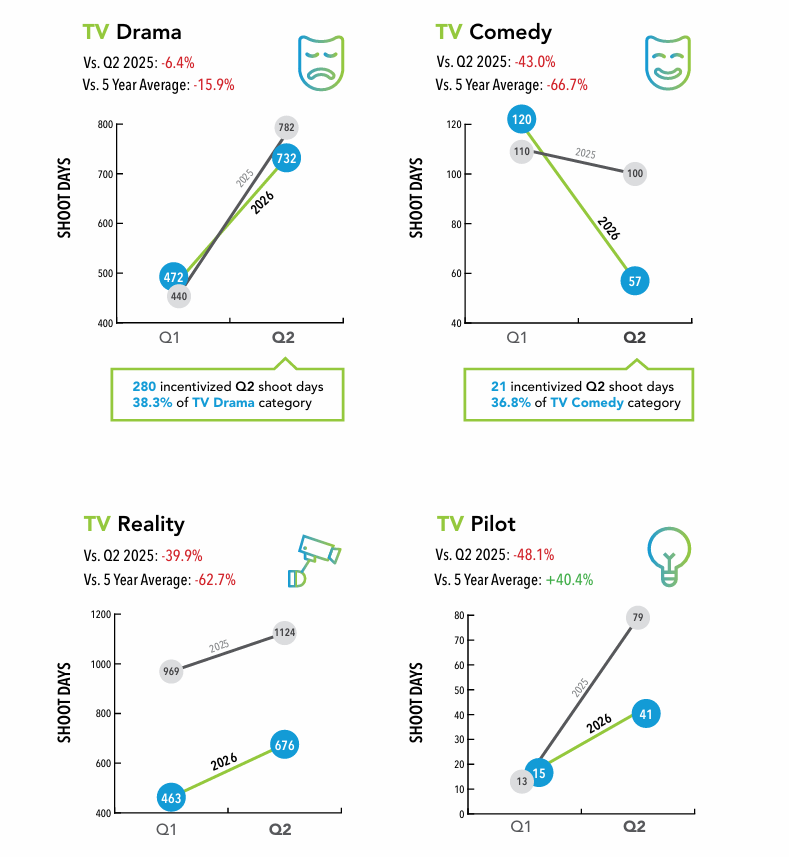
In other categories, feature films fell nearly 20% to 443 shoot days, with independent productions making up the majority of shooting. Commercials, which do not qualify for tax credits, continue to slide with 543 shoot days, down 21.5% year-over-year. TV dramas managed to stem the tide, dropping only 6% year-over-year with 732 shoot days logged and 38% coming from incentivized productions, including Fox’s much publicized reboot of “Baywatch.”
The only year-over-year increase came in FilmLA’s “Other” category, which includes music videos, student films, short films and online videos. 2,118 shoot days were logged in this category, rising 10% year-over-year. Earlier this year, FilmLA launched a “Low Impact Pilot Program” aimed primarily towards productions in this category, allowing those with minimal cast and crew sizes and no special safety requirements to apply for an expedited permit process.
The FilmLA report also comes as Los Angeles Mayor Karen Bass prepares for a November runoff election against city councilmember and onetime ally Nithya Raman, with production flight among the top issues of the campaign.

“While there is still much work to do, FilmLA’s quarterly report is proof that incentives are working: local incentivized productions are on the rise, creating good-paying union jobs and realizing economic opportunity for Angelenos,” Bass said in a statement.
“I created the state’s first-ever film and tv tax credit, fought to expand it to $750 million, and I’m doubling down by fighting for an un-capped tax credit that includes competition reality television and ‘above-the-line’ spend, while also fighting to create the first-ever federal film incentive. We’ll keep cutting red tape and slashing permit fees at the local level, because this industry is core to the history, culture and economic power of Los Angeles,” Bass continued.
Earlier this year, Raman, whose husband is a veteran writer-producer with credits on shows like “30 Rock” and “Modern Family,” told TheWrap that expanding Bass’ film liaison office and making more sweeping changes to the city’s permitting process were among her plans should she be elected.
“After years of Hollywood jobs leaving Los Angeles, I’ll fight to bring them back,” Raman said. “For too long, we’ve treated filmmaking like a nuisance while other cities around the world rolled out the red carpet. That ends when I’m mayor.
“We’ll make L.A. a reliable partner with a dedicated L.A. film office, guarantee faster, more predictable permitting, lower and eliminate fees for small and mid-sized productions, remove outdated neighborhood conditions, and lobby the state for uncapped, consistent, above-the-line tax credits,” she continued.
