Cristian Mungiu has rarely shared the spotlight. His 2007 Palme d’Or for “4 Months, 3 Weeks and 2 Days” consecrated both a singular film and a national cinema, cementing him as a defining figure of the Romanian New Wave and a brand-name auteur in his own right. All of which makes “Fjord” an object of unusual curiosity, as the project takes him outside his home country, into two new languages, and alongside a pair of recent Oscar nominees who have staked their own claims on the Cannes red carpet.
Monday’s world premiere should, at the very least, quiet any casting concerns, as Romania-born Sebastian Stan and Norway’s Renate Reinsve fit so intuitively within Mungiu’s precise machinery that it’s hard not to feel he made “Fjord” to explore these exact tensions. Indeed, among its many preoccupations, the film turns on how a closed ecosystem absorbs — or resists — foreign intrusion.
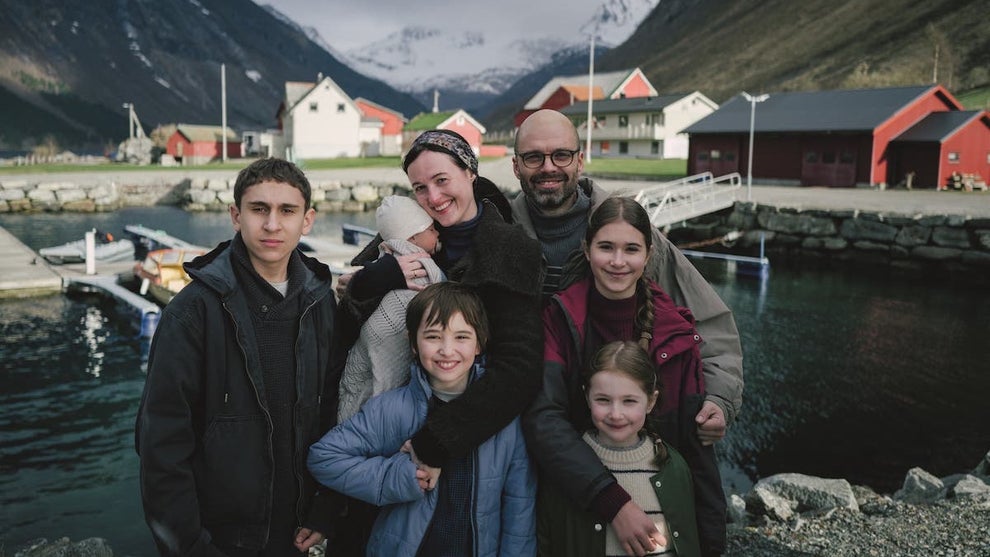
Romanian immigrant Mihai Gheorghiu (Sebastian Stan) is a fine neighbor and a dreadful hang. He’s no fun at parties, abstaining from drink and sustained eye contact, mostly fidgeting in his seat or playing hymns on the piano. The devout family man has long since heard the Good News, but don’t expect him to share it with a smile, as he approaches his faith with the same grim obligation he brings to parenting five children raised in his abstemious code. (“We’ve been blessed,” he tells new Norwegian colleagues, visibly uneasy with the phrase.)

His wife Lisbet (Renate Reinsve), however, should know better. Born nearby and raised in the secular values of the local flock, her practice may have drifted toward religious traditionalism during two decades out east, but that only sharpens her neighbors’ resentment when she returns, family in tow, with no intention of putting aside cultish things.
Like an avalanche, gathering speed and danger as it moves closer, that neighborly resentment steadily builds, mostly in real time, through carefully staged unbroken takes that weave the Gheorghiu family into an interconnected rural community, often equally present in the frame. Mungiu, working with greater star power, also avoids close-ups, keeping his camera at a chilly distance to set the town’s vast landscape of glaciers, lakes, and the titular valleys against the claustrophobic smallness of its social world.
Here, your neighbors are also your adversaries, teachers, colleagues, nurses, employers, lawyers, and possible paramours — and that’s just in the family next door. Papa Mats (Markus Scarth Tønseth) runs the local school; mama Frida (Lisa Loven Kongsli) works in law; and troubled teenager Noora (Henrikke Lund-Olsen) becomes a fast friend — and perhaps something more — to the Gheorghius’ eldest daughter, Elia (Vanessa Ceban). Soon, all of those ties come under strain when Elia arrives at school with bruises running down her back.
The fact that all these moving parts come together with such precision — and such speed, given we’ve barely cleared the 15-minute mark — reflects Mungiu’s meticulous approach. He averages a film every five years, using that time to construct works of painstaking narrative, visual, and thematic complexity — shipwrecks in a bottle whose final elegance belies heroic layers of craftsmanship. “Fjord” fits neatly within his wider practice, though it stumbles slightly when it shifts into courtroom drama, where everything previously implied and richly embroidered is stated a little too directly.
Mihai and Lisbet end up there once Child Protective Services enters the fray. If some form of state intervention becomes inevitable once a kid bears evidence of physical harm, the swift decision to take all five children from the household — and to cast the couple into a bureaucratic morass designed to ensnare — also carries a clear punitive logic aimed at non-conformists. Ironically, the Gheorghius should understand this in the abstract, given their own punitive approach to parenting and their vague openness to corporeal discipline. What one side frames as religious persecution, the other defends as institutional enforcement — and both, in their own way, can claim a measure of truth.

This narrative paradox hinges on uncertainty. “No one can know what goes on inside a family,” Frida tells her husband, defending her growing involvement in the case within the liberal legal framework of presumed innocence. Here too, Mungiu holds his cards close, leaving key facts unstated while giving equal weight to Mats’ view that the defendants do not adhere to those same liberal standards. Mihai may be an IT whiz, but he raises his children as technological Luddites, shaped only by homilies and hymns. Placed into foster care, they miss their parents but not the closed world cut off from YouTube.
Driven, unmistakably, by love, Mihai and Lisbet aim to pass on a clear set of values; the social workers and legal minds of the state pursue much the same goal. Lest one imagine an easy moral escape, the state’s argument will likely align more closely with that of anyone encountering this at an international film festival or cosmopolitan art-house audience. In a very real sense, our own ethics are on trial.
Last seen in Cannes for “The Apprentice,” Stan returns here as an even thornier figure (say what you will about the young DJT, at least he could tell a joke). Mihai is a wronged man just as often as he is in the wrong, aligning with an unsavory international coalition to put pressure on the state. What’s more, his logic is sound and his emotions real — so does Mungiu really want you to side with the religious right?
The filmmaker is too canny to come down on any single position, though his best instincts emerge more clearly beyond the didactic strictures of the courtroom, and instead in the stifled cries of a father watching his children taken away, or as his once-local wife, gone native in religious rigidity, is made to pay the price. In “Fjord,” as in his best work, he builds entire systems that grind his characters down.
