
DreamWorks Animation, the studio founded by Jeffrey Katzenberg after his exodus from Disney, where he went from animation novice to a chief architect of its second renaissance, has always been underrated, even when churning out global hits and winning the inaugural Best Animated Feature Oscar (for “Shrek,” beating out Pixar’s “Monsters, Inc.”)
They were the first American studio to partner with legendary British stop-motion animation studio Aardman and have been as consistent as any studio in both creating and maintaining viable franchises that can last decades; their franchises quickly become institutions.
And in the past few years, DreamWorks has taken some bold leaps, experimenting with look, feel and narrative texture. “Puss in Boots: The Last Wish,” released in 2022, could have been just another extension of the “Shrek” would, but with its painterly visuals and complicated thematic concerns (some of which inspired Ryan Coogler’s “Sinners”), it stood apart.
2024’s “The Wild Robot,” written and directed by Chris Sanders, saw that illustrative stylization pushed even further, in a heart-tugging story of survival and connection. Even the “Trolls” movies and 2022’s underrated “Ruby Gillman: Teenage Kraken,” feel unlike anything else, with “Trolls’” tactile arts-and-crafts aesthetic and “Ruby Gillman’s” kaiju-movie-by-way-of-Lisa-Frank-sticker book vibe.
It’s with this new era that “Forgotten Island” arrives. An original film written and directed by Joel Crawford and Januel Mercado, the same team behind “Puss in Boots: The Last Wish,” the film was screened, in all its work-in-progress glory, as part of Universal’s CinemaCon presentation. The movie doesn’t open until the end of September, which shows you how confident DreamWorks is about it. The strategy recalls when Disney screened an unfinished version of “Beauty and the Beast” as part of that year’s New York Film Festival.
“Forgotten Island” is dazzling, in ways both expected and surprising. And while it breaks a significant amount of new ground, both technically and on a narrative level, it also feels like classic DreamWorks Animation – this is a film about the elemental power of remembrance. And watching “Forgotten Island,” it’s hard not to think back to some of your favorite DreamWorks Animation moments, whatever they are.
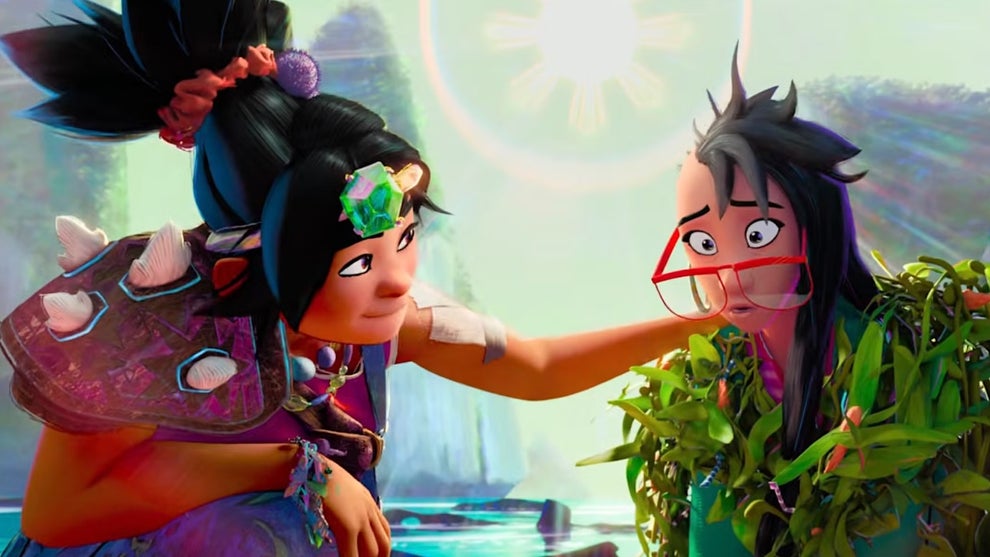
Set in the Philippines in the late 1990’s, “Forgotten Island” follows two best friends, the rebellious Jo (H.E.R.) and the more straight-laced Raissa (Liza Soberano). For their entire childhood, they’ve been chasing after a portal to another world – the titular Forgotten Island, full of fearsome creatures like the Manananggal (Lea Salonga), a fearsome, vampire-like creature that can split in two and other, less bloodsucking beings. Finally, on the eve of Raissa leaving home for college in the United States, the pair find the portal to the Forgotten Island and go on an unforgettable journey, befriending demon babies and narcissistic mer-men and an anxious were-dog voiced by Dave Franco.
The look of “Forgotten Island” is pushed even further than what Crawford and Mercado did on “Puss in Boots: The Last Wish,” but it’s also sneakier. Instead of that film’s emulation of storybook illustrations, “Forgotten Island” incorporates elements of anime and manga, along with 1990’s street art and the cluttered, everything-has-a-place style that echoes both maximalism of the period and the frantic, colorful world of both the actual Philippines and its mythological counterpart. It’s stunning; each frame reveals some new detail or design choice – look at the way that some of the line work hovers just outside of where they should actually be, floating in space, the way that the characters are adrift (emotionally and spatially). There is also a considerable amount of 2D animation in “Forgotten Island,” probably the most since DreamWorks gave up on hand-drawn animation more than 20 years ago.

Structurally and storytelling-wise, the movie is just as bold as its look. Jo and Raissa wake up in Forgotten Island transformed; they have different clothes and hair styles and matching tattoos. 12 hours have passed since they jumped in the portal. Now they have to figure out what happened in those 12 hours while also devising a way to return home. (Raissa’s got to leave for college, after all.) That means that the story is going backwards and forwards at the same time, as they piece together the past and make way for the future.
Not only does this work on a thematic level, since the movie is about embracing where you came from while forming a new path (and how the fantasy of youth is always more complicated when you actually achieve some of your dreams), but it provides ample opportunity for rich detours (one character describes them as “side quests”), being able to explore different parts of the world of Forgotten Island – most too good to give away here.
And while this might sound taxing – start-and-stopping along the journey – it actually gives the story real emotional weight. When it all comes together in the final act, via some “Eternal Sunshine of the Spotless Mind”-indebted shenanigans, there wasn’t a dry eye in the Coliseum. (Yes, folks selling popcorn and soda have feelings too.) “Forgotten Island’s” climax is a nearly overwhelming experience, where the adventurousness of the movie’s style and its bold storytelling collide for an unforgettable emotional wallop. Remember when the robot taught the goose to fly in “The Wild Robot?” It’s like that.
There are other elements of “Forgotten Island” that should be applauded – its character design (and terrific character animation), the specificity of the Philippines’ culture that makes it roundly universal, and its willingness to push the boundaries of what a PG-rated animated offering from DreamWorks can be. (It’s not just in the saltier language and more ribald jokes. There’s a maturity and honesty here that is so, so refreshing.)
“Forgotten Island” really does feel like a breakthrough.
But it also feels very much a piece of the DreamWorks legacy; it expertly deploys pop songs and cultural references are sprinkled throughout (including, incredibly, a shoutout to a John McTiernan masterpiece) that ground it in a time and place, the same way, say, Counting Crows’ “Accidentally in Love” firmly plants “Shrek 2” in 2004. It’s vibrant and zingy in the way that most DreamWorks movies are and unexpected resonant in a sneaky way too. Not only does it feel like a perfect encapsulation of where DreamWorks has been the past few years, but it signals a promise of an even bolder, more uncompromised future for the animation studio, one where originals are given just as much love as tried-and-true franchise entries and where the only artistic limits are those in the filmmakers’ imagination.
