
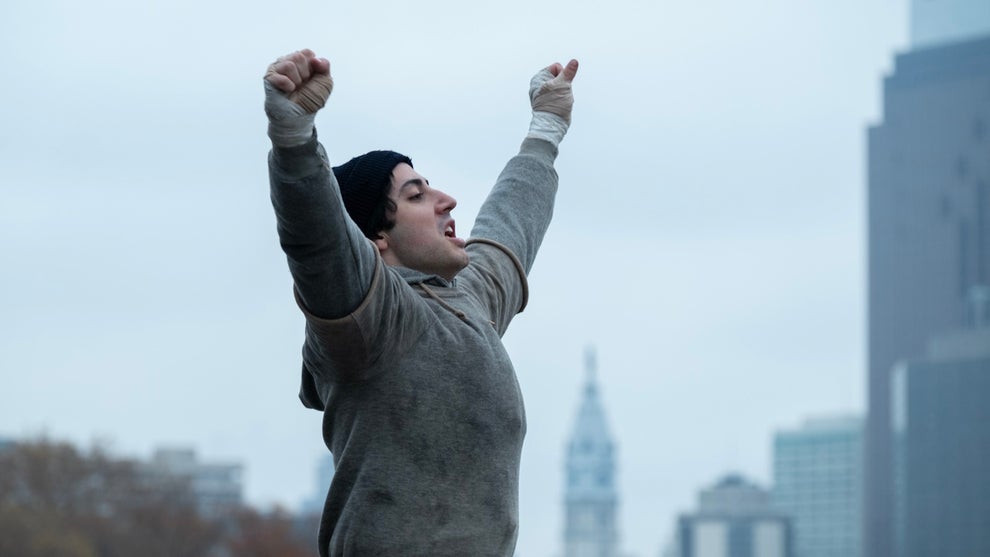
Midway through “I Play Rocky,” Peter Farrelly’s misfire of a movie about Sylvester Stallone and the making of “Rocky,” production is underway on the film that would make its lead a star. But, despite them shooting a key emotional scene, things aren’t working.
Sly (Anthony Ippolito) is pulled aside by the film’s director John Avildsen (Jay Duplass) and told he needs to dig deeper in the next take. There has to be something more, Avildsen says, that this is the moment where he’ll find the “thing,” the emotional why of the entire picture. Without it, the experience — even when the efforts of a dedicated crew moving heaven and Earth to make it work — will be empty.
Unfortunately, while the real Sly found that emotional depth in “Rocky,” the fictional version of him, even when pushed, never does here.
Instead, what we get is a film that’s broadly crowd-pleasing, having fun with some playful jokes about filmmaking here and there, though without a cinematic soul it can call its own. It never uncovers that deeper “emotional why,” reducing the unconventional success story of Stallone to something aggressively conventional and without a greater emotional punch.

It darts around, hitting all the beats you’d expect it to, but never instills them with any greater life. The only blows it lands are when it repeatedly punches itself in the face by insisting on spelling things out, rather than dancing gracefully in the ring.
The disappointment is felt right from the opening moments, when you first see Ippolito as Stallone, down on his luck and struggling to find his footing in New York. When you first hear him speak, taking part in an audition where he’s just meant to be a nameless thug, Ippolito credibly impersonates the voice of Stallone, but the delivery lacks the iconic actor’s soul. He’s occasionally able to have more earnest chemistry with Stephan James as Carl Weathers, who briefly appears before vanishing from the movie, but the rest comes across as shallow.
Much of this falls not on the shoulders of the cast, but on the consistently hackneyed script by Peter Gamble, which is lightly humorous and emotionally inert. It bolds and underlines every development and reference in such a repetitive fashion that it doesn’t feel like you’re even watching a movie as much as a visual representation of a Wikipedia page. We see Stallone leave New York with his wife Sasha (AnnaSophia Robb) to try to make it in Los Angeles, and there’s little time for us to inhabit their lives before, suddenly, they’re a couple and the creaky narrative takes over.
There’s still something occasionally interesting to the film — the story of the making of “Rocky” is genuinely fascinating, with Stallone pouring his heart and soul into his script, then stubbornly refusing to sell it unless a studio agrees to let him star. But again, “I Play Rocky” lacks the passion this story requires, hitting the beats but missing the heart. The narrative comes across as tiresome more than compelling, and the film consistently makes you wish you were just watching “Rocky” instead.

Indeed, in so many ways, “Rocky” is already a perfect expression of Stallone’s underdog struggle. This is merely a simulacrum of it, flatly shot without any visual texture, save for when it tries to emulate the look of the classic film.
In the end, “I Play Rocky” lacks both the courage of its convictions and the creativity of its subject. You only wish someone had sat down with the filmmakers and given them that same pep talk about needing to find that emotional something. The reason for being. The why.
“Rocky” will always remain a triumph, but when this film raises its hands in an attempt to tap into that feeling by replicating its most iconic shot, it’s a painfully hollow victory.