
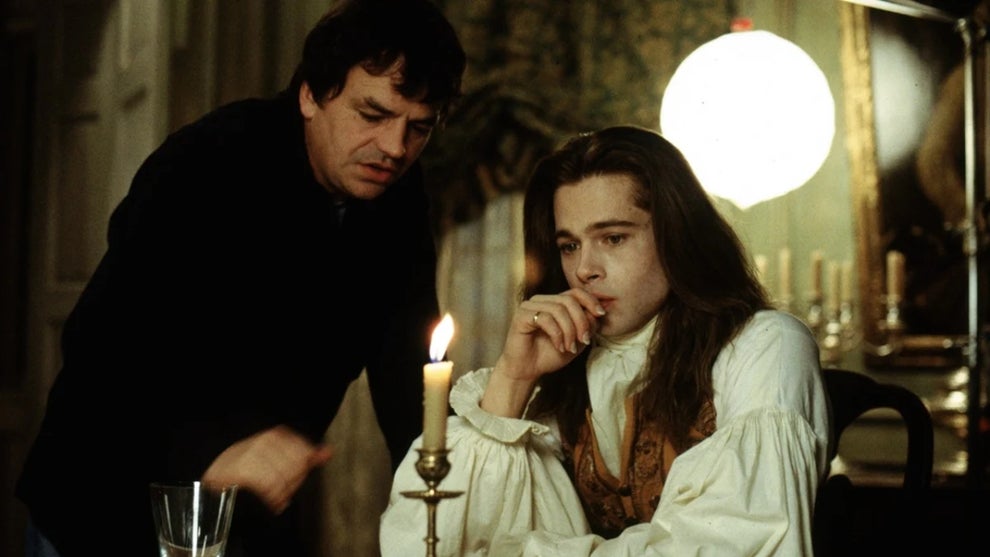
“And then I cast Tom Cruise and everything went insane.”
That’s how Neil Jordan describes “Interview With the Vampire,” his decadent 1994 horror epic based on the 1976 novel by Anne Rice, which is now available as a deluxe 4K Blu-ray festooned with delicious new special features and a handful of previously unseen deleted scenes. (And just in time for Halloween!)
But Jordan’s version of events isn’t exactly true.
At the time, Jordan was coming off the phenomenal global success of “The Crying Game,” which won him the Best Original Screenplay Oscar and made more than $70 million internationally on a budget of £2 million. (It was also, back before the instant echo-chamber of the internet, a provocative, word-of-mouth sensation that sparked countless conversations.) The studios wanted to work with Jordan, recognizing both the artistic and commercial possibilities of such an endeavor. “People were sending me things,” Jordan said in his typically self-deprecating, extremely Irish way.
It was during this period of people sending him things that David Geffen, the controversial record executive and film producer, brought up “Interview With the Vampire.” Jordan said that he’d “heard about the legend of it;” how difficult the book had been to adapt and how many iterations had come before. At this point Rice herself had written a screenplay. Jordan read the script.
“I thought it was intriguing and then I said, ‘Look, let me read the book,’ because I’d never actually read the book. I sat down and went through the book and there was so much darkness and it seemed to me entire a book about loss of innocence of some kind,” said Jordan. “I just said, ‘Look, give me some time. Let me do my own pass on the script,’ which I did, and I actually did it very quickly. And they read it and they got very excited.”
While Jordan didn’t get a writing credit on the film “because the WGA rules are very complicated,” his version of the script was enough to finally get the movie into production. Jordan remembered telling Geffen, “Look, if you can allow me to make this the way an independent movie is made, because that’s the way I function best.” “He had a lot of power at Warner Bros. and said, ‘I’ll create the condition.’ So that’s what we did,” said Jordan.
With his version of the screenplay, Jordan said, he was instead trying to capture more of Anne Rice’s original spirit.
“It was actually returning it to the novel itself. It’s odd because you know there was a lot of the kind of erotic longing in the relationship that had gone. There was quite a bit of the darkness that had gone. There was a theatricality to it that wasn’t in the novel itself. I basically tried to make the whole movie more responsive to the book itself,” said Jordan. “I just thought it was a beautiful book. I just couldn’t work out why people had never made it before.”
It was that erotic longing – specifically the homoerotic longing – that had helped torpedo earlier versions of the movie. But Jordan said that he never felt any nervousness from the studio, perhaps because Geffen (who came out as gay in 1992), protected the movie but also because they were sticking true to Rice’s book. Mostly.
“When Louis meets Lestat, in the book he’s mourning his dead brother. And in the script I had gotten from her, I’d made a change that he is in mourning for his dead wife. Now is that a great change? I don’t think it is really, but that was one of the major changes for that character,” Jordan said. Does this make Louis less gay? Not in Jordan’s eyes. “I thought it was appropriately homoerotic. The metaphor is absolutely clear,” Jordan said.
It was, of course, a fairly expensive movie, coming in at around $60 million. Jordan credits the success of Francis Ford Coppola’s “Bram Stoker’s Dracula” with allowing them to go big. “That was a few years beforehand and had widened the appetite for a film like this in a way,” Jordan explained.
Now back to Cruise. It wasn’t actually Jordan who cast the star, who was coming off the back-to-back hits of “A Few Good Men” and “The Firm,” both films where he played morally complicated lawyers in modern-day dramas. According to contemporaneous reporting, it was Geffen who had reached out and offered the role of Lestat the Vampire to Cruise, not Jordan. Jordan confirms that that was what happened. But he was still involved.
“David and Warner Bros. asked me to meet him in the in the role,” Jordan said. While other names had been bandied about for the role (including, in a gender-flipped version, Cher) and Jordan admitted that he did some tests with “some actors who are very well known now” but it was clear everybody wanted Cruise.
“They said, ‘Look, Tom is interested.’ I went out to meet him,” Jordan said. He could see where the physical differences between Cruise and the character Rice had written could rub people the wrong way – Rice’s character “was tall and Nordic and blonde.” It would become a much louder sticking point in the weeks and months to come, but it didn’t ruffle Jordan.

“That didn’t matter to me as much as the chilling reality of this character,” Jordan said. “I’ve always admired Tom as an actor and I saw something in him that could really be part of this. Something that could be terrifying in this role. We had one meeting, then we had another meeting, and we decided to go for it.”
Brad Pitt had already been cast as Louis de Pointe du Lac, an 18th century rascal who Lestat turns into a vampire and who narrates the film, but Jordan was responsible for casting Antonio Banderas as Armand, the leader of a Parisian gang of vampires (and arguably the biggest scene-stealer of the movie), along with Jordan regular Stephen Rea as Santiago, who runs Théâtre des Vampires, a stage show masquerading as Grand Guignol where people are actually getting consumed on stage.
“I had the unique opportunity of making a big studio movie without a lot of interference. It was cool. It was lovely,” said Jordan.
While there might not have been any studio interference, there was plenty of discussion about the movie, particularly Cruise as Lestat. Several months before the film was released Rice told Movieline, “The Tom Cruise casting is so bizarre, it’s almost impossible to imagine how it’s going to work, and it’s really almost impossible to imagine how Neil and David and Tom could have come up with it.”
Jordan now desceibes the backlash to Cruise’s casting as “kind of stupid.” “Because the guy is a great actor. I have had to deal with stars before, but I’ve always dealt with them as actors and not as stars. It was irritating,” Jordan said. “You’ve been asked to become the fastest sprinter in the world to prove everybody wrong. Do you understand?” (Sort of.)
The increased scrutiny put “a bit of pressure on” the production, which shot mostly at night, with locations including New Orleans, San Francisco, London and Paris. “We blocked ourselves off from all the paparazzi, from any kind of press intrusion. We entered a little nighttime bubble for six months,” Jordan said.
Still, with all the precautions, stories during the production ran rampant – that Cruise had spent six months training with the vampire teeth, never taking them out (“Did he say that?”), that tunnels were built to protect the actors from prying eyes and to keep the paparazzi from spoiling the look of the vampires (“We didn’t build tunnels but grips used things to block light so that you couldn’t take a picture”) and that Jordan hung the actors upside down so the blood would rush to their head and the make-up artists, led by the legendary Stan Winston, could paint the veins on their faces (100% true).
“I had a young son. He was two. And I noticed the way the veins on kids that are of that age stand out because the skin hasn’t matured yet. I thought, Okay, that’s what we should do. We should somehow find a way of making that the skin of vampires,” Jordan said. “We traced the veins with blue pencil and that became the look. It became a difficult shoot for the actors because they had to hang upside down for a bit and they had to wear haptic lenses and all this sort of stuff.”
By all accounts, the person who had the worst time on the “Interview with the Vampire” set was Pitt, who reportedly didn’t get along with Cruise and who chafed against the all-night-shoots production schedule. In a revealing 2011 print interview with Entertainment Weekly, Pitt opened up about the experience, calling it “miserable … six months in the fucking dark, I’m playing the bitch role.” (He also hated the contact lenses.)
Pitt claimed that there “was no script,” and that he felt when he finally did get a script, his character had been diminished in service of the more flamboyant Lestat. “They took the sensational aspects of Lestat and made that the pulse of the film, and those things are very enjoyable and very good, but for me, there was just nothing to do — you just sit and watch,” Pitt told EW. At one point, Pitt said that he called Geffen and asked how much it would cost him to leave the movie completely. Geffen told him $40 million. “It actually took the anxiety off of me,” Pitt told EW.

“I was very close to Brad at the time and I knew he was having a hard time because he said to me that it was driving him nuts. The darkness was getting to him. But it’s often the case in a movie that is narrated by the central character – the central character suffers and is acted upon by all of the other characters,” Jordan said. “The part of Louis was the emotional heart of the movie. The fun that everybody else had was messing around with Louis, particularly Lestat. I think that got to Brad a bit. There was a passivity to the role. But I loved what he did. I really did.”
Jordan refutes the reports that Pitt and Cruise didn’t get along and remembered when Cruise would rent out go-kart venues “And we’d all go karting around together,” Jordan said. “It was a fun set of encounters.”
Once the movie came out, the sentiment turned. The movie was a huge success, making more than $223 million on a budget of around $70 million. And more than that – Rice loved the adaptation too. “She changed her mind enough to write this letter in praise of it all,” Jordan said. She even called Cruise to apologize.
In fact, it was such a hit that Warner Bros. and Geffen hired Jordan to write a sequel, this time based on Rice’s 1985 novel “The Vampire Lestat.”
“I was thrilled with it,” Jordan said. “It was all set in 18th century France and late 20th century Los Angeles. I didn’t get that much into the rock and roll aspect of it because it was a bit cornball.” Instead, Jordan’s script focused on “how Lestat became Lestat, how he was turned into a vampire.” He was a comedian in Paris whose mother is dying of cancer. “He turns his mother into a vampire. It was a blast. I would have loved to have made it,” Jordan said. (He even minimized Louis’ role in the sequel, potentially as a way of appeasing Pitt and coaxing him into a return.)
“At the time Tom Cruise never did sequels,” Jordan said. “Nobody shut it down. Tom just said he didn’t want to revisit the role. I suppose we just moved on to other things.”

There might not have been his version of “The Vampire Lestat,” but Warner Bros. released a truly crummy 2022 standalone film called “Queen of the Damned” that was a box office and critical bust. And there is of course the recent acclaimed AMC series. Jordan said that he has watched “two or three episodes.”
He might not have gotten his sequel, but at least Jordan has the new 4K release.
Jordan was haunted by a screening of the film held for the 25th anniversary in Belfast. It was a 35mm print and the projector might have been “out of whack,” but Jordan was dismayed by how dark the experience was and how muddy the image appeared. At the time of the restoration, cinematographer Phillippe Rousselot was sick and in the hospital (he also doesn’t appear in the new special features created for the disc) but still signed off on the new transfer. “We could restore everything – we could bring out every piece of shadow and light in the background that was necessary to see properly,” Jordan said. “The 4K would be great for people who love the movie and for people who hate the movie? I don’t care.”
While Jordan’s role on the restoration was to make the movie look and sound better than before, not by changing anything but by highlighting what was already there, there are still some things he’d like to fix with the movie itself. And it involves Daniel Molloy, the interviewer character played by Christian Slater (who replaced River Phoenix, who had been cast but who had died a few weeks before filming was set to take place; Slater ended up donating his fee to Phoenix’s favorite charities). Molloy is the one who interviews the vampire, played by Pitt.
This has clearly been bugging Jordan. “I never got to do it. I don’t know why I didn’t get to do it,” said Jordan.
His frustration centers around how Molloy and Louis meet and begin the interview.
“Why is he interviewing a vampire in San Francisco? Did he put an ad saying ‘vampires needed for newspaper articles? It always struck me as a little bit arch and too convenient,” Jordan said.
Jordan’s answer was simple – Molloy is “actually in the late stages of AIDS in an AIDS unit in a hospital.” Molloy wakes up and “sees this vampire looking down at him.” The vampire tells Molloy a story. “And at the end of that, when the interviewer says, ‘Turn me into a vampire,’ there’ll be an absolute reason for it. Because you save him from this terrible disease that was really rampant at the time.”
“That’s only one thought I had, but I don’t know why we I didn’t do that. Probably because the book didn’t do that. Let’s put it that way.”
Faithful to the source material, until the bitter end.
“Interview with the Vampire” on 4K Ultra-HD Blu-ray disc is out now.
