Guillaume Canet’s “Karma” opens with a couple, Jeanne (Marion Cotillard) and Daniel (Leonardo Sbaraglia), slow dancing to “Until I Found You” in their house tucked away in a Northern Spain village. “I said I would never fall, unless it’s you I fall into / I was lost within the darkness, but then I found her,” singer Stephen Sanchez’s voice croons over them while they’re lit by nothing more than candlelight. Cinematographer Benoît Debie keeps the camera close so that we can see every fold of their face, every eye glance calibrated in real time as their bodies weave to the rhythm of the song.
It’s probably the film’s most romantic moment and acts as a very nice rug from which you’ll be pulled under; from us all, the events that follow will test the devotion expressed in Sanchez’s lyrics. A punishing, tense and brutal odyssey to hell and back with a reliably great performance from Cotillard, “Karma” is a film that morphs before your eyes more than once, often to its detriment. It has a lot on its mind, about how the secrets we take into relationships can corrode intimacy, the ways that religious cults hijack not just our minds but our bodies, and lambasts the abuse that is perpetuated when fallible people try to interpret God’s will.
It trades away its more intriguing mystery for a more standard story about a woman escaping from the system that sought to keep her captive. There’s a baseline level in seeing cults get their comeuppance, but there’s still a sense of wasted potential that rings through, as it gives away its central mysteries too soon in favor of pontification.

One of the first ways Canet subverts expectations is by positioning the story as a familial thriller, where the suspects of unspeakable violence are the ones nearest to you. Jeanne spends the majority of her days with her godson, Mateo, picking him up from school and taking him to the river. Both of Mateo’s parents, as well as Daniel, tolerate it but also feel that their dynamic is inappropriate, with Daniel quipping whether or not it’s normal for godparents and godchildren to have such an intimate dynamic. Cotillard leans into the tenderness and unease of these moments, such as a scene where she attends Mateo’s soccer match and, with alcohol in hand, berates the coach for a bad call. The camera pans to reveal that she’s the only adult watching the proceedings.
This mystery at the start of the film is heightened thanks to the eerie production design and Debie’s camera work. Take one sequence where, as Daniel and Jeanne drive back from the police station, Daniel stops the car in the middle of the country. We see the outside of the car, bifurcated by the headlights and the surrounding fog, representing with just a shot, the ways the characters are caught between clarity and confusion about their situation.
Additionally, Debie’s camera loves Cotillard’s face, and when the film rests on her expressions, the film clicks together. He zooms in on her visage, pointing to the rage that she keeps slow cooking; we don’t know if she’s capable of violence or just that she’s experienced it. Once Mateo goes missing, she flees and goes back to the religious commune she was raised in, named Saint-Céré, hoping it will also provide answers for what happened to Mateo. Daniel tries to locate her, all the while suspecting that she may still be responsible for Mateo’s disappearance.
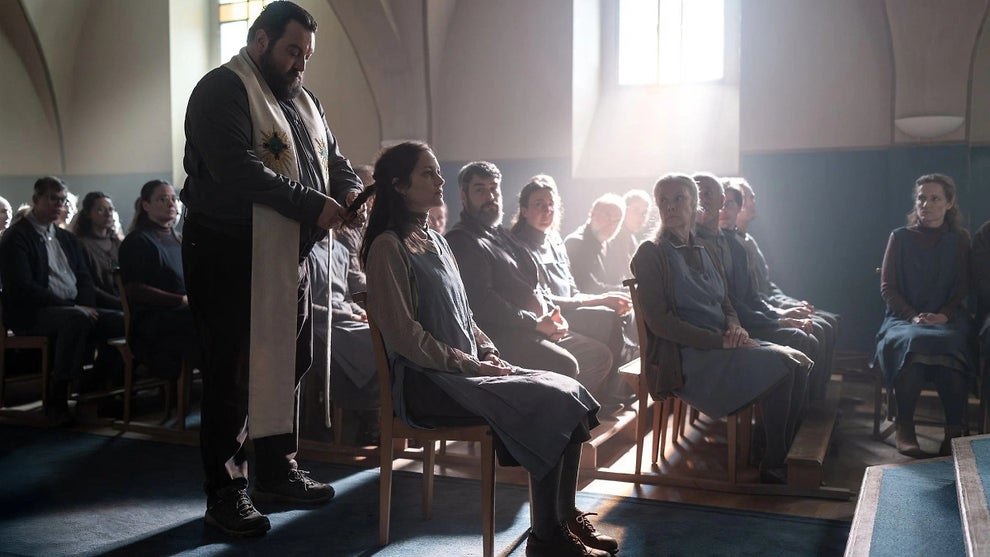
While there’s still some central mystery as to what happened with Mateo, the energy of the story shifts into the happenings of Saint-Céré, which is ruled with an iron fist by Marc (Denis Ménochet). Marc carries out unspeakable horrors against his community, sexually abusing the women and children, and forbidding any personal attachments to form. Jeanne has to pay penance for her transgression and is holed up in the compound’s basement. For a good portion of the film, we instead see Marc brutalize his community, and Daniel earnestly but inefficiently tries to find Jeanne.
It’s a curious development, as the moral ambiguity and mystery of the first part of the film is replaced with a sermonizing that saps the story of its intrigue. We know cults are evil, that any type of religious fundamentalism flagellates the body, not just the soul, and that communes like these thrive in small towns because they amass greater power and can wield it over the populace. While what we witness in this half is more horrific, it’s less formally or thematically interesting.
While Debie’s cinematography, Canet’s direction and a chilling, organ-heavy score that feels like experiencing a jump scare every time it is deployed make this more than mediocre, you’ll find it hard to distinguish these stories from other tales you can probably find on Netflix of people finding liberation from cults. Part of the way that cults like Saint-Céré amass such power and following is the way they exploit people’s fears.
Create hell, and you create people who will do anything they can and be subject to anyone if it means they can save themselves from that damnation. There’s no withholding of mystery here; “Karma’s” messaging is telegraphed the moment Jeanne enters the compound, and as a result, it loses any grip it might have had in the beginning.
