
“Atonement” is a movie steeped in real tragedy.
“In Baghdad, in 2003, U.S. Marine Lou D’Alessandro (Boyd Holbrook) and his unit open fire on two ostensibly hostile vehicles. Three passengers are killed before it’s revealed that those vehicles were carrying three generations of a civilian family. A decade later, following a dishonorable discharge, Lou is back in San Diego, haunted by the incident, unsupported by Veterans Affairs, and unable to continue the life he started before the war,” reads the official synopsis.
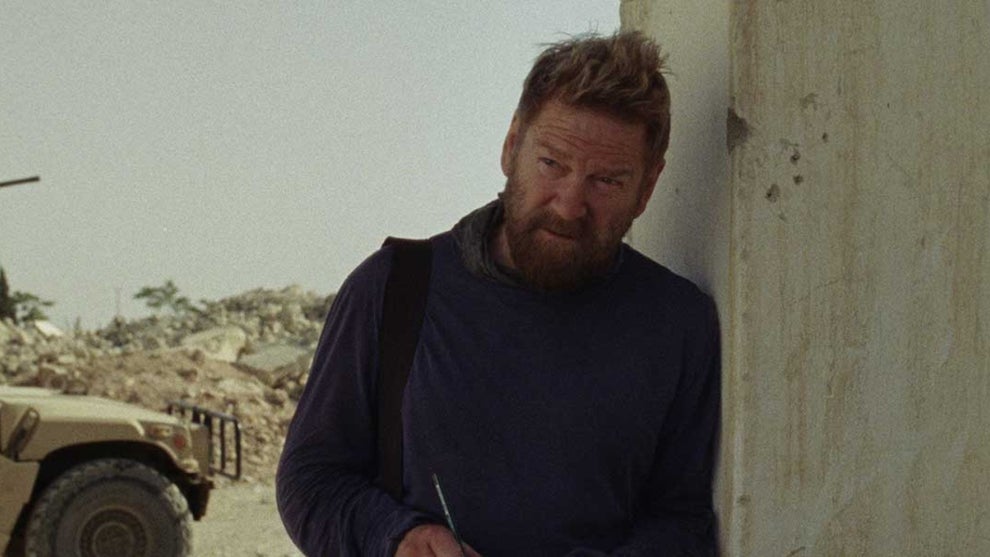
The multilayered story, based on a 2012 New Yorker article by Dexter Filkins, also follows Mariam (Hiam Abbass), the matriarch of the family that was torn apart by that shooting, as she begins a new life in California with her daughter and her young family. “She’s profiled by journalist Michael Reid (Kenneth Branagh), who was also in Baghdad when the tragedy unfolded,” the synopsis continues. “Desperate to explain his side of the story, Lou asks Michael to broker a meeting with Mariam.”
The film marks the feature debut of writer-director Reed Van Dyk, who was nominated for an Oscar in 2018 for his live-action short film “DeKalb Elementary.”
Abbass, Branagh and Holbrook joined Executive Awards Editor Steve Pond at TheWrap’s studio at the 2026 Toronto International Film Festival and opened up about their approach to playing actual people as opposed to fictional characters.

“Certainly I try not to meet them because for me it’s much more interesting to bring my sensitivity as a human being to whatever I’m serving in order to make them authentic in a fictional way because we’re working with fiction and not with documentary,” said Abbass. “I have a feeling that if I meet the real people, it just gets me nervous. I have a feeling to serve really the humanity of that story and to give it a place in a fictional world.”
Holbrook took a similar approach.
“Reed and I had spoken about Lou, and you know Reed has done so much research on this film, and I had about two hours of audio interviews of Lou and Reed,” said Holbrook. “When you’re trying to put a performance together that comes into it – if maybe there’s a voice here I could use or there’s a mannerism I could use. I think if you keep distilling that down, it’s the emotional value of how I can bring this story to life, and so I thought that was far more important. And what was on the page was definitely enough to use for that.”
Branagh, on the other hand, wanted to meet the man he was playing, considering he didn’t really know all that much about how the New Yorker writer went about doing his job.
“I did want to speak to Dexter Filkins about how he got there, how he came across the story, how he pursued it, and how high on his list of interests it was,” the Oscar winner explained. “Was this a particularly mysterious one for him? It seemed a little more objective about being less directly involved, but he was surprised and I think humbled to be a conduit.
“But his finding of the story was interesting. It was haphazard. And although the circumstances are tragic, his being there was fortuitous. So I was glad to just hear. I asked him things like, ‘What kind of notebook do you use? Do you write shorthand?’ Things I really didn’t know about, and I was glad to just have a specificity to that that was useful to me.”
