
When I was a lad, American cartoons were … let’s be generous and say “crappy.” There were always exceptions, of course, but if you sat down in front of the TV on Saturday morning you’d have to sift through a lot of “Snorks” and “Get Along Gangs” and “Turbo Teens” before anything halfway decent came on. By the time “Jem and the Holograms” finally began your standards were so low that a TV series about tricking your boyfriend into cheating on you with your own hologram alter ego was like heroin and Shakespeare, all rolled into one.
So when “Robotech” debuted it felt revolutionary. It was like eating flavorless food for years until someone finally invented seasoning. “Robotech” was the Americanized version of “Macross,” created by Shōji Kawamori, who also created the Diaclone toyline (which we know as “Transformers”). It was a completely serialized anime series about an intergalactic war where the heroes died, tragically and permanently, and pop music was celebrated as a life-altering art form, capable of converting warlike aliens into feeling creatures capable of redemption. All that and the animation kicked ass. There was nothing like it on American television. Even the shows that were kinda like it were nothing like it.
“Robotech” took a lot of liberties with Shōji Kawamori’s creation but it was his work that shined through, and now — over 40 years later — he’s finally releasing his first feature film (unless you count some of the “Macross” specials, which you probably should). As exciting as that is, it’s important to remember not everything a great artist produces can be a game changer. And it’s especially important to remember that right now, since his new movie “Labyrinth” is a mixed bag.
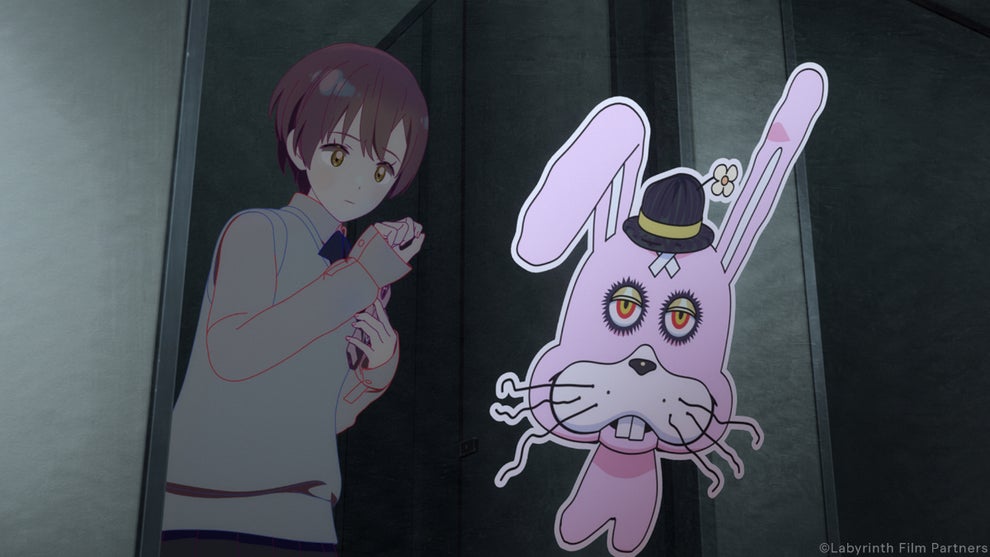
“Labyrinth” is a sci-fi story about an insecure teenage girl, Shiori Maezawa (Suzuka), who wants to be a social media influencer. When Shiori makes a dance video with her popular friend Kirara (Aoi Itō), she falls down a staircase and Kirara posts it anyway, leaving Shiori exposed to waves of public ridicule. The mental strain becomes so unbearable that her phone cracks, seemingly by itself, and Shiori gets trapped inside her own device: an empty, depressing dimension populated almost entirely by soulless stickers.

What’s worse, another version of Shiori has broken into the real world and is finally living her best life. “Labyrinth” takes place in a universe where people put so much of themselves online — their private thoughts, passions, personal data — that it creates an electronic doppelgänger. The new Shiori, posting as “Shiori@Revolution,” is a rainbow-haired extrovert everybody loves. And if she can get 100 million likes, the external validation will make her the “real” Shiori, while the original, unpopular Shiori languishes in cell phone purgatory, reduced to nothing more than a sticker — visual shorthand for having nothing to say. It’s like being trapped in “The Emoji Movie” but not remotely as scary.
The concept of accidentally creating our own electronic alter egos, who can hack our real lives like trolls would hack our BlueSky accounts, is on the nose but it’s effective, dramatic symbolism. Where “Labyrinth” gets caught up is in the minutiae of smartphones. Watching Shiori turn into a cutesy sticker is too absurd to be suspenseful, even though that’s how it tries to play out, and while it’s abundantly clear Shōji Kawamori is being playful — especially when the giant mechs show up — the absurdity of “Labyrinth’s” execution usually undercuts the intensity of the premise. It’s hard to think of “100 million likes” as the most important thing in the world, even to teenagers, when you make it completely literal. I know you’re all kids and you think this is all very, very important but seriously, put down the phone.
“Labyrinth” does, of course, get around to the idea that needing the validation of others is unhealthy, but that message is muddled by the plot, which can only be resolved when Shiori receives the validation of her close friends. That’s better than seeking attention from millions of strangers, I suppose, but her personal journey is still a lot less personal than “Labyrinth” seems to think. It scrolls past thoughtful ideas, too quickly to fully process them, and the experience is as cacophonous as the typical social media feed. I’ll grant you it’s thematically appropriate but it’s not cohesive filmmaking.
Shōji Kawamori’s film tries to explore youth culture, and maybe he gets some of it right. I’m not a teenager anymore and I’ve never been to Japan, so I can’t pretend I can recognize or critique all of “Labyrinth’s” intricacies. And of course it’s more exciting for a film to have too many ideas than too few. But even so, “Labyrinth” never entirely gels in a larger dramatic context. It’s whimsical and superficial, but critical of whimsy and superficiality. It’s fast-paced, youthful and bright, but half the time it’s a dreary slog. You could argue it’s a film of many contrasts but by the end it doesn’t feel like those contrasts have fully explored the modern social media experience. Or even the plot, which gets opaque, and quickly.
By the end we get the distinct impression that Shōji Kawamori was wandering aimlessly. You know, like in a labyrinth. Except this labyrinth never gets solved. The movie reaches the end because after a while there was nowhere left to go. Sure, we can marvel at the sights along the way. We can even appreciate the winding roads and unexpected turns. But we were still lost, dang it, and it was the filmmaker’s job to guide us.
