
Travis Knight can’t remember the “exact time” he watched “He-Man and the Masters of the Universe,” an animated series that aired in first-run syndication from 1983 to 1984, or held a He-Man action figure in his hands.
Not that it didn’t make an impression.
“It was seismic in so many different ways,” Knight said.
He was eight when the franchise, consisting of the animated series and the action figure line, debuted. In the deregulated television landscape of Reagan’s 1980s America, animated series for children could exist, explicitly, as extended toy commercials. And they did.
“It was everything that I love in one big stew – fantasy and sci-fi and barbarians with battle axes and swords and robots with laser guns,” Knight said. “All these things that you wouldn’t think would go together but somehow they made this deranged thing work. And I loved it.”
Knight said that he was “a completist,” reading the comic books, watching the cartoon, playing with the toys. His knowledge of the lore bordered on the encyclopedic. He even made his own He-Man movies with his dad’s borrowed camcorder (he starred as He-Man, obviously).
This, of course, makes Knight the ideal person to tackle Amazon MGM Studios’ attempt to turn a beloved ’80s cartoon into a full-blown film franchise. With comic book movies seemingly out of vogue with moviegoers, there’s a void in colorful, high-concept fantasy and adventure films which “Masters of the Universe” is hoping to fill. And Knight has the bona-fides, having already made “Bumblebee,” a lovingly set-in-the-1980s spinoff of Paramount’s mainline “Transformers” series.
“To be here 40 years later and to now somehow have made another He-Man movie, it’s a bit of a trip,” he reflected.

The fact that Knight, best known for his role as president and CEO (as well as chief animator) of Portland, Oregon-based stop-motion animation studio LAIKA, got “Masters of the Universe” made at all is somewhat miraculous, given the numerous failed attempts. But hey, if it’s someone that’s going to complete the task, it’s a man who has a steely patience, built over years of painstakingly making animated features by moving puppets one frame at a time.
The long and winding road to the big screen
“Masters of the Universe” was first adapted into live-action in 1987 by Cannon Films, the notorious, low-rent production company run by Israeli cousins Menahem Golan and Yoram Globas. It was directed by Gary Goddard, a former Walt Disney Imagineer (he would later be accused of sexual misconduct by several young men, including Anthony Edwards) and starred Dolph Lundgren as He-Man. But Cannon was facing financial trouble during production, which led to an underwhelming fantasy mostly spent on Earth. Frank Langella, as the evil Skeletor, emerged in a post-credits scene proclaiming, “I’ll be back!”
He would, in fact, not come back.
While the franchise was continually refreshed, mostly through animated series and new toys another live-action adaptation remained slightly out of reach – like an action figure on the top rack of a too-tall toy store shelf. For nearly 20 years, various directors, producers and studios have circled He-Man and his virtuous warriors of Eternia without ever getting it done – everyone from John Woo to Jon M. Chu to Joel Silver were all attached at different points.
More recently, Aaron and Adam Nee were attached, with Noah Centineo set to play He-Man (later replaced by Kyle Allen) in a project for Sony (then Netflix). In 2023 Netflix canceled the film due to budget concerns after the streaming giant had already spent $30 million in pre-production costs.
The project then migrated to Amazon MGM Studios, without the Nee Brothers, with Knight (who had directed the 1980’s-set “Bumblee”) attached to direct, joined by writer Chris Butler, his frequent collaborator at LAIKA.
A fresh start
Knight said that he “purposely avoided” looking at any of the material that had been generated for earlier attempts at a live-action “Masters of the Universe” feature. “It’s been kicking around with the producers – bless their questionable fixity of purpose – for nearly two decades. It’s been this storied, snake-bitten properties that they’ve been trying to make forever,” said Knight. “There have been a lot of writers, there have been a lot of directors, there have been a lot of actors attached at various points. But I avoided looking that stuff.”
Instead, Knight listened to his own instincts.
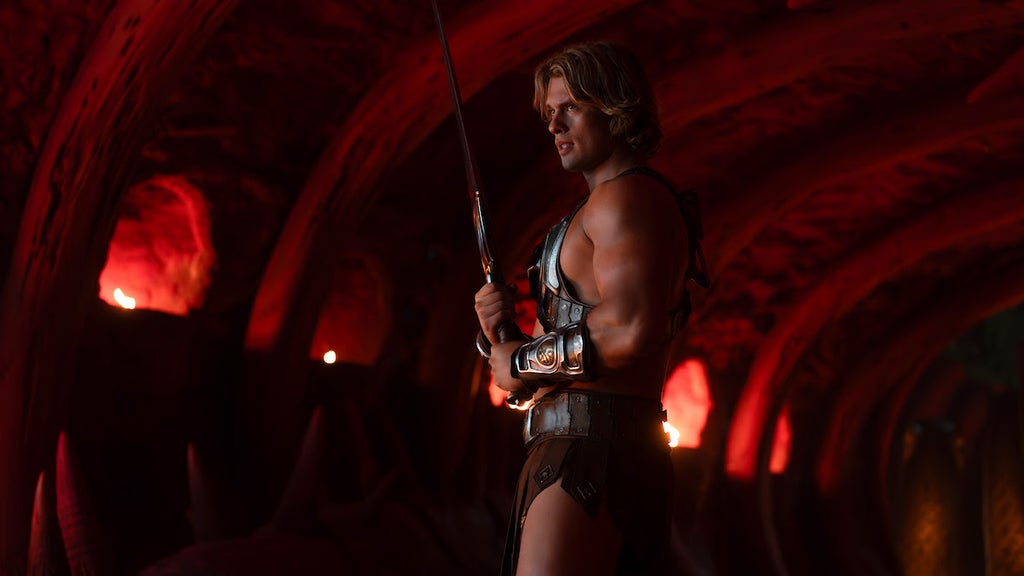
“I had in my mind what I thought a ‘Masters’ movie needed to be and that was the thing that I pitched,” Knight said. He had seen a little bit of the version that had been developed right before he was brought aboard and admitted that “there was some really fun material that the Nee Brothers had generated and we used some of that stuff.” The Nee Brothers are credited for the screenplay, along with David Callaham, who had co-written the most recent draft of the Netflix version before it had shut down.
When he came aboard the project, the first person that he hired was Butler. “He grew up in Liverpool, I grew up in Portland, but we both loved He-Man, and so I knew that he was the perfect person to help me figure out, like, how we were going to bring this world to life,” said Knight.
As he got into making “Masters of the Universe,” Knight said that there wasn’t a moment where he stopped and thought, Oh, now I know why this was so difficult to get off the ground.
“It is a tricky property, if you take an objective step back and look at it, it’s weird as hell. I could see there are probably a lot of pitfalls trying to make it something that maybe it isn’t or doesn’t want to be,” said Knight. “For me it was about channeling my inner eight-year-old and kind remembering what made it so unique and distinctive and special – wrapping my arms around that. It didn’t seem to me like it should be that challenging to adapt. Anything is hard to make. I very much lucked out, in the sense that the producers supported what I wanted to do.”
Courtenay Valenti, Amazon MGM’s head of film, was “a huge supporter of what we were trying to do,” said Knight. “That made all the difference in the world. All those things have to coalesce and be right for you to be able to make a movie like this and I lucked out,” said Knight.

Embracing the weird
The pitch that Knight presented, the one that got everyone on board “Masters of the Universe,” had him embracing all of the oddness that makes up the foundations of the property (and probably the things that had led the project to be reshuffled so many times) – “all the idiosyncratic weirdness of what ‘Masters’ represents – the crazy colors, the crazy designs, larger-than-live characters, insane action sequence, a tone that can flip between silliness and comedy and drama and real, keenly felt emotion, and then underneath it all, telling a story that that meant something, and that had a strong beating heart.”
Knight knew that if he had landed the emotional center of the movie, “we could go in all sorts of different directions and layer all of this wacky stuff into it, and it would work, it would hold together. And that’s the movie that we made.”
In “Masters of the Universe,” British actor Nicholas Galitzine plays Adam Glenn, who was cast out of the fantastical realm where he was raised as a child and who, as a young man in suburban Oklahoma, is struggling to return home. He eventually finds a magic sword and is transported back to Eternia, where he joins a band of freedom fighters (played by Camila Mendes, Idris Elba and Jóhannes Haukur Jóhannesson, plus a giant robot voiced by Kristin Wiig) to take back their kingdom from the evil Skeletor (Jared Leto).
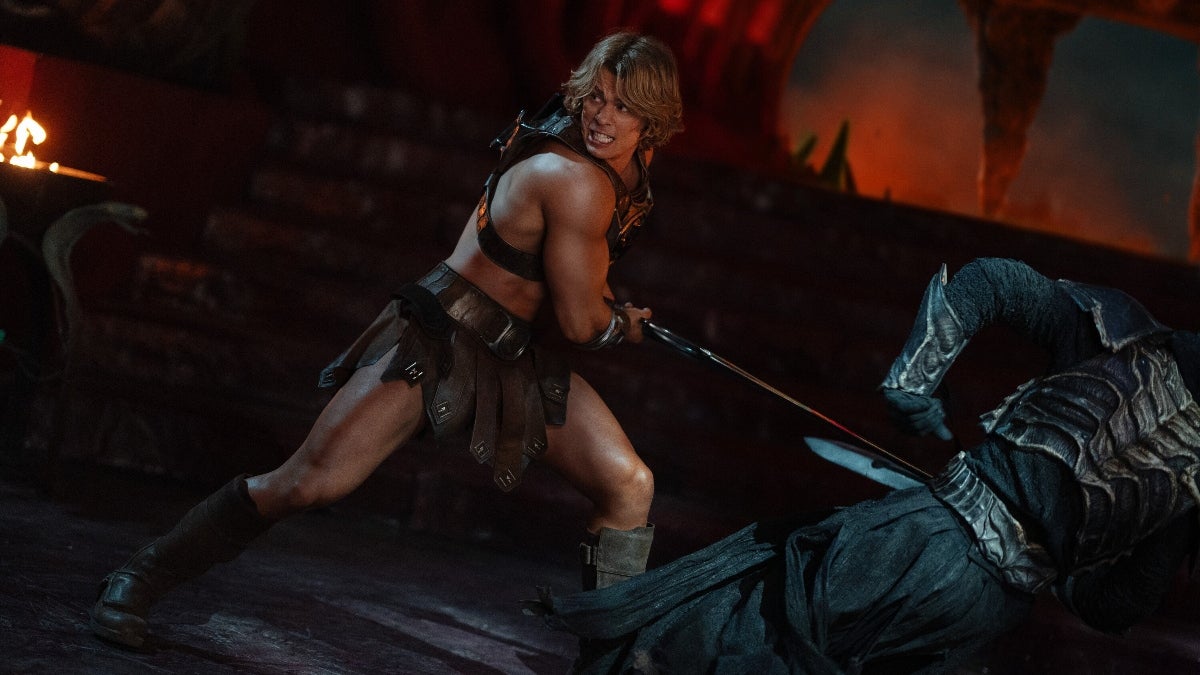
It’s goofy, for sure, but it is also incredibly earnest. This is not a He-Man movie in quotes. Instead, it’s a full-blooded fantasy adventure that respects its subject matter as much as one can respect a cartoon series meant to sell action figures to sugar-addled little kids.
“It is a tight rope to walk, for sure, and you can go too far in one direction or the other. I certainly never wanted it to feel like we were veering into anything resembling parody, because that suggests that you’re detached, that you’re looking down your nose at the material, and that was never the case,” said Knight about finding the right tone for “Masters of the Universe.” “I sincerely love these characters and this world, and so even if we’re being playful and cheeky and having fun with it, it’s done with complete affection. I’m glad that comes through as earnest, because the movie is completely sincere, even though it’s very, very silly at times.”
Key to that silliness is Leto’s performance as Skeletor. He’s got a classic British accent and is both threatening and hilarious. Many early reviews have singled out the embattled actor as one of the highlights of the movie, which makes his complete absence from promotional events in the lead-up to the marketing’s release even more perplexing. Sure, he’s had a rough go of it, particularly in the wake of the box office disappointment of Disney’s “Tron: Ares,” which failed to generate much heat last fall. But he is usually pretty dutiful to his commitments, no matter how he feels about the finished product.
“I can’t speak to any of that, but what I can speak to is his performance and working with him, and he does give an amazing performance. Part of that is, well, he’s a great actor, of course, but it’s also that he knew the material, he grew up with ‘Masters,’ he loved it as a kid, and Skeletor was his favorite character,” said Knight, diplomatically. “He understood, when I spoke to him about the different qualities of Skeletor that I wanted to make sure that we were evoking in our version of the movie, all of that because he knew who the character was. It was just about making our own version of it and his performance is so delightful. He is so horrible and entertaining and just a joy to watch.”

At the Hollywood premiere (which Leto skipped), there were moments during the screening when oohs and ahhs rolled through the audience; clapping and shouting was not uncommon. The joyful reverence to the original material, the way that he was able to emulate the sensation of sitting in front of the television with a bowl of Frosted Flakes, it all translated, beautifully, to those who watched it that night.
“It’s funny, because the process goes, you test these things multiple times as you’re fine-tuning them, and the very first time we put it in front of the audience, it was so raw, there were virtually no visual effects that were done, it was just ropey as shit, and it was just a nerve-wracking experience, because you don’t know how people can respond, you don’t know if they can see beyond what crude stuff is in front of them,” said Knight. “And right from the beginning we got a great response, and so people were vibing on the stuff that mattered to me. I kind of knew that people who are fans of the material would see the ‘Masters of the Universe’ that they knew and loved reflected back at them.”
What Knight wasn’t sure of us was how people who didn’t know a thing about “Masters of the Universe” would respond to his wild new concoction.
“It was the hope but you never know. You’re working in these insular bubbles for so long – I’ve been working on this movie for two-and-a-half years – you never really know how people are going to react. You’ve just got to do something that you think works and that’s what we did,” said Knight.
When he heard the crowd at the premiere, he was able to breathe a sigh of relief. “The fact that we’re getting this kind of response is really heartening,” he said.
There is a scene towards the end of “Masters of the Universe,” which we won’t give away here but suggests that there could be further films in the franchise.
Not that he’s thinking about a sequel yet.
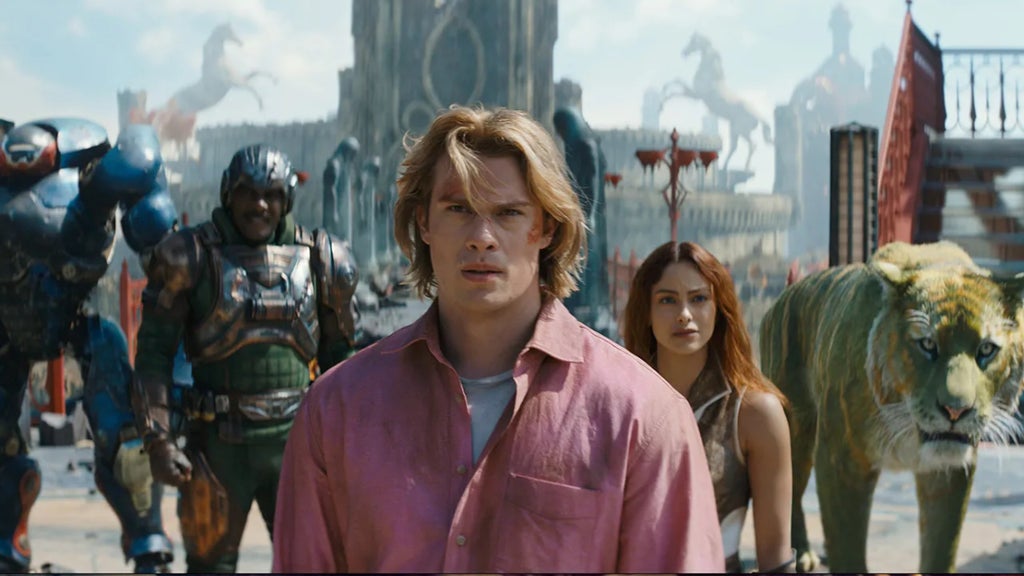
“I approach every single story that I tell, every movie that I’ve made, as if you only get one chance at telling the story, so I wanted to make sure that the movie stood on its own two feet,” he said. “We tell a story that has a beginning, middle and end. This guy’s journey to this point in his life by the end of the movie is complete. But there are so many different places you could go with this world, and I did want to suggest within the movie itself, and then on the little buttons that we have at the end, there is a whole universe outside the frame of the movie. If we were to be so lucky to be able to tell more of these stories, I have so many ideas about where we could go and those things that we suggest at the end give you some hint about where we might go.”
“Masters of the Universe” is in theaters now.
