
There’s a scene in David Lowery’s third feature, “A Ghost Story,” where the title specter watches and listens helplessly as a mysterious, living man opines — at considerable length — about the futility of art and human existence. In that scene, Lowery argues that we’re all forgotten eventually, so we do everything we can to stick around in this universe as long as possible, if only by making art that’s hard to forget. If you’ve never seen it, trust me when I say you can practically smell the hashish wafting off the screen.
That’s the closest any David Lowery movie has come to pausing in the middle to watch another David Lowery movie. I thought about it a lot while watching his latest, “Mother Mary,” a film which would rather be remembered than coherent. It’s a behind-the-scenes camp musical melodrama. It’s an indulgent, serious two-hander between Anne Hathaway and Michaela Coel, who eat this material up with a side order of gourmet gruyere. It’s an exposé of the collective artistic subconscious in all its glorious, embarrassing, self-contradictory sloppiness. It’s a ghost story about a great, big, red blob of something. It won’t soon be forgotten, and that’s whether audiences love it, hate it, or have no idea what’s going on.
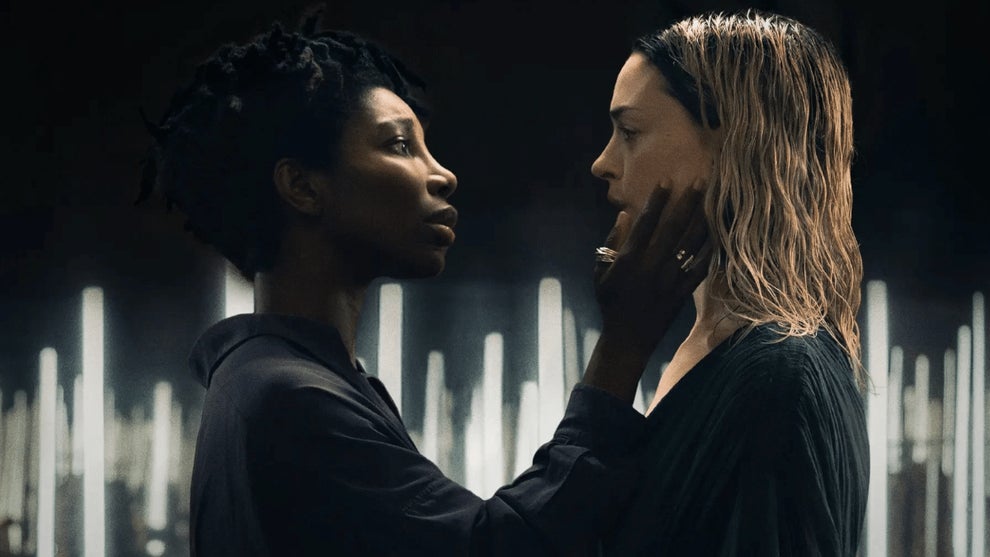
“Mother Mary” is ostensibly about a pop music superstar, Mother Mary (Hathaway), who comes crawling back to her old costume designer, Sam (Michaela Coel). They had a falling out years ago, and in the aftermath Sam rebuilt her life and career, fueled by Mary’s rejection. Mary never missed a beat. She’s more successful than ever but something’s wrong. She’s completely lost her identity, and needs Sam to give it back to her by making a brand new dress, one which will redefine Mary’s whole brand, and her whole life.
And of course, since it’s a movie, there’s a ticking clock. Sam only has a couple days to make the greatest dress in the history of everything, and she can’t do that unless the two of them work out their baggage in record time. In other words, “Mother Mary” is about Anne Hathaway and Michaela Coel knocking a proverbial ping-pong ball back and forth for nearly two hours, alone in a vast and haunted manor, snipping and sniping and eventually getting into the real reason they’ve reunited. And surprise! It’s got a ghost in it. Or, maybe, it’s just an elaborate, borderline laughable metaphor for the creative and/or collaborative spirit.

“Borderline laughable” describes “Mother Mary” to a T, but it’s not an insult. You can’t make great art if you’re terrified of making bad art. Lowery runs headfirst up to the edge of bad art, stumbles and leans perilously forward for the entire film. It’s only at the end you find out whether he fell into insufferable pretentiousness, or just made a film about insufferable pretentiousness. I think he pulled himself, and “Mother Mary,” from the brink at the last possible second. But the similarities between the good film Lowery made and the bad film he almost made are hard to count.
Either way, “Mother Mary” lives on that edge. Anne Hathaway is a powerful performer, and at the beginning of the film she’s withered, beaten down by something we don’t understand yet. The mystery of what happened to her rizz looms large, and that emptiness gives Michaela Coel a lot of room to explore the space. She’s so chillingly passive-aggressive she could give Maggie Smith frostbite.
Over the course of “Mother Mary” Anne Hathaway gets recharged, Michaela Coel warms over and David Lowery somehow refuses to acknowledge — let alone explore — the obvious: that a white celebrity is exploiting the (apparently free) labor of a Black artist to achieve her own self-actualization, and that she’s only attempting to right her past wrongs when it suits her own interests.

It’s the only part of “Mother Mary” that feels timid. Everything else is brazen. Dreamy flashbacks to Mother Mary’s performances, riffing on Taylor Swift’s Reputation and Eras tours, are stark yet fabulous. The music, sung by Anne Hathaway, can sometimes impersonate actual, hit songs. (The rest of the time it’s close enough.) The plot, such as it is, can change its whole tone and tenor at a moment’s notice, so by the time we’re in exorcism territory, what the heck, this might as well happen.
“Mother Mary” takes place in a world where art is magic and forms eternal bonds, which can be a blessing or a curse. It can also raise the dead and infect the soul. And in David Lowery’s film it can captivate the mind even when it’s arguably absurd. We’re watching extremely talented artists try to accomplish something grand and potentially embarrass themselves in the process, and it works because they’re committed to taking that risk. Lowery doesn’t hold back (mostly). His cast doesn’t hold back. That’s how cult classics are born. And let’s face it, cult classics tend to live longer than the bona fide variety, whether they’re brilliant, mortifying, or just plain odd.
