
There are lots of old jokes about how people change as they get older. Like how there comes a point where, suddenly and magically, all guys become obsessed with World War II. Or how people start talking about the weather like it’s a dramatic topic and not, you know, just the weather. Sure, I guess it really is hot today, and sure, I guess Operation Abercrombie technically was something, but no, that’s not necessarily riveting. Even if you have started counting literal tank rivets.
Anthony Maras’ “Pressure” was specifically designed for people who love The Weather Channel and The History Channel. Or to put it another way, this movie was made for dads.
Based on the 2014 stage play by David Haig (who here co-writes the script with Maras), it’s about a meteorologist trying to convince Gen. Dwight D. Eisenhower that it’s going to rain on D-Day, and another meteorologist who disagrees. You will not need the edge of your seat for this movie, folks. “Pressure” is what lazy Sundays and recliners were invented for.
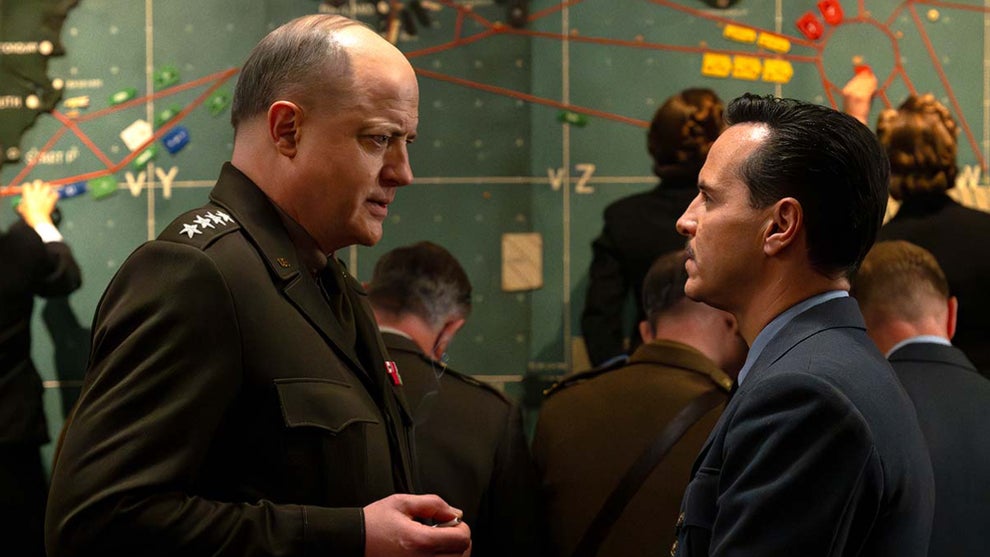
Andrew Scott stars as James Stagg, a Scottish meteorologist responsible for presenting the weather forecast for one of the biggest military operations in history. His American counterpart, Irving Krick (Chris Messina), says it’s going to be pleasant and sunny, perfect for a seaborne invasion. Stagg says it’s going to rain, a lot, so the Allies should delay D-Day, which could lose us the whole war.
The question, which everyone repeats, is whether D-Day is going to take place on June 5, 1944. So if you remember when D-Day was, and the target demo for this movie will (not to mention anyone who paid attention in history class), there’s no suspense. The ending is a foregone conclusion, and not a lot happens before we get there.
Brendan Fraser plays Gen. Eisenhower, who’s running the whole operation, but as far as the movie’s concerned his only job is to decide which meteorologist knows more about meteorology. And as far as the audience is concerned, there’s no doubt our minds: If you’re thinking about chilly, you gotta choose Stagg.

A movie like “Pressure” only works if the actors make it work. Scott and Messina are polar opposites, which makes sense on paper. Stagg is quiet, Krick is charming, and they both think they’re right. Those characterizations are thin but at least they’re at odds. Then again, they have nothing to talk about except the weather and their egos, and their arguments never change. Krick bases his forecast on historical precedent, Stagg bases his on current atmospheric conditions, and they just keep butting heads until their deadline. It’s an erudite rendition of “Am not!” vs. “Are too!,” which makes the conflict classy but never makes it thrilling.
Gen. Eisenhower has to make the final call, and he’s portrayed as a thoughtful man with a conscience wrestling with an impossible task. Fraser wears Eisenhower’s doubts effectively but he’s less convincing when he takes command and dresses his men down. It’s hard to shake the sensation that Fraser, who can be a marvelous actor, is role-playing as Eisenhower instead of inhabiting a role. We’re not watching Eisenhower in action, we’re watching Brendan Fraser act a little like Eisenhower. All the actors in “Pressure” have been excellent elsewhere. Most of them struggle here.
Maras’ sturdy, competent direction isn’t enough to turn “Pressure” into anything more than a nifty historical anecdote that can’t sustain a feature-length motion picture. It’s not that the film plays like a play. A lot of films play like a play, including some which aren’t based on plays. The issue is that after “Pressure” makes its point — that meteorology was more important to World War II than most people realize — there’s not much left. And the point is made very quickly, so afterwards the film can only spin its wheels.
It’s possible to turn a story like “Pressure” into something bigger without drizzling it with artificial melodrama or historical inaccuracies. The question at the heart of Haig’s story is still relevant: What does it take to make decision-makers listen to science when the science is inconvenient to their goals? It’s the same quandary scientists have faced for decades as they’ve tried to raise alarms about climate change, to little avail. It’s the same quandary medical professionals currently face as they try explain that vaccines work and gender-affirming care saves lives.
“Pressure” does precious little to explore its most resonant themes. Instead it seems content to frame its story as a mere battle of wills, but it’s not enough to overcome the fact that, again, we know how this ends. We know when D-Day happened. And even if we didn’t know exactly what went down between these two meteorologists and Dwight D. Eisenhower in the 72-hours beforehand, now that we do, we know it wasn’t terribly interesting.
Tempers sure did flare, but the filmmaking was only temperate.
