
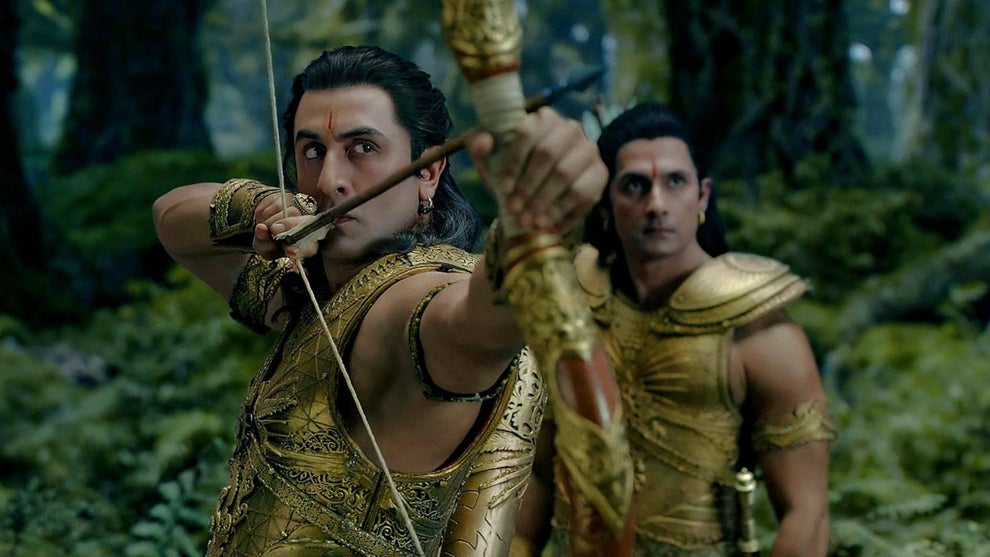
In case you haven’t noticed, it’s been an atypically good year for big budget film adaptations of 3,000-year-old fantasy epics. At least, I think it’s atypical. If last year’s “Zootopia 2” and “F1: The Movie” were stealth reboots of “The Epic of Gilgamesh” and “Beowulf,” they hid it really, really well.
Christopher Nolan’s “The Odyssey” was the talk of the town this summer, with an all-star cast and an exceptionally dour take on Homer’s classic saga. Lots of greys, lots of misery, lots of monsters. People like that kind of thing nowadays. It’s a great movie but if you thought it was a bit of a downer, Nitesh Tiwari’s “Ramayana: Rise of a Legend” is the three-hour magical action spectacle for you. It’s an electric rainbow of a movie, shimmering with extravagance, and brimming with more adventure and romance than a movie theater can usually handle.
American audiences are probably less familiar with Valmiki’s Hindu poem “Ramayana” than they are with “The Odyssey,” in part because a lot of teenagers in this country are required to read Homer in high school, and in part because “The Odyssey” is constantly referenced throughout Western popular culture. I’m pretty sure there’s never been a screwball bluegrass musical version of the “Ramayana” but then again, I’m one of those Americans who wasn’t exposed to Valmiki’s epic in school, so I could be wrong. I’d love, love, love to see that film.
Tiwari’s epic covers a staggering amount of ground in three hours, making a plot summary trickier than usual. The shortest version I’ve got is: A man named Ravana (Yash) wants to liberate his enslaved people, and undergoes unthinkable penance at the top of a mountain. The god Brahma, astonished by his perseverance, offers him a gift. Ravana asks for immortality, but when he’s told that he’s pushing it, Ravana settles for being unkillable by any of Brahma’s creations, except for humans. It seems like a really big loophole but maybe, just maybe, it’s part of Ravana’s diabolical plan.

Ravana conquers his kingdom, slaughtering a whole army single-handed (I thought at least some of those guys were human, but I guess I was wrong). It’s pretty bad when there’s an immortal warlord who could punch out god, especially when he immediately lets the power go to his head, so the god Vishnu creates a new avatar in a human body. His name is Rama (Ranbir Kapoor), he’s one of four princes born to a faraway king, and he’s trained since birth by a flying birdman to do daredevil stunts, kill demons and pursue his incredible destiny.
Along the way, Rama and his younger brother Lakshmana (Ravi Dubey) save enchanted forests and lift impossible magic weapons, and eventually Rama wins the hand of the beautiful martial arts princess Sita (Sai Pallavi). But just when a happy ending seems within their grasp, palace intrigue threatens Rama’s throne — and eventually, I promise you, Ravana comes back into this story eventually.
I felt a great swell of pity for the many film critics who were shoved into bottomless wells of popular culture they had hitherto left unexplored in the early 2000s, when superheroes and anime and video games and cartoons became the dominant force in the mainstream consciousness. I remember full well how some tried, with mixed success, to quickly wrap their heads around lore they didn’t understand. The “Ramayana” isn’t a comic book but it’s a gigantic, action-packed text with millennia of cultural history behind it, and as someone who is new to this tale, I can’t pretend to know whether this movie is faithful to the source, and which parts may have been modernized for contemporary audiences. There are other critics for that, I hope you read their analyses. I know I will.
But ignorance is a starting point, not an end, and it’s literally a film critic’s job to be curious about everything we’ve never seen before. The glorious thing about not knowing something is that you have the opportunity to learn, and watching Nitesh Tiwari’s “Ramayana” is an exciting crash course. I can’t tell you how many cyclopses I’ve seen stabbed by jerk-ass Greek antiheroes in my time, but I’ve only seen one flying lotus aircraft attacked by a giant birdman, and that’s exhilarating.

Tiwari does a remarkable job of keeping this gigantic, episodic story from ever feeling dull, and what’s more, he does it without leaving the adrenaline firehose spewing at full blast. There are stunning action sequences of heroes chased by demons through collapsing, gargantuan forests, tempered with quiet, courtly romance, political intrigue, and hallucinatory visits to ethereal planes. (There’s also some sexism, which is a bummer, but that’s an undercurrent, not the tide.) Movie tickets are expensive these days, and whether you love “Ramayana” or not, it’s a bargain. There’s a lot of movie in this movie. It’s more movie than most of this weekend’s other new theatrical releases put together.
Earlier this year I complained that Adam Wingard’s genre throwback “Onslaught” ended just when it was getting good, denying audiences the promise of its premise. “Ramayana” also ends suddenly, but after three hours of jumbo-sized fantasy spectacle — with gorgeous costumes and luscious sets, and magical creatures galore — it’s impossible to complain. Minutes before the film ended I had forgotten this was a two-parter. I’d even forgotten that I had already watched it for three hours straight. So I found myself getting excited for what I could only imagine was at least another 90 minutes of wonderment and thrills.
I was slightly miffed that I couldn’t see it right now, but at least I know that when the second part of “Ramayana” debuts it promises to be comparatively huge. And I know I’ll be right there to see how it concludes, this time after doing some research, because there’s no way to watch Nitesh Tiwari’s first half without getting pulled into this world.
