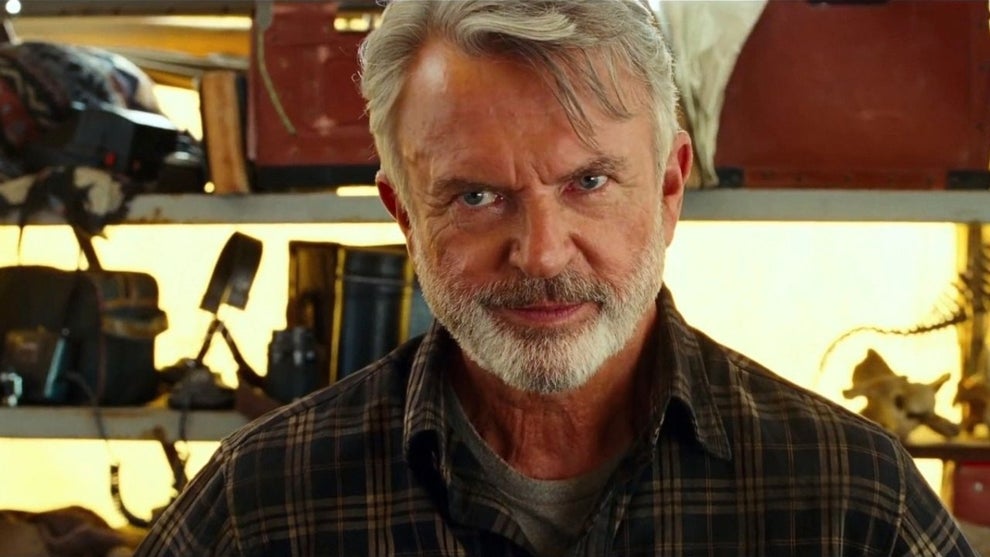
The news of the passing of Sam Neill, the beloved New Zealand actor whose career spanned five decades, multiple continents and practically every genre, hit us all like a ton of bricks. Despite a long battle with cancer, from which he was free at the time of his death, he seemed like the kind of actor who would be around forever.
Indeed, for some generations of film fans, he was. His presence on screen was one on which viewers could rely, regardless of the role or material. He’d spent the best part of 50 years evolving: From rising local star and figure of the Australian New Wave, to character actor and horror icon, to blockbuster leading man, to elder statesman. He died suddenly in Sydney on Monday at age 78, his loved ones shared.
Born in 1947 in Northern Ireland, Neill’s family moved to New Zealand seven years later. He acted in university plays before finding work in the country’s growing film industry. His breakout role came with 1979’s “My Brilliant Career,” Gillian Armstrong’s fiercely feminist period drama where Neill played the potential love interest of Judy Davis’ independent, career-minded Sybylla. That film helped to launch the Australian New Wave, bringing the country’s cinema to an international audience and with it, actors like Neill. It didn’t take long for him to break through in America.

In 1981, he won his first big international role, as Damien Thorn, son of the devil, in “Omen III: The Final Conflict.” He made for a great demon, threading the fine needle between suave and sinister that would come to define his career. It was also his first foray into horror, a genre he would frequent and become something of a scream king: From the psychosexual thrall of “Possession”, where he more than holds his own as the toxic husband of a feral Isabelle Adjani; to his cosmic breakdown in “Event Horizon”; to his smarmy descent into psychosis in John Carpenter’s “In the Mouth of Madness.” Even his work in Jane Campion’s “The Piano,” where he plays the feckless cuckolded husband of Holly Hunter’s mute pianist, is imbued with a Bluebeard-esque unease that wouldn’t feel out of place in a thriller. The typical Neill horror character was a man of a certain degree of smugness who seemed completely in control until he realized that he’d already stumbled down the rabbit hole.
That’s what made Dr. Alan Grant such a great hero. For millions of fans, Neill will forever be synonymous with “Jurassic Park”, Steven Spielberg’s dinosaur adventure and a bona fide blockbuster masterpiece. In retrospect, Neill makes for an unexpected protagonist for such a tale. He plays a brilliant but cynical scientist, a gentleman oddball whose canny perception of a miracle makes him the perfect person to call out its inevitable failings. In his first scene, he threatens an annoying kid with a raptor claw and a session of passive-aggressive palaeontology! For all of his excellence in playing sinister, Neill could also be the safest port in the storm, the guy you wanted in your corner. No other “Jurassic Park” film has found a hero as captivating or grounded as Dr. Grant. There’s a reason they had to bring him back more than once.
Even after he headlined one of the biggest movies of all time, Neill never strayed too far from home, returning to New Zealand and Australia frequently to work on local films like “My Mother Frank” and “The Dish.” He was never off our screens for long, doing everything from voice-over performances to grimy indies to a hilarious cameo in “Thor: Ragnarok.” A ton of TV work followed too, including the miniseries “Merlin,” a scene-stealing arc on “Peaky Blinders” and a starring role in Peacock’s “Apples Never Fall.”
By the 2010s, his title as an elder statesman, a stable and always-intriguing presence whatever the project, was thoroughly secured. He was a consummate supporting player but never outshone. Consider “Hunt for the Wilderpeople,” Taika Waititi’s dramedy about a foster kid who accidentally ends up on the run with his sort-of adopted father. Neill was the perfect fit for Waititi’s offbeat humor with its frequent punctuations of poignancy. His gruffness gives way to an earned warmth and protectiveness of his reluctant ward. Even as the story takes some bananas turns, Neill keeps it grounded without losing control of the punchline. In hindsight, it’s the kind of role that should have gotten him some real awards season attention.
He’d receive five AACTA Award nominations, the Australian equivalent of the Oscars, and one win, as well as two Emmy nominations. The lack of an Oscar nod now feels criminal. Surely, he’s one of the great actors of his generation to never receive one? But maybe that’s fitting too: the downside of being so familiar and reliable is that you’re often taken for granted, and Sam Neill was nothing if not consistently great, even if we didn’t always notice it. The work remains, and it will be revisited time and time again. If all Neill had ever done was “Jurassic Park,” his place in movie history would have been secured, but how lucky are we all that he did so, so much more? He once described himself as someone who was in “the cheering-up business.” Mission accomplished.
