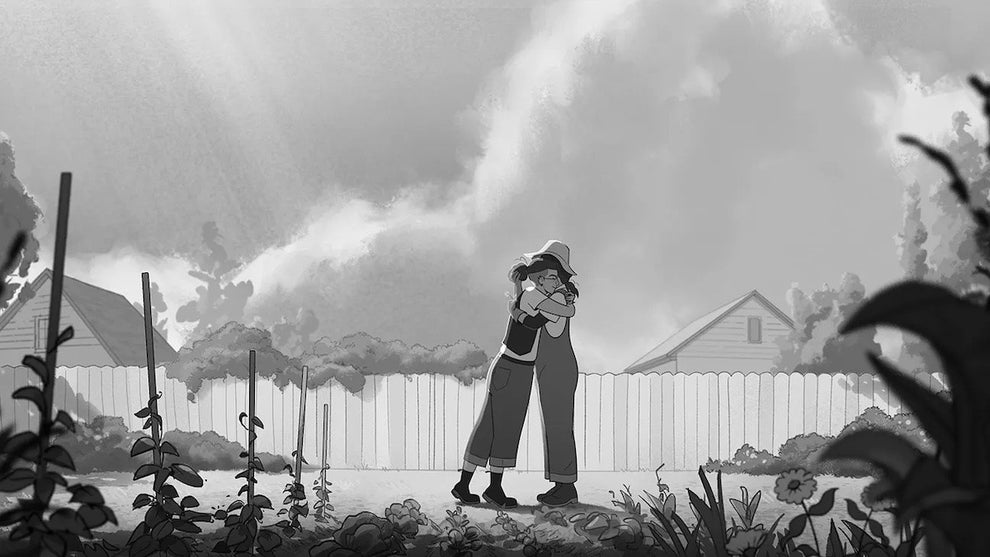
Illness dramas are rarely aspirational, especially those saddling entire families with a disease as cruel as Alzheimer’s. Still, anyone facing such an ordeal would be lucky — or at least fortunate — to do so alongside the clan in “Tangles,” an affectionate and irreverent animated memoir that shades every stage of grief with gallows wit.
Buoyed by a murderer’s row of voice talent and a deft command of tearjerker mechanics, the film plays with a winning familiarity that should help it find a wide audience after its Thursday premiere in Cannes.
The year is 1999, and Sarah (Abbi Jacobson) is finally living her best life. The 20something has shed the last traces of teenage awkwardness, come out — to the surprise of absolutely no one — and settled happily into San Francisco’s queer scene. What’s more, the aspiring cartoonist has suddenly found herself with both the biker dream girl Donimo (Samira Wiley) and a promising media career. If nothing else, that last detail is how you know it’s a period piece.
Of course, Sarah will eventually have to put that life on pause as family circumstances force her to spend more and more time in her hometown of “Bumblef–k, Maine,” but let’s not get ahead of ourselves. Both director Leah Nelson and co-writer Sarah Leavitt — on whose memoir the film is based — share that same fond nostalgia for comparatively simpler times, and so they linger with a happier, more intact Leavitt clan even as denial quietly begins to take hold.
Everyone knows that something’s off with Mom — but as a vibrant woman in her early 50s, Midge (Julia Louis-Dreyfus) just chalks it up to menopause while her husband (Bryan Cranston) and sisters (Pamela Adlon and Sarah Silverman) are all inclined to agree. Meanwhile, second daughter Hannah (Beanie Feldstein) is off playing hanky-panky with the town’s resident goofball (Seth Rogen), leaving poor Sarah to confront what nobody else wants to see.

You might notice a common thread running through the voice cast (which also includes Philip Rosenthal as a rabbi). That’s right — they all come from comedy, a background that links producers Seth Rogen and Lauren Miller Rogen’s work in film with their Alzheimer’s philanthropy. (If you notice another genetic through-line, chalk it up to the film’s investment in authenticity.)
“Tangles” builds on an interesting artistic proposition, channeling the impressionistic and surreal visuals of Leavitt’s source comic — which foregrounded the emotional toll of the story by literalizing idioms like the ground giving way or the walls closing in — through the lexicon of contemporary American humor. Sharply paced and full of gags, the film offsets its austere charcoal visual palette with a genuinely impish spirit, especially during a scene in which the family waits for a doctor’s diagnosis. Until the dreaded word is spoken, every other possibility still feels in play, and so the clinic turns into a casino as the family silently roots for a less catastrophic outcome. “Come on, syphilis!” Jacobson blurts out with perfect comic timing.
That irreverence actually deepens the film’s emotional pull, recognizing humor as both a release valve and a coping mechanism — after all, people rarely laugh harder than at a wake (or a shiva, in this case). Still, the gags gradually dwindle as time marches on, Midge’s condition worsens, and the rest of the Leavitts slip through the next stages of grief. Though anger and depression surface through family recriminations — especially as Sarah butts heads with her sister — “Tangles” never pushes those moments too hard, instead letting the steady momentum of decline carry the drama.
Granted, to certain sensibilities, “Tangles” could come off as generous to a fault, as it never really moves beyond the question of why bad things happen to good people. But the fact is they do, and intimate family stories often rhyme with so many others. All of which gives the film a certain cathartic quality as it settles into familiar tearjerker rhythms.
As it recreates family photos and mini-DV home videos, “Tangles” often plays like an animated scrapbook, something Sarah herself underscores when she notes that “anytime could be the last time” with that particular facet of her mother. What else can the filmmakers do but capture each moment gone by?
