
At last year’s Toronto International Film Festival, writer Ed Solomon was greeted by his past and his future at the same time.
The festival was premiering his new film, “The Christophers,” directed by Steven Soderbergh, and was presenting a special anniversary screening of “Bill & Ted’s Excellent Adventure,” the 1989 sci-fi comedy that Solomon wrote with Chris Matheson (his first film, it effectively jump-started Solomon’s career). His first movie and his latest, together.
“When I got there, two movies written exactly 40 years apart, were playing side-by-side,” Solomon told TheWrap. “One was about these young kids who think they’re going to live forever through their art, their music, and the other was about an aging artist who quit and whose dreams were dashed, who’s struggling with what he perceives to be a failed legacy. It was fascinating to see both films next to each other in one spot. It shocked me.”
It’s a twist so ingenious, so loaded with symbolism and meaning, that it could have come out of one of Solomon’s scripts.
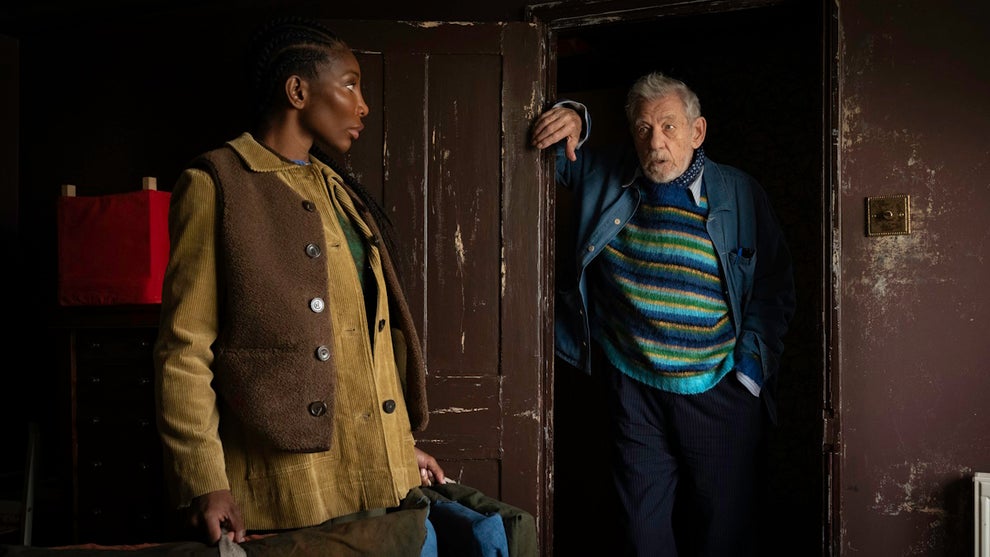
“The Christophers,” now playing nationwide, stars Michaela Coel as Lori Butler, an artist hired by James Corden and Jessica Gunning. They’re the failed children of famous painter Julian Sklar (played by a rascally Ian McKellan), who has put his art aside, starred as a judge on a chintzy competition series and now makes Cameo videos for cash in his Dickensian London home. Their proposal – Lori can get ahold of some unfinished paintings, complete them and then the three of them can sell the paintings as lost Julian Sklar masterpieces. Imagine that. Of course, it becomes much more complicated from there, with Lori and Julian engaging in a flinty battle of wits. It’s like one of Soderbergh’s grand heist movies, except “The Christophers” is confined to a single ramshackle estate.
It’s the latest achievement in a creative collaboration between Soderbergh and Solomon that started more than 10 years prior.

Solomon first got a call asking if he would be interested in talking to Soderbergh about a branching narrative piece that the director, constantly curious about both the latest technology and the most unexpected way to tell a story, was interested in. The writer lied and said he was already in New York, where Soderbergh was. “Then I bought a ticket and went to New York and was like, Yeah I’m here. Happy to meet,” Solomon remembered.
The meeting was fruitful. Solomon was a fan of Soderbergh’s work (and told him so). They talked about what the project would be. “We thought, Oh, this is kind of interesting. And then we thought, Let’s see if we can do something longer with it,” Solomon said. It led to Solomon writing 350 pages of what would eventually become “Mosaic” on spec before HBO agreed to take it on. (The project would eventually balloon to a 400-page script.) It would consist of a branching narrative online experience, where the direction of the story would be dictated by the user. Sadly, the site that hosted the original experience is now defunct; HBO, as part of the agreement, would air a pared down, linear version of “Mosaic” on the cable channel.
“’Mosaic’ offered the chance to really flex muscles that I had never flexed before and Steven had never flexed before. We said we’re going through a kind of Nautilus cycle, and really developing all sorts of new skills and knew that just by trying this, we’d be thinking differently,” Solomon recalled. “And for me, I think the key was to have somebody at Steven’s level who trusted me to work in, not just a genre that I was not, quote, unquote, known for, a genre that I had not been proven in, in a medium that didn’t even really exist yet. I knew at the end of this I would be a different writer – and hopefully a better writer.”
“Mosaic,” more than anything, would spark a long-running creative collaboration that would also include 2021’s excellent “No Sudden Move,” part of Soderbergh’s deal with HBO Max (“Steven said, ‘Would you be interested in trying a ‘50s noir thing for Don Cheadle?’ And I was like, ‘Yes, a million times yes’”); “Bill & Ted Face the Music” (which Soderbergh executive produced); “Full Circle,” which started life as another branching narrative project but became a more traditional streaming series on HBO Max (before they picked it up, Solomon wrote 580 pages on spec); and, now, “The Christophers.”
They met in New York City to discuss the project. “I said something like, ‘What are you thinking about doing next year?’ And he said something like, ‘I wanted to do a little chamber piece, but with a kind of Patricia Highsmith-y entry, maybe about art and maybe a young artist and an old artist,’” Solomon shared.
The screenwriter had wanted to do something utilizing his own experiences with a few different older artists; not painters, but comedians and comic actors and writers “that I had mentor/mentee relationships with, several of whom quit in their careers, gave up, and one of whom gave up and then turned on his own fans in a certain way,” he noted. The project Soderbergh proposed would give Solomon an opportunity to write about that relationship. It was all there, even the older artist’s English accent.
“I said, ‘I know what this movie is.’ It was a different movie than Steven originally imagined. I think he was imagining a bit more of a caper and I was imagining more of a relationship story. However, he also wanted to do something which, again, is one of the many things I admire, he wanted to take all the risk,” Solomon said. “We’ll write it on spec. We’ll try and raise just equity funding. We won’t get a distributor. We’ll try to believe in ourselves and believe in the project and make it for very, very, very little.”

Then Solomon did something that writers are never supposed to do – he wrote the script for exactly two people: McKellan and Coel, who Solomon did not know. “We did the stupidest thing you could possibly do, which is write a spec script with two people in mind, specifically, not just two people in mind, probably the only two people on the planet who could play these roles,” Solomon said. Still, they persisted. Somewhere along the process, they reached out to McKellan’s agent; the same thing with Coel’s managers. Both were kind and said to send the finished script to them once Solomon was done. It was a short shoot so it wouldn’t require much time from either of them. And they both agreed.
The rehearsal process was held at McKellan’s house. Solomon said watching McKellan and Coel rehearse his script was “one of the highest points of my career.” Solomon recorded it all, his cell phone perched on a radiator; he said he has around 15 hours of footage.
“It was Michaela and me and Ian sitting in a room with Ian reading every line of the script, and after every line, speaking out his subtext, and then going on to the next line,” Solomon said. “Michaela and I, and I only met Michaela just then, too, by the way, squeezed each other’s hands and I and leaned over to her and we basically said to each other, ‘No matter what happens in our life, we will always have this moment of sitting across from Ian McKellen and watching him break down a role.’ It was really meaningful. I never thought I’d have a moment like that in my career. It was beautiful.”
Making the movie was just as moving, with Solomon saying it was “a joy.”
“What was also particularly meaningful for me was to get to write for an 86-year-old actor and he’s playing someone who is many things at one time. It was a way for me, in that trajectory, in the old relationships with those old mentors of mine, it was a way for me to bring it around,” said Solomon. “The movie has a really special place for me, in my heart, as someone who has been doing this for a long time. And someone who’s felt all the things you feel when you’re thinking you’re not good enough, or you just deal with somebody at that point in his career trajectory. Not Ian’s. I’m talking about the character he plays.”
Part of what makes “The Christophers” so special is that it’s about the purity of artistic expression, made by artists who are bringing the story to the screen with the same purity and sense of purpose. It’s also about how that artistic intent can get corrupted – by gross commercialism, by cloying family members, by misunderstanding and shortsightedness.
Not that Solomon and Soderbergh talked about the movie’s underpinnings.
Solomon said that they thought about the themes individually. Solomon’s mom was a painter. He grew up in his mom’s studio. When he thinks about her, he thinks of her there.
“By writing it on spec, by shooting it essentially on spec, with Department M doing the equity financing of it, but they’re taking a massive risk on that, it gave us a chance to just make something that was its own expression of itself, without any notes from anyone, whether it speaks to others, I don’t know,” Solomon explained. “I was never thinking beyond, Oh, this is a chance to write something I’ve always wanted to write. And then once we got Ian and Michaela, all I was thinking about was, Oh my God, these amazing actors are going to make these words sound so much better. And the shooting period was so short and I never thought past that. Then it was like, Oh we’re going to screen in Toronto.”

He also never thought about the possibility of someone not picking up “The Christophers,” which was filmed in just 19 days. But had that happened, he wouldn’t have been that upset.
“The experience where you work really hard to make something and then just people don’t see it, that would have been a bummer, but the experience of making it was so enriching for me and I learned so much doing it, that it still would have been worth it for me,” Solomon said, spoken like a man who had, up until this point, written thousands of pages for Soderbergh without the promise of any distribution.
Of course, it all worked out. Neon, arguably the hippest distributor of smaller films, picked it up out of TIFF. And now it’s coming out nationwide. It all worked out.
Solomon is currently very deep into his upcoming show from A24 and Hulu, “The Spot,” starring Claire Danes and Ewan McGregor, and hasn’t spoken to Soderbergh about a new project. But Solomon is ready, should the director have another idea. They just need to find the right pub.
“I’d love to do another one after this,” said Solomon.
Maybe next time they can actually get some funding first?
