
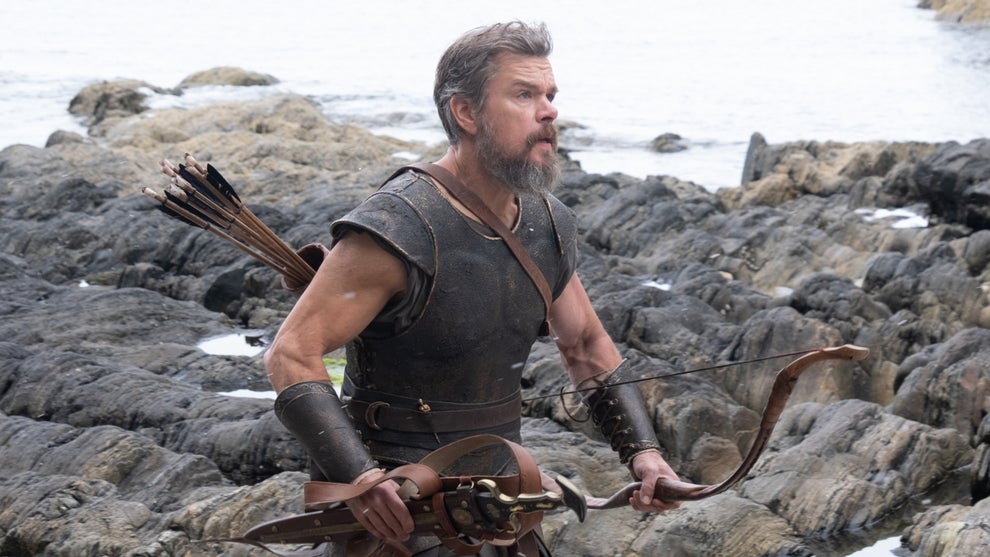
“The Odyssey” translator Emily Wilson published Wednesday another scathing takedown of Christopher Nolan’s adaptation of the Homeric epic barely a week after she went viral for calling the film’s writing “abysmal.”
Nolan has cited Wilson’s translation of “The Odyssey” and particularly the opening line of it, “Tell me about a complicated man,” as major points of inspiration for his adaptation of the Ancient Greecian poem. While the film has received nearly unanimous positive reviews from critics and continues a record-breaking run at the worldwide box office, Wilson made it clear she would “be ashamed to have written any part of this script” in a review for the London Review of Books.
In the new op-ed for The Atlantic, Wilson dug her heels in on her issues with the film and why she thinks it misses key points about Homer’s poem, calling it “emotionally empty.”
Wilson argued that Nolan’s treatment of the Trojan horse ultimately muddies one of the story’s central moral questions. In Homer’s epic, the horse is not simply an impressive feat of engineering or a clever military maneuver; it is deeply tied to Odysseus’ capacity for deception and the complicated moral consequences of war. Wilson believes Nolan’s film struggles to communicate that distinction, particularly because it does not depict the decade-long Trojan War that precedes the horse’s arrival.
“The horse is presented as the ultimate violation of the law of Zeus, because it entails wielding a weapon of mass destruction disguised as a gift,” Wilson said. “The horse is presented as breaking ‘civilization’ because it represents the moment when the good guy, Odysseus, echoes the behavior of the bad guy by being a deceitful, ungrateful guest.”

But, Wilson argues, the movie does not provide enough context for that moral framework to land. Because Nolan’s film does not spend significant time establishing the Greeks’ 10-year siege of Troy, she believes the emphasis on hospitality and the horse’s deception becomes confusing. The Trojans, after all, are not welcoming the Greeks into their homes; they are enemies who have been at war with them for a decade.
“The film does not explain what ‘hospitality’ has to do with a narrative situation in which the Greeks have been besieging Troy for 10 years already [which Nolan’s movie does not depict]; the Trojans are not their hosts but their enemies in war,” she added.
“If the war is bad, it is nonsensical to suggest that the most important turning point is the use of the horse rather than Agamemnon’s choice to invade Troy in the first place and Odysseus’s choice to yield to the empire’s demands,” she continued.
For Wilson, another main issue is that the camera’s focus on physical objects and spectacle is fundamentally at odds with the film’s stated interest in human morality and compassion.
“What matters cinematically are the logistics: the rolling of the horse uphill and the claustrophobic, waterlogged interior,” Wilson said. “Once the ambush of the Trojans begins, the camera lingers repeatedly not on the human actors but on the enflamed, toppling buildings and the great gates of the city, whose slow-moving mechanism is observed at great length.
“The script tells us loudly that people matter, but the camera shows us that what matters is the mechanical challenge of moving objects through space,” she continued.
That ultimately led Wilson to her most pointed criticism of Nolan’s adaptation. She argued that “The Odyssey” becomes its own version of the Trojan horse — a visually dazzling object that promises one thing while concealing something else underneath.
“Nolan’s ‘Odyssey’ is itself a kind of Trojan horse,” she said. “The script grandly insists on the importance of human kindness, while the camera shows us an entirely different set of values.”
“In these times of hatred and misinformation, we need more than the ‘apparent magic’ of deceptive images,” Wilson added. “We need art that is truthful about the costs and the necessity of compassion, and that recognizes that a sense of spiritual superiority may not protect us from lies.”
“These lessons are legible in Homer and Virgil, but are elided by Nolan’s visually stunning, emotionally empty film,” she concluded.
Nolan in part weight in on criticisms surrounding his film in a recent interview, specifically the framing of “sympathetic” heroes.
“The criticism that’s often leveled at movies in general is, ‘Oh the character has to be made sympathetic, so the character is manipulated in different ways or changed in different ways.’ And that’s a fundamental flaw of film criticism in a way,” Nolan argued. “Because to be able to identify the mechanism does not invalidate the mechanism. And that’s a real problem in criticism today.”
