
There’s a sequence early on in “Everytime,” writer-director Sandra Wollner’s uncompromising, understated meditation on all-consuming grief and the ripple effects it can have on the rest of our lives as we try to carry on, that will stick with me forever. It’s also essential to understanding the immense power her film finds in confronting what happens when the worst possible thing imaginable knocks the life we thought we would live off its very foundations.
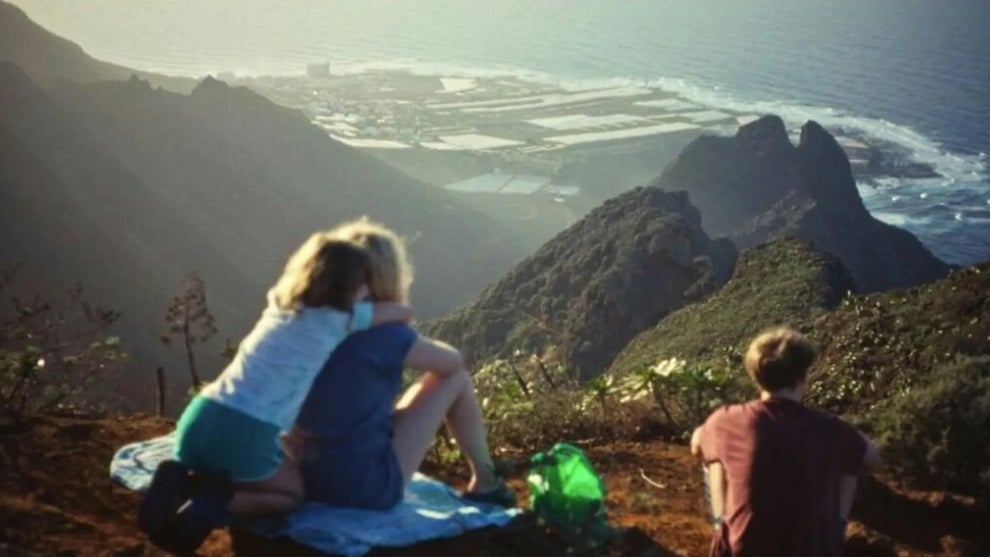
The sequence begins simply enough, with a long, extended shot of a building from far away that slowly draws in closer and closer. It’s incredibly beautiful, but also a perfectly ordinary sight. And yet, the film captures the joy of Jessie (Carla Hüttermann) and her boyfriend Lux (Tristan López) as they look out over the city like it’s the most magical memory one could ever have. This beautiful moment, while feeling like it could move mountains in the eye of the astounding “Aftersun” cinematographer Gregory Oke, is also not to last. In the blink of an eye, the tranquility of this scene falls into terror, as the haunting visual of a figure suddenly falling and being briefly tracked by the camera before disappearing entirely into the trees below rattles you to your core.
It’s a sudden shift that feels both shockingly fast and agonizingly slow, with the moment almost seeming frozen in time just as life will continue after it. But it’s also one that’s captured with a restraint that only makes it that much more devastating. Too many more specifics about what exactly happens in this moment and everything that follows would take away from the enduring impact of the film. However, what can be said is that loss soon hangs over every frame as the story shifts to being about a daughter, Melli (Lotte Keiling), and her mother, Ella (Birgit Minichmayr), as they try to find a way forward together.

Premiering in the Un Certain Regard section at the 2026 Cannes Film Festival, the journey of the duo that the film explores is far from conventionally told. There aren’t really any grand speeches or moments of emotional breakthrough to be easily found here. Instead, the two characters, especially Ella, must find a way to keep waking up each day and going about their lives despite the yawning absence that will now forever define their future.
The focused way Wollner writes and directs this ensures that the drama, much like the one memorable early shot, is restrained, never once feeling exploitative of this grief. Rather, it just frankly shows how it is when you lose someone, immersing us in the details of a life now spent picking up the pieces and holding them as close as you can to your chest. It reveals how, even in moments where nothing in particular could call it to my mind, you can suddenly be overcome with pain. The film authentically captures how not only is this something you can’t stop from happening, but that it can come at even the simplest of moments, shattering the routine the pair has worked so hard to build.
At the same time that there is this immense pain, there are moments of play scattered throughout. Recurring sequences of the young daughter playing a video game (which seems to be Minecraft) or going into the beautiful world outside offer them a greater grace. To say that the 2D world of Minecraft could feel as emotional as the great outdoors sounds silly on paper, but when you see how much Melli is able to get lost in it, Wollner makes it so. Sometimes, these are the only things that hold us together.

Of course, there’s no easy escape in life when dealing with loss, and seeing Ella wrestle with this while also trying to help ensure her daughter can continue to live is deeply affecting. Not only does Minichmayr give a magnificently layered performance that brings to life both a sense of crushing melancholy in one moment and a small sliver of potential hope in another, but Wollner’s astutely observational filmmaking complements her every move.
There is an element where the film then puts itself in direct conversation with the past, potentially even breaking itself free from time and reality as we know it. As seen via Oke’s continually outstanding and textured cinematography, it feels like a look at something both very close to us yet also infinitely far away. Thus, it’s much more heightened and unexpected, meaning it could very well be where the film loses those who were going with the more grounded approach that it had taken until then.
However, this bold move, which plays almost like an echo of the breathtaking recent “Blue Heron” in how that too pulled off a similar narrative upending, only deepens the emotions of the film. It’s not quite as successful as that is, but it still proves hard to shake in its own way. There’s much that is then left unresolved, but what is clear is that Wollner has made not just one of the more intriguing discoveries of the festival, but a delicate depiction of grief that’ll stick with you.
