
Antoine Fuqua’s “Michael” is the latest in a very long line of musical biopics that follow a familiar formula. It is, however, probably the first celebratory musical biopic about an artist who spent the last two decades of his life dodging allegations of child sexual abuse.
If you’re wondering how “Michael” can provide all the nostalgic performances and sappy melodrama you’d get from films like “Walk the Line” and “Bohemian Rhapsody” while failing to acknowledge the elephant in the room, this is “Michael’s” answer: Don’t worry about it.
You won’t hear a word about it in “Michael,” even though many scenes uncomfortably foreshadow the accusations. To hear Fuqua’s film tell it, nothing of interest happened to Michael Jackson in the last 20 years of his life. Weird, huh?
“Michael” exists in a vacuum that obliterates vital context and important people.
(The film also takes place in an alternate universe where Janet Jackson was never born, though she was already a superstar in her own right years before the credits roll in “Michael,” so clearly she should have been around somewhere.)
It prints a legend and edits out everything that detracts or distracts from that legend. And while elements of the production are successful, and accurately recreate the pop superstar’s biggest career triumphs, those elements are in service of such an incomplete narrative that it’s hard to celebrate even the parts that work. (The film reportedly addressed those allegations in a previous cut, but was dramatically reshot and re-edited.)
“Michael” follows the life of Jackson from the earliest performances of The Jackson 5 through the late 1980s. Young Michael, played by Juliano Krue Valdi, experiences the brunt of his father’s psychological and physical abuse, the latter of which mostly happens off-camera. The dramatic arc of this film is about Michael enduring and, after decades, finally extricating himself from the manipulative Joe Jackson, played with soap operatic relish by Colman Domingo. Nia Long plays Katherine Jackson, Michael’s mother, who gets to stand by while awful things happen and then eat ice cream and watch TV with only one of her sons.

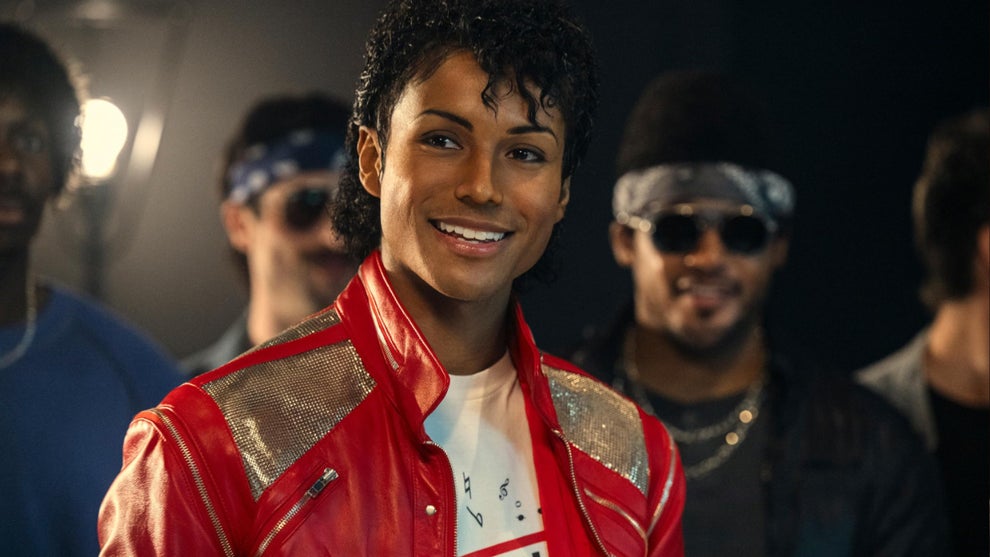
Jaafar Jackson, the singer’s real-life nephew (the son of Jermaine), plays Michael as an adult. It’s an uncanny impersonation. There are moments when the younger Jackson looks and moves and sounds so much like his uncle that it’s like we’re watching a ghost. John Logan’s screenplay depicts Jackson as permanently arrested in a childlike state, surrounded by toys and pets and picture books (especially a copy of “Peter Pan,” which gets more screen time than La Toya).
Jaafar plays this up in every scene, portraying Michael as a tragic figure whose life was ruined by childhood abuse, even as his career was skyrocketing. There’s a lot to unpack there, and if you reach the bottom you’ll find some irony, but “Michael” never digs that deep. (Possibly because of those reshoots, but we can only assess the version that exists, and that version has these problems.)
Antoine Fuqua spends a lot of “Michael” recreating Jackson’s most famous moments, and he seems impatient to get to the good stuff. Watch the singer’s iconic performance on the 1983 television special “Motown 25: Yesterday, Today, Forever” and look at how often Fuqua and his editors, John Ottman and Harry Yoon, cut to Jackson’s feet before he debuts his famous moonwalk. It’s like they know the big moment is coming but forgot which part of the song it’s from, so they keep checking his footwork just to make sure they don’t miss it.
It’s almost suspenseful. That’s how movies like “Michael” work. They’re made for fans who know the No. 1 songs and important performances. We’re waiting for these big moments, and as soon as we see them coming there’s a tiny twinge of excitement. But it’s not actually suspense. Suspense is when you don’t exactly know what’s going to happen. These scenes are like presents you already know you’re getting but got wrapped up anyway; so you go through the motions of tearing the paper, as if maybe it’s not the air fryer you put on your Amazon Wish List. Oh look, it’s the air fryer. That’s nice. It’s just not great drama.
In the panoply of biographical motion pictures, “Michael” occupies a space between “The Babe Ruth Story,” which claimed Babe Ruth cured diseases by hitting homers, and “Back to Black,” which argued that Amy Winehouse’s family and record label were blameless for her ongoing, life-ending substance abuse. Whether it’s by design or legal necessity, “Michael” picks as few battles as possible and backs off almost every time. It’s a film about how great Michael Jackson was and how great you are if you’re still a fan. It can’t be taken seriously, no matter how earnest it looks and sounds. because it’s not really a story. Maybe it used to be before the reshoots. Maybe not. Either way, now it’s just feature-length publicity.
“Michael” steps into theaters on Friday.
