
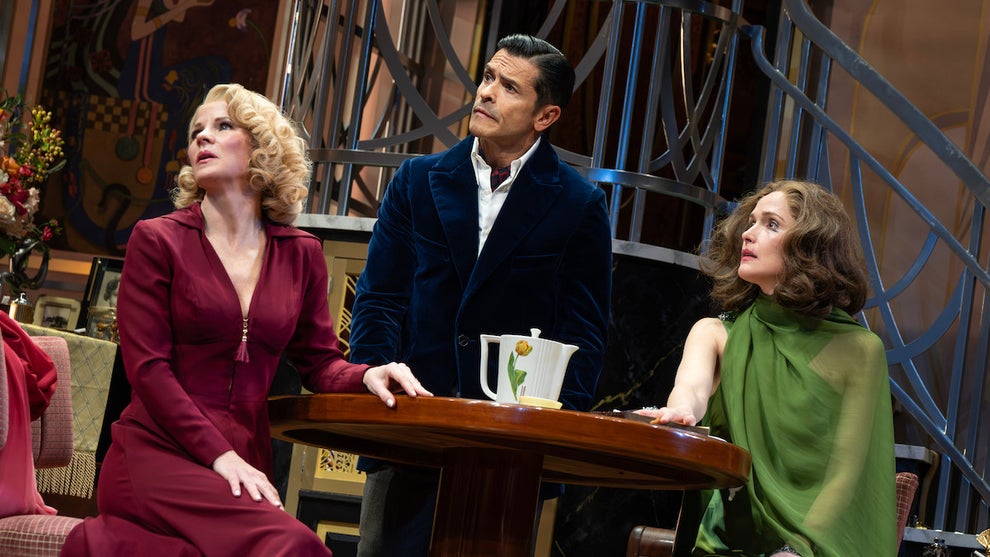
In the Noel Coward oeuvre of rarities, “Fallen Angels” is no “The Vortex.” The latter play was the playwright’s first major success on stage, opening in 1924. It dealt with such then-controversial subjects as drug addiction, female promiscuity and incest. “Fallen Angels” opened a year later, and while Coward recycled the illicit sex theme, he did so with a far lighter touch and with far less success.
OK, the characters of Julia and Jane in “Fallen Angels” aren’t exactly the jaded female roue Florence who beds a lot of younger men to hang on to her own rapidly fading youth in “The Vortex.” Julia and Jane had only one premarital sex affair each before getting married. What made it shocking to the British censors back in 1925 is that both women are pretty frank in talking about it (but not to their respective husbands), and Julia and Jane shared the same French lover simultaneously back in libertine Italy. Equally risqué, they now contemplate rekindling those affairs with that same Gallic stud despite being married to dull Englishmen they like but don’t much love.
“Fallen Angels” opened Sunday at the Roundabout’s Todd Haimes Theatre, and this new production recalls another Broadway revival of a Coward rarity. Back in 1999, “Waiting in the Wings” received its Broadway premiere despite Coward writing it nearly four decades earlier. The comedy, set in a retirement home, finally made it to the New York stage with “revisions” by Jeremy Sams. The new revival of “Fallen Angels,” likewise, has “additional material” by Claudia Shear, who must have also done a lot of editing, since the three-act comedy now runs only 90 minutes without intermission.
The big question: Does anyone ever have to rewrite or revise “Private Lives” or “Present Laughter”?

Even at the very un-Coward-like length of 90 minutes, this production of “Fallen Angels” under the direction of Scott Ellis takes about half an hour to light any real comic fire in what was once the play’s first act. When it finally does ignite, Rose Byrne’s Jane and Kelli O’Hara’s Julia don’t delight by what they say. Instead, they have to get s–t-faced drunk.
How drunk?
Think Lucille Ball in the famous “Vitameatavegamin” episode of “I Love Lucy.” Byrne and O’Hara show themselves to be divinely physical comedians. They take stunning pratfalls, slide down chairs and onto the Oriental carpet, trip over table legs and even crack up over each other’s stumbles onstage. Since they’re having fun, the audience does, too.
Byrne and O’Hara are a good comic team, but not a great one. Unlike Lucille Ball and Vivian Vance, they haven’t decided whose the alpha comic and who’s the beta, and their twin very high-pitched sopranos are too equally matched, making the first 30 minutes something of a screeching match.
The extended drunk scene is basically what’s left of the original second act. Sober, O’Hara and Byrne are far less funny in what’s left of the third act, although the unexpected appearance of Byrne’s much-ratted wig (by David Brian Brown and Victoria Tinsman) – did she or didn’t she spend last night with that French lover? – brings down the house.
Julia and Jane are frank about no longer loving their respective husbands (Christopher Fitzgerald and Aasif Mandvi, both being remarkably restrained). In one of Coward’s defter touches, it’s the two men and the two women who are the real couples here, because they care enough about each other to still engage in fights.
The last 30 minutes of this “Fallen Angels” appear to be about as lackluster as the first 30 when, to the rescue, the French lover makes a surprise visit in the form of Mark Consuelos of “Live! with Kelly and Mark” talk-show fame. The way Coward has written “Fallen Angels” (or Claudia Shear has rewritten it), it’s questionable where the old lover will ever show up. Consuelos appearing at the last minute for his cameo is almost as delightfully tacky as the entire drunk scene.
It isn’t Noel Coward, but it’s a lot of fun.
