
Warning: This article contains spoilers for “Lanterns” Episode 1.
Let’s get the big spoiler out of the way.
Hal Jordan is dead. At least, he seems to be.
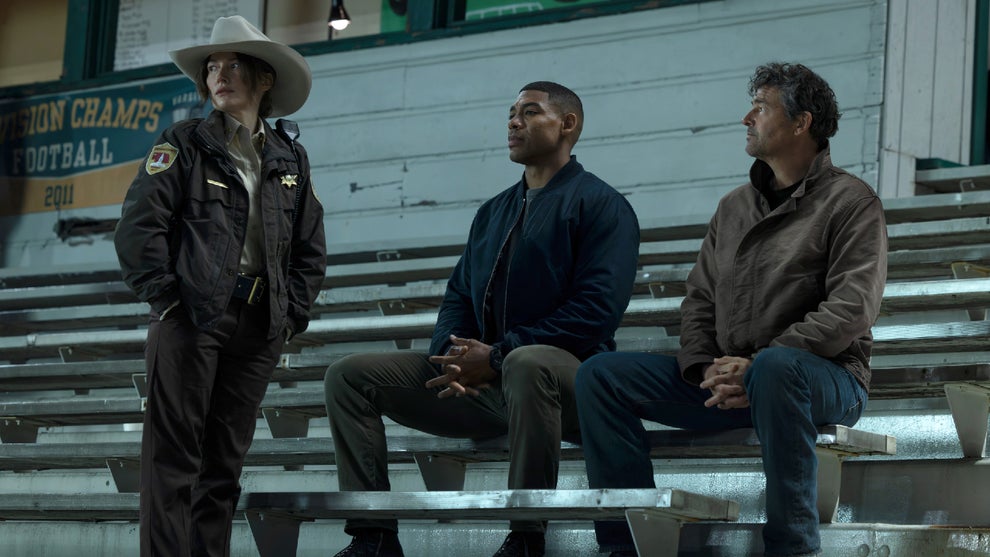
The first episode of “Lanterns” ends with John Stewart (Aaron Pierre) called back to Rushville, Nebraska, by Sheriff Kerry (Kelly Macdonald) a decade after he first visited the town as Hal’s trainee. There, Kerry shows John that Hal (Kyle Chandler) is sitting, dead and ringless, on the bleachers of the football stadium where the trio encountered an intergalactic presence 10 years earlier.

The death of Hal Jordan, right as he was introduced to the DCU, is no doubt going to be a major talking point that looms over the rest of this season. Whether Hal stays dead is anyone’s guess.
But comic book fans will know that Hal Jordan has died before. He also turned evil, destroyed the Green Lantern Corps, saved the world and became a vengeful ghost in an epic decade-spanning DC Comics saga.
Here’s everything you need to know about the death of Hal Jordan in DC Comics.
What happened to Hal Jordan?
It started with the death of Superman.
After Superman was killed at the hands of Doomsday in the iconic early-‘90s storyline, the evil Cyborg Superman emerges and teams up with the villainous Mongul. Together they destroy Coast City — the home of Green Lantern Hal Jordan.
A few months later, writer Ron Marz kicked off his epic Green Lantern story with “Emerald Twilight,” a three-issue story that sees Hal attempt to recreate Coast City and everyone in it (including his father, who died when he was a child) with his ring. The Guardians of the Universe forbid him from doing so, causing Hal to head to Oa.
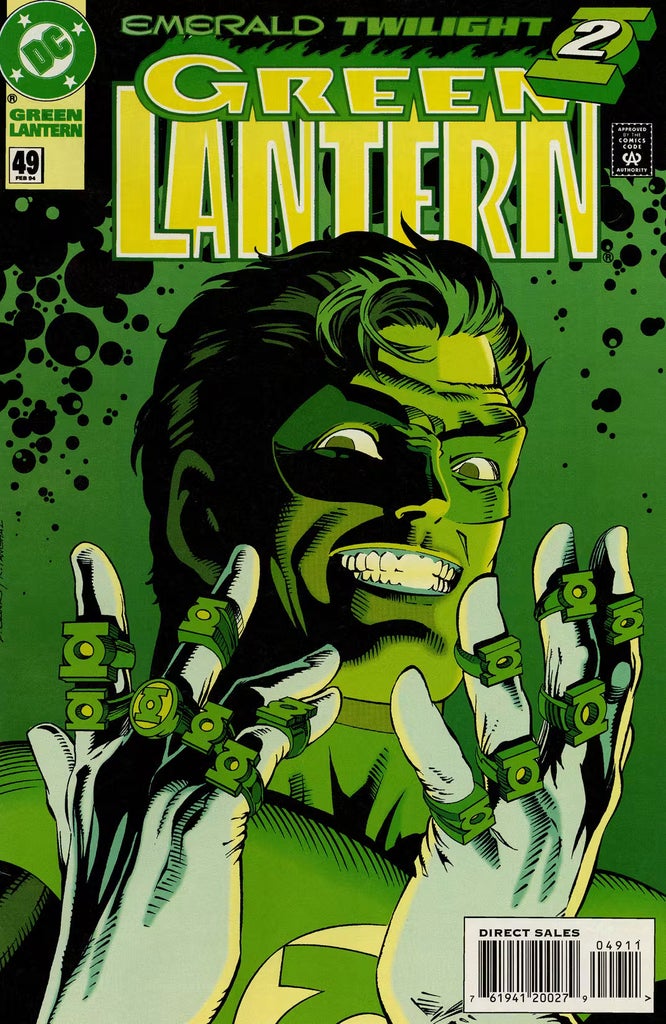
On the way, Hal fights a number of Green Lanterns, stealing their rings (and leading to the iconic cover of “Green Lantern #49” by Darryl Banks, Romeo Tanghal and Anthony Tollin). He then arrives to the Lanterns homeworld, where the Guardians have unleashed the villainous Sinestro. Hal kills both Sinestro and his friend/fellow Lantern Kilowog before taking all of the energy from the Central Power Battery on Oa.
All of the Guardians die except for Ganthet, who goes to Earth and chooses directionless artist Kyle Rayner to be the last remaining Green Lantern — the Torchbearer who wields the final Lantern power ring. Hal, meanwhile, takes on the name Parallax and cements himself as a villain.

What else did Parallax do?
Kyle had a couple of encounters with Parallax in his early days as a Green Lantern. During one confrontation, Hal returns to Earth to take his ring back from Kyle, causing a fight between Parallax and the Justice League. In the end, a depowered Kyle attempts to fight Parallax in a last stand, despite knowing he will easily die. Hal is impressed by this and leaves Kyle with the ring.
Later, Parallax becomes the main villain of the event “Zero Hour: Crisis in Time!” by Dan Jurgens and Jerry Ordway, a book that helped work out some of the kinks in the post-“Crisis on Infinite Earths” continuity changes in the DC universe. In “Zero Hour,” Parallax attempts to turn back the clock and restart the universe so he can undo the destruction of Coast City and the Green Lantern Corps. Parallax is eventually shot in the heart by Hal’s best friend, Green Arrow, though he survives.
How did Hal die?
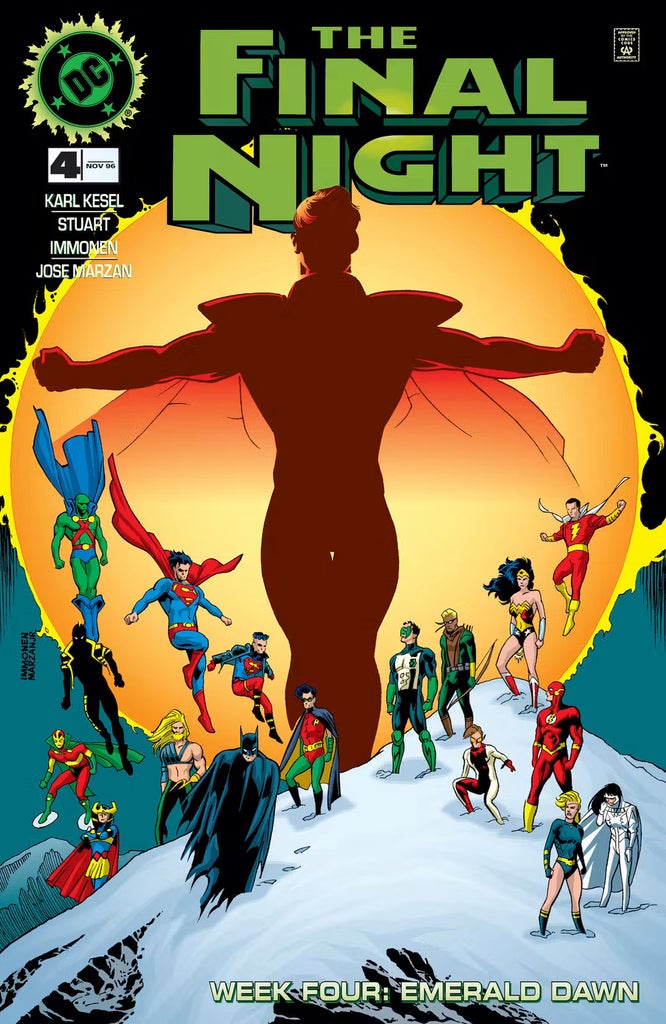
Hal/Parallax eventually died during Karl Kesel and Stuart Immonen’s 1996 event series “The Final Night.” There, a weapon known as a Sun-Eater extinguishes the solar system’s sun, giving Earth’s heroes only five days to figure out how to turn it back on before losing the planet. In the end, Parallax offers to give up his life to destroy the Sun-Eater and reignite the sun, saving the world and partially redeeming himself. Hal Jordan is given a proper memorial, with many of Earth’s heroes showing up to remember his life.
In Geoff Johns and Matthew Dow Smith’s 1999 event “Day of Judgment,” Hal is becomes the new host for the Spectre, a Spirit of Vengeance (or, as Hal puts it, a “Spirit of Redemption”) delivering God’s judgment and divine wrath. This role previously belonged to Jim Corrigan, and Hal would fill it for several years.
How did Hal come back?
Geoff Johns and Ethan Van Sciver’s “Green Lantern: Rebirth” opens with one of the most memorable images in Green Lantern comics: Two bystanders approach a crashed spaceship, and a bloody, wounded Kyle Rayner stumbles out, urging them, “Don’t be afraid.” It is later revealed that Kyle and Ganthet have retrieved the body of Hal Jordan (still dressed as Parallax) and brought it to Earth. Other Lanterns, like John Stewart and Guy Gardner, meanwhile, start going haywire and attacking Earth’s heroes.
Kyle later reveals to Green Arrow that he “found something on the edge of the universe” and learned that Parallax isn’t just a name that Hal took on. Parallax is actually a living entity made of pure fear, capable of destroying whole civilizations by turning them insane. The Guardians kept Parallax a secret and hid it in the Central Power Battery on Oa, where it remained dormant for a lengthy time.

But after the destruction of Coast City, Parallax used its prison to infect Hal through his ring, preying on his fear and negative emotions. In a series of retcons, this explains why Hal turned evil, why Green Lantern rings were ineffective against the color yellow (something that’s no longer true once Parallax escaped) and even why Hal Jordan developed white streaks in his hair (not unlike Kyle Chandler’s salt and pepper look in “Lanterns”).
Sinestro returns from the dead, revealing it was he who awakened Parallax while he was also stored in the Central Power Battery. Apparently, the version of Sinestro Hal “killed” was just a construct of Parallax’s. This paves the way for Sinestro to use the yellow power of fear, and for the whole emotional spectrum of Lanterns, that Johns later introduced to the Green Lantern mythos.
The Spectre and Parallax begin fighting for control over Hal, and the Spectre eventually frees his soul, allowing it to return to the body that Kyle and Ganthet recovered — and thus reviving Hal Jordan the hero for good. Parallax temporarily stores itself in Ganthet, but Hal and his fellow Lanterns eventually free the Guardian, imprison Parallax once again and banish Sinestro to the anti-matter dimension. From there, Hal became the main character of Johns’ lengthy run on “Green Lantern,” essentially resetting his status to the pre-“Emerald Twilight” continuity.
You can read the first issue of “Green Lantern: Rebirth” for free now on DC Universe Infinite.
How does this relate to “Lanterns”?
A lot about Hal Jordan’s death on “Lanterns” remains unclear — like whether or not he’s actually dead at all.
It seems unlikely that a show as grounded as this will be taking on this epic saga — one involving spirits of vengeance and extinguished suns — any time soon. It’s also unclear how long Chandler is committed to playing the character as, unlike Aaron Pierre (who is already confirmed to appear in “Man of Tomorrow” as John Stewart), no future appearances of Hal Jordan are currently lined up. Comic book fans know that death can be a very temporary thing, and the show already establishes that Chandler can play a younger Hal Jordan well in the first episode.
Chandler himself wouldn’t talk much about Hal’s apparent demise at the end of Episode 1. He did, however, say that he was “full-on” after reading the show’s first script.
“I knew also that it was going to be a non-linear story and they were going to be able to shift and move it around, and I just liked it even more. It was one more dynamic to the whole thing that was going to be exciting. What I didn’t know — that was the most exciting part of it,” Chandler told TheWrap. “All I needed to know was what I read, the people in it, their talent level and their respectability in the business, what my manger and agent told me, and my desire to want to go out and have some fun and take a shot at a superhero. But I could tell also by reading it that this was a different project. It was a different type of superhero story, and I think people are going to dig that a lot.”
“Lanterns” airs Sundays on HBO and HBO Max.
