
Note: This story contains spoilers from “Monster: The Lizzie Borden Story.”
It’s best to treat everything claimed in “Monster: The Lizzie Borden Story” with a pile of salt. Netflix’s latest installment of its crime anthology series begins with the assumption that Lizzie Borden really did kill her father and stepmother, a crime that the real Borden was acquitted from in 1893 as well as an unsolved murder case that has haunted America for over a century.
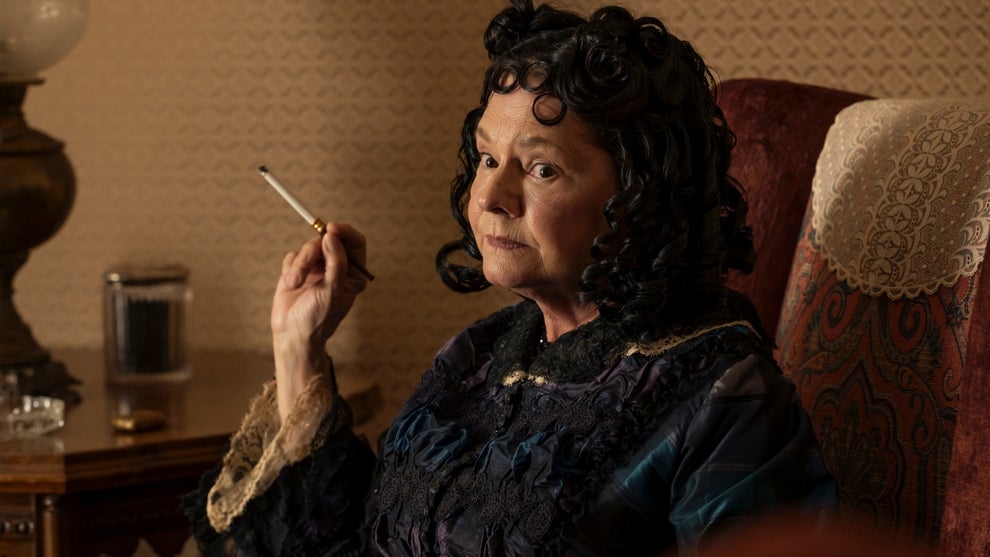
That sense of speculation is especially true of Bertha Manchester, who is played by Linda Reiter in the series. “Monster” claims that Bertha was a family friend and neighbor of Abby Borden (Rebecca Hall) and that she borrowed the Borden family maid for a period of time. In reality, Bertha Manchester’s murder had next to nothing to do with the Borden homicides, though all three deaths took place in Fall River, Mass.
Did Lizzie Borden really kill Bertha Manchester?
No, that was a work of fiction.
“Monster” starts with the premise that Lizzie Borden (Ella Beatty) and the Borden family maid Bridget “Maggie” Sullivan (Vicky Krieps) murdered Lizzie’s father and stepmother. But, before going through with the axe murders, Maggie convinces Lizzie to practice on a neighbor and family friend who has been abusing her, an older woman by the name of Bertha Manchester (Reiter).
Bertha Manchester was a real person, but she was 22 years old, not an older woman. Also, the real Manchester was murdered days before Lizzie Borden’s trial, not days before the murders of Abby and Andrew Borden.

How did Bertha Manchester die?
Six days before Lizzie Borden’s trial, Fall River faced another violent tragedy when 22-year-old Bertha Manchester was hacked to death in her home. Many authors have theorized that Manchester’s murder impacted the Borden jury, but there’s little proof to these claims. In fact, most of the accounts making this connection were published decades after the Borden and Manchester homicides.
For one, there was no way Borden could have killed Manchester as she was imprisoned during the time of Manchester’s death. Manchester’s murder was also unlike the Borden homicides; though all the murders involved an axe or a hatchet, Manchester was a young woman, a target that is very different than a middle-aged couple. Also, during the 1890s, it wasn’t unusual for households to have several axes or hatchets, tools that were essential to household chores like chopping wood. That means the murder weapons used in all three murders wasn’t as eyebrow raising then as it would be today. Manchester lived in a remote farming area, which was different than the urban-dwelling Bordens, and she was killed while she was home alone, not while she was in the presence of other people in her household.
The day before the Borden trial started, Jose Correiro, a Portuguese laborer who worked at the Manchester farm for a brief period of time, was arrested for Bertha Manchester’s murder. The citizens of Fall River would have likely known about all of these differences as well as Borden’s incarceration ahead of her trial. So while Manchester’s murder may have spooked the town, there’s little evidence to suggest it impacted Lizzie Borden’s trial.
“Monster: The Lizzie Borden Story” is now streaming on Netflix.
