Last week at Doc NYC, Brandon Kapelow debuted his feature documentary “Under Fire” to a sold-out crowd. Now, he’s hoping to continue the conversation around psychedelic treatments for first responders — and how all of us in society can do our part to better help the people who keep us safe.
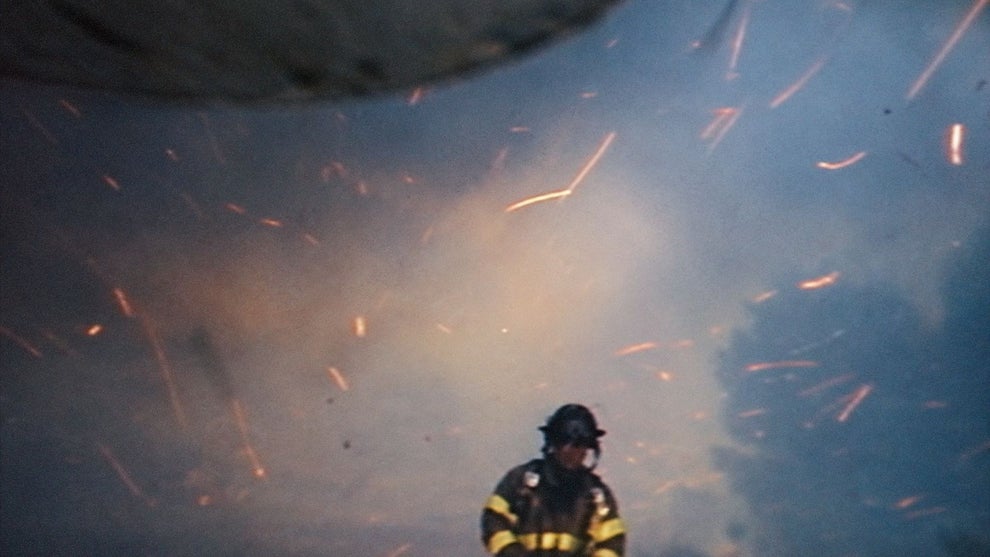
“Fire Capt. Rob Christensen has spent decades saving lives, fighting blazes and losing colleagues as he valiantly serves his Idaho community. Under immense mental strain, he undergoes experimental ketamine-assisted therapy to treat his post-traumatic stress disorder, assuage his spirit and connect with his teenage daughter,” per the festival logline. “A cinematic portrait of a man seeking to live with his trauma, ‘Under Fire’ is disarmingly vulnerable as it takes audiences inside sessions with Christensen, at the frontier of psychedelic therapy.”
“There was a world in which we had originally considered maybe addressing a lot of different psychedelic compounds, like doing a multi-character film that explored ketamine and psilocybin and LSD and trying to showcase a lot of different use cases,” Kapelow told TheWrap. “After getting into it with Rob’s story and the more that I learned about him, the more that I learned about first responders and the unique nuances of that population, the more I learned about ketamine … the more that I dug into it, the more I felt like there was something there that could be explored in its own standalone feature.”
The film was inspired by Kapelow’s 2024 New York Times op-doc “An Act of Service,” with the filmmaker serving as director, producer and cinematographer on this full-length project. However, he also has his own personal connection to the PTSD themes throughout the piece.
“I am a suicide loss survivor. I lost my dad to suicide when I was 12 years old, and I’ve basically been engaged in the topic of mental health ever since then. I started volunteering with the American Foundation for Suicide Prevention and was involved in that space in more of a volunteer capacity up until about COVID,” Kapelow shared. “Around that time, I was, like many people, doing a lot of soul-searching as to what I wanted to be doing with my time. I was encouraged to pursue mental health topics as a focus of my visual output in media, because I was working independently as a filmmaker before that, so I started doing some research.”

“I’m from Wyoming originally, and I learned that all the highest suicide rates in the United States are all in the Mountain West, where I grew up — and it’s basically been that way for 200 years. I got really curious as to why that was the case, so I started looking into it and exploring the different demographics that comprise that issue, and that’s become the real focus of my work,” he continued. “Right around 2021, psychedelics really were coming back into the zeitgeist in a major way and I was reading about the efficacy that they were claiming for some of these treatments. It was just very interesting to me, because it addressed a lot of the things that I was seeing day-to-day in the peer support that I was doing.”
“It seemed like a very encouraging, breakthrough type of treatment. I saw a lot of films that had been made up until that point, but I felt that there was space to do things a little bit differently and explore that topic in a way that kind of dispelled a lot of the misconceptions around it,” Kapelow further noted. “I also was struck by the fact that the American West, where we have these really negative mental health outcomes, have some of the most conservative views on psychedelics; the most reticence to accept these treatments. So there was this gap that needed to be addressed … we had done some conversations with clinics in the Bay Area and some other places, and it just kind of felt like people in California don’t need more convincing about psychedelics, but people in my part of the country very much do.”
However, first responders in California still need support too, as exemplified by the 2025 Los Angeles wildfires.
“I’m also a part-time Angeleno, so I was there during the wildfires and very much lived through that experience. We were still working on the film at the time, so it did shape my thinking in the sense that this is a really widespread issue,” Kapelow recalled. “As much as I wanted to focus on the nuances of the Mountain West, I do think that this is a very universal story. One of the major themes that emerged for us is the idea of: Who takes care of the people who take care of us? That can apply to firefighters, police officers, paramedics; it can also apply to frontline medical workers and teachers. There are so many populations that are community-minded and serve us, and we can be doing a lot more to support them.”
So how has the stigma surrounding psychedelics and mental health changed since “Under Fire” first started shooting?
“Rob, the main participant in our film, he talks about how when he first was addressing his own mental health that he was so afraid of being seen by his peers if there was a bumper sticker of a firefighter in the parking lot at his therapist’s office,” Kapelow recalled. “Now, he’s not only the participant, but after having gone through the process of making the film, he decided to write a book and then go on a speaking tour with firehouses and conferences for first responder mental health. He’s still approaching retirement, and a big challenge for him has been: How do I maintain this community service mindset after I leave my role as a firefighter? So he’s decided to make his focus on mental health and I’d say that’s not just unique to him.”
“We’ve spoken with a lot of other people within his community that have decided to take up this cause and be more willing to be vulnerable in public and open up these conversations and try to reduce that stigma,” he added. “I think the general population moving more towards embracing alternative therapies is a heartening sign. One of the statistics that I talk about a lot in my work is that we have more people going to therapy, we have more people willing to have these conversations out loud. But unfortunately, a lot of the outcome is still trending in a negative direction. There’s still a long way to go, which is why it’s important for us to tell these stories.”
Executive producers on the 88-minute doc include Riley Keough, Clay Tweel, Sacha Ben Harroche, Gina Gammell, Shannon E. Riggs, Reef Oldberg, Andrew Hutcheson, David Terry Fine, Ronald Richardson and Emily Richardson, with Laurel Thomson also producing alongside Kapelow.
“My hope is that the film itself is not overtly advocating on behalf of a certain solution, but that it’s creating a platform to then have these conversations,” he explained. “I do feel that something that we all can do is just have more empathy for the experiences of first responders and the folks who take care of us, and that can extend to the realm of policy decisions.”
“For a lot of people, unless they are personally affected by a topic or have a direct connection to somebody who is directly impacted, we don’t have the same capacity to be open-minded or to be considerate of new ideas. Part of the idea of making this film was to create that vehicle for direct empathy with somebody who is going through this lived experience; to serve as a proxy,” Kapelow concluded. “You may not have a friend who’s a firefighter, but hopefully after watching this film, you get a little bit of a sense of what they go through.”
Virtual tickets for “Under Fire” are available for online screening with Doc NYC through Nov. 29.
