
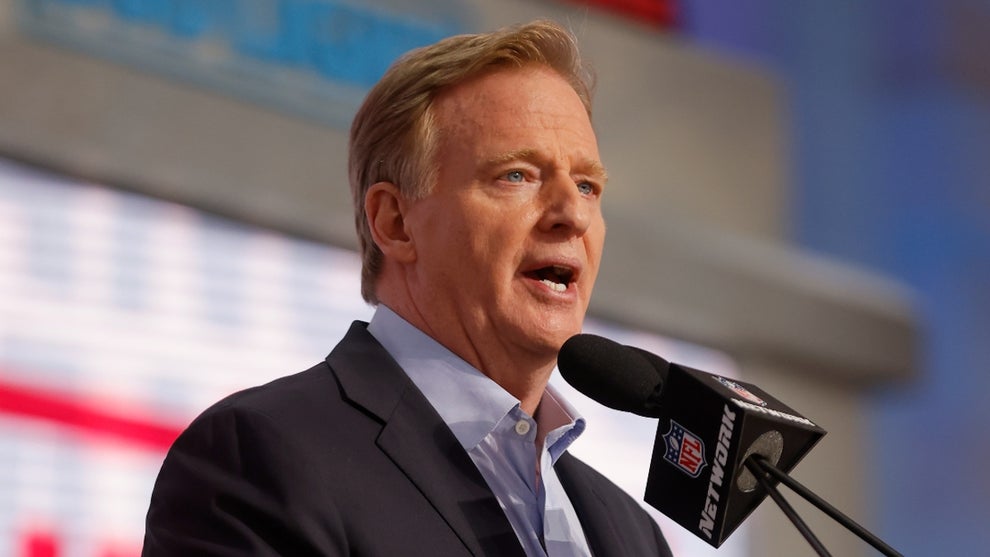
NFL Commissioner Roger Goodell has declined an invitation to testify before the House Judiciary Committee next week on its media rights deals, distribution strategy and the Sports Broadcasting Act of 1961.
In a letter to committee chairman Jim Jordan, the NFL’s general counsel Ted Ullyot said that it has developed the “most fan-friendly media distribution model of all sports at any level” in part due to the SBA.
“While the media landscape has evolved multiple times since 1961, maximizing reach and accessibility for our fans has remained our North Star for all NFL media deals,” he wrote. “As has been the case for many years, approximately 87 percent of all NFL games are primarily distributed via free over-the-air broadcast, and all NFL games (100 percent) are available free over-the-air in the competing teams’ home markets. This distribution approach has remained consistent over time as for decades we have continued to rely on free, over-the-air broadcast television as the primary source to watch the vast majority of our games.”

Ullyot added that the NFL has adjusted its approach as viewing habits have changed and technology has presented ew ways to distribute video content, but argued it has not come at the expense of its dedication to broadcast television.
From 2022 through 2026, the NFL notes that broadcast distribution has remained basically flat (87.3% to 87.0%), while streaming distribution has slightly risen and cable distribution has slightly dropped. Over that same period, cable TV distribution has eroded, while streaming offers the ability to reach tens of millions more viewers,”
“The takeaway is clear: The NFL’s decision to license a few more games to widely adopted streaming services is simply a reflection that those platforms now offer significantly more reach than the current pay TV ecosystem and that broadcast television remains the foundation of our media distribution,” Ullyot continued. “As media consumption habits change, both the NFL and our broadcast partners look to make our content available to as many fans as possible. That is why the broadcasters themselves require games on their broadcast. We believe this model is not only faithful to the letter and spirit of the SBA but also working quite well for our fans – as evidenced by the 2025 NFL season being the highest viewed season since 1989.”
In addition to defending its distribution strategy, the NFL said that the Sports Broadcasting Act is “foundational to creating a successful and competitive league.”
“This model permits small and large market teams to compete every
year on a level playing field for a Super Bowl. If the league were not to handle media distribution as it has since the passage of the SBA, the result would be to harm NFL fans through increased cost and confusion and the undermining of the competitive balance that makes NFL games so exciting,” Ullyot argued. “By contrast, under the current SBA-driven model, this past season saw the second-highest viewership in the NFL’s history. Fans continue to embrace how our games are offered.”
Ullyot concluded the letter by noting that it has been working with Jordan’s staff to answer questions presented to the league and offered to brief members of the House Judiciary committee on any additional questions they may have. He added that due to “ongoing litigation related to the topic of the hearing,” Goodell would not be able to participate.
“We appreciate your invitation, and we look forward to continuing to work with the Committee,” he said.

The fresh scrutiny from Congress comes as the Department of Justice and Federal Communications Commission are investigating the league’s practices and media rights strategy and how sports’ shift to streaming is impacting consumers. As such, NFL execs met with FCC officials on April 17 to discuss distribution approach for live games and how it benefits both fans and local broadcasters.
In addition to declining the invite to testify, the NFL shared a separate letter from members of Congress who expressed concern that proposed changes or a repeal of the SBA would create “unnecessary uncertainty and confusion for NFL fans and consumers.”
The group also urged the House Judiciary committee to “preserve the SBA’s core protections while maintaining appropriate oversight to ensure that the law is applied consistent with its intent to keep America’s Game thriving.”

The NFL has an opt-out clause in its current media rights agreements that can be exercised starting after the 2029-30 season, but could potentially reopen negotiations as early as this year.
The league’s current partners include Disney/ESPN, Comcast/NBCUniversal, Paramount/CBS, Amazon and Fox. It also has separate deals with YouTube for the NFL Sunday Ticket and Netflix for Christmas Day games.
The NFL and CBS are currently in renewal talks. Paramount CEO David Ellison declined to comment on specific negotiations, but previously told CNBC that Paramount has “planned accordingly” in the event of a potential increase in the overall cost of the NFL by as much as 50%.
Per an NFL presentation to the FCC, Amazon’s Thursday Night Football saw a 16% year over year ratings increase to 15.4 million average viewers in 2025. Meanwhile, CBS’s Sunday package grew 11% to 21.3 million average viewers, Fox’s Sunday package grew 6% to 19.6 million viewers, NBC’s Sunday Night Football grew 11% to 23.5 million viewers, ESPN’s Monday Night Football grew 13% to 16.5 million viewers and the NFL Network grew o.1% to 7.6 million viewers.
The House Judiciary’s hearing, which will examine the SBA and its effect on the modern broadcast market for major sports leagues, will take place on June 10 at 10 a.m. ET.
