So many things can go wrong when shooting a massive world-building television show, but the production designer’s sudden bout of appendicitis the first week of filming is pretty high on the disaster scale.
That’s what happened to Martha Sparrow, who had returned to the “Handmaid’s Tale” franchise for its spin-off, “The Testaments,” after winning three Emmys for the original series in 2018 and 2019. As they worked on a look that felt like part of the “Handmaid’s” universe but also allowed the new show to be its own entity, the production was running behind.
“I was already anxious,” she said. “I had to keep saying, like, ‘Help! We need to decide these things!’”
Then Sparrow got so ill that she had to go to the hospital, where she was told that her appendix might burst. “I didn’t let them operate,” she said. “I told them to give me antibiotics and I went home.”
Post-recovery, she headed back to the world of Margaret Atwood after four years of pursuing projects including “Fargo,” “Poker Face” and “Shining Girls.” “The Testaments” centers on Agnes (Chase Infiniti), the kidnapped daughter of the first show’s main rabble-rouser, June (Elisabeth Moss), and largely takes place at a school where the young women of Gilead are groomed to marry the ruling Commanders and save the human race through their precious fertility.

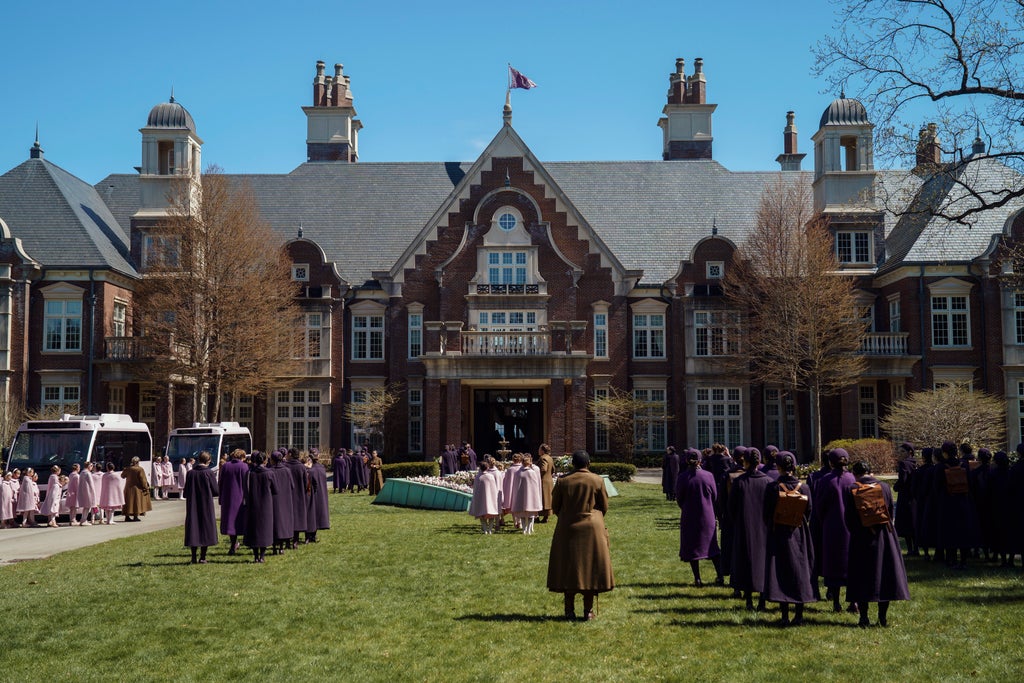
Her aesthetic idea, she said, was to make the series look pastoral and deceptively warm. Her inspiration was fascist architecture from right after World War II — a time of optimism, lumbering toward modernism while falling back toward religious conservatism and traditionalism. (Think: a lot of gorgeous Italian marble.) As for the modernism, she insisted on school buses with flat fronts so they at least looked electric.
“The backstory is that the fertility crisis is caused by chemicals, and so Gilead is very environmentally conscious, so all their vehicles are electric,” she explained.
While in “Handmaid’s” everything felt sterile and confining because the story was told from the perspective of June, who was very aware she was a captive, “The Testaments” begins from the POV of Agnes, a child of Gilead who’s treated like a jewel who may grow into a rare fertile woman.
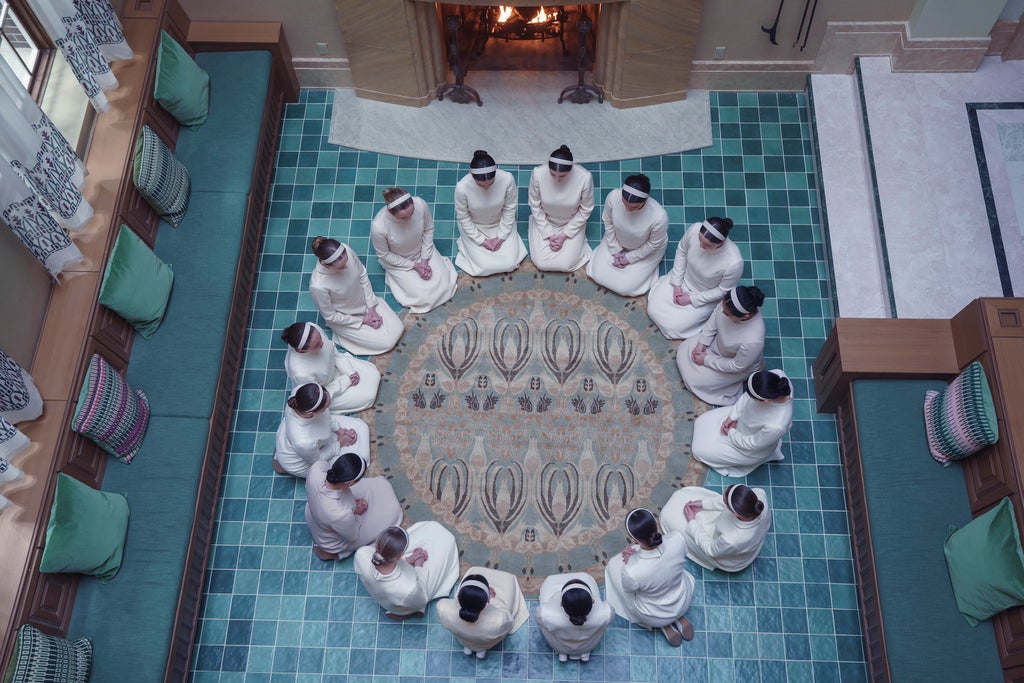
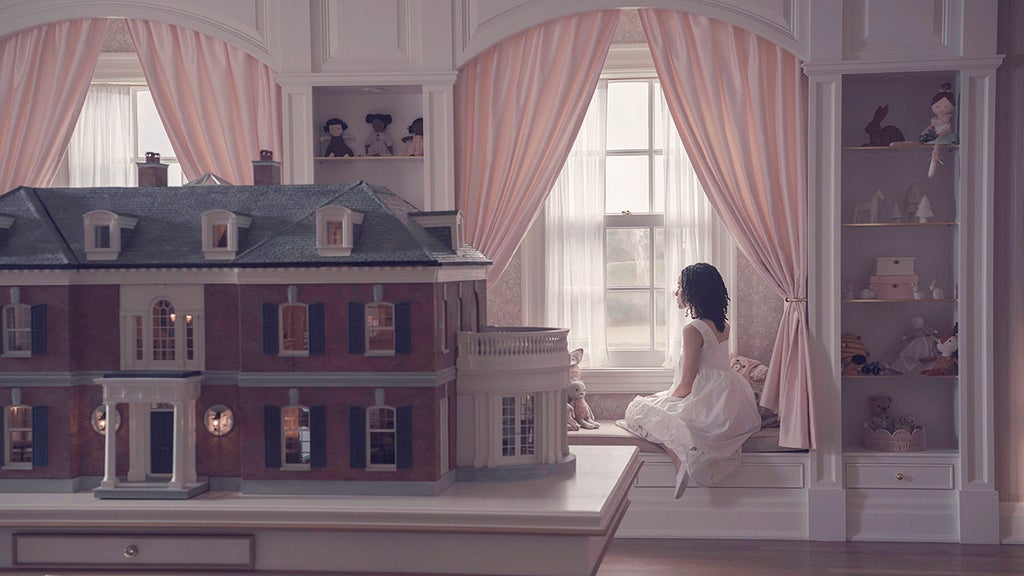
“From her perspective as a child, everything feels very beautiful,” Sparrow said. “We wanted to bring in a sense of enchantment, starting with her bedroom: a lot of saturated color and sunlight. We wanted it to feel like she has all the freedom that she wants, even though, as we go through the story, we reveal that she doesn’t.”
While the exterior of the school where most of the action takes place was shot on location at a private estate in Ontario, the interior was all Sparrow’s team — and the double-height ceiling is her pièce de résistance.

“I don’t think I’ll ever be able to design something like that again,” she said. “I wanted it to be a kind of aspirational and beautiful space.“ To get there, she had to put herself in the minds of Gilead’s leadership: “What would the image they want to project be? And what would be the school that they want to put their most precious daughters into?”
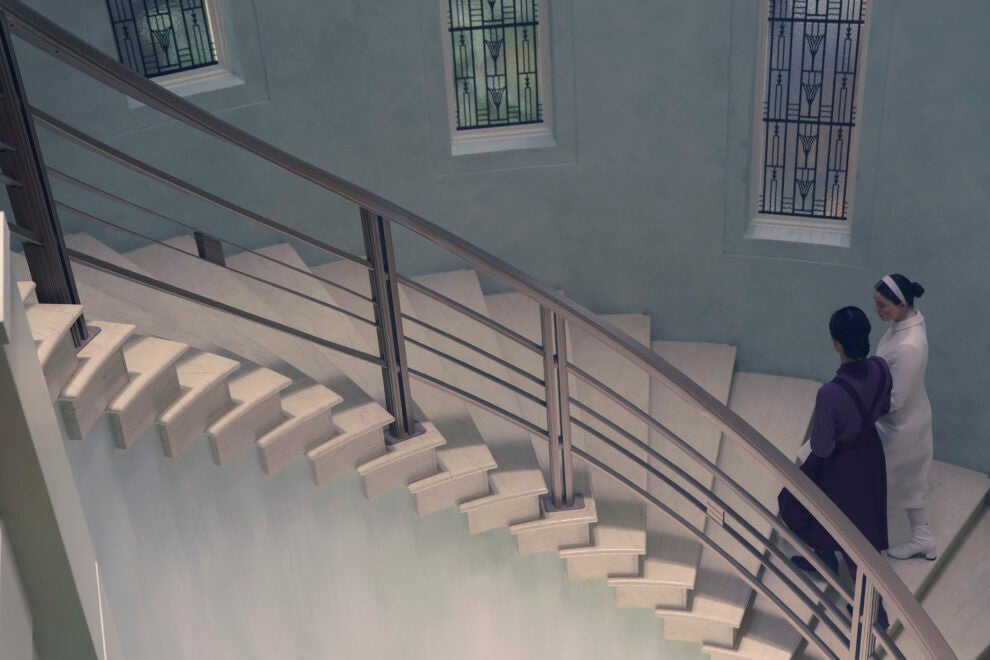
The set was intentionally oversized so that the actresses, who are in their 20s but playing teenagers, would seem small. Sparrow designed the grand dining hall with a debutante-style ball from Episode 5 in mind, giving it a mezzanine on which the Commanders could stand, “looking at the girls as if they’re at a cattle auction.” It turned into a focal point of the series, where the girls fight or race up and down a glorious curved staircase that Sparrow covered with marble she designed and 3D-printed herself.
The sets include a lot of green, the aspirational color worn by the sacred fertile young women who have gotten their period. Capturing the many colors of “The Testaments” required extensive cooperation with the show’s cinematographers and extends the look of “Handmaid’s,” in which the hue of a woman’s clothes signifies her class: teal for Wives, red for Handmaids, brown for Aunts, gray for Econowives…
The look of the final episode was driven by Sparrow’s concept of this world as a beautiful lie. The action involves a hanging, a wedding and a Commander’s promotion — but Sparrow reasoned that the hanging would be quite everyday (“I’ve designed a lot of gallows!”), the wedding would be casual and hurried and the promotion would be the big to-do.
“It’s a really beautiful space where a Commander is being promoted, and then they say, ‘Okay, you’re a Commander now. Take this wife,’” she said. “It’s not about romance, and it’s not about the big day, and it’s not about the bride at all.” Sparrow’s sunny inspiration? Lars von Trier’s “Dancer in the Dark,” starring Björk as a woman who’s slowly going blind. “I was thinking of that film,” Sparrow said, “and how, at the end, she’s counting down to her death.”
This story first ran in the Drama Series issue of TheWrap’s awards magazine. Read more from the issue here.