


- AI is a tool, not a replacement for human experience or creativity
- As AI-related job insecurity persists, some creators have embraced the technology in an attempt to get ahead of the curve
- The best way to beat criticism about using AI is to tell good stories
- Filmmakers and creatives have already started using AI in their pitches to Hollywood execs
The worlds of artificial intelligence and creators collided on Tuesday at TheWrap and What’s Trending’s inaugural AI Creator Day, with executives, creators and entrepreneurs converging to tackle both hot-button topics.
Filmmakers and creators embraced the technology wholeheartedly onstage at the Freud Theater at UCLA. Whether it was a sponge stop motion short or a trailer for a full-length, AI-generated sci-fi series, the audience at the conference was enamored with the capabilities of the technology, a response that stands in contrast to the public and Hollywood’s trepidation with the technology. In addition to long-standing concerns that AI will lead to a flurry of layoffs, posts from AI leaders and departing employees have added an extra element of dread.
It’s with that backdrop that executives from Adobe, Fox, IAB and UTA, among others, broke down how they integrate AI into their workflows and how they handle the pushback from consumers and oftentimes employees. Other panelists discussed the legal ramifications of the technology and how increased regulation could lead to more freedom with AI use.

The event took place one day ahead of TheGrill, TheWrap’s flagship business conference exploring the future of entertainment, media and technology.
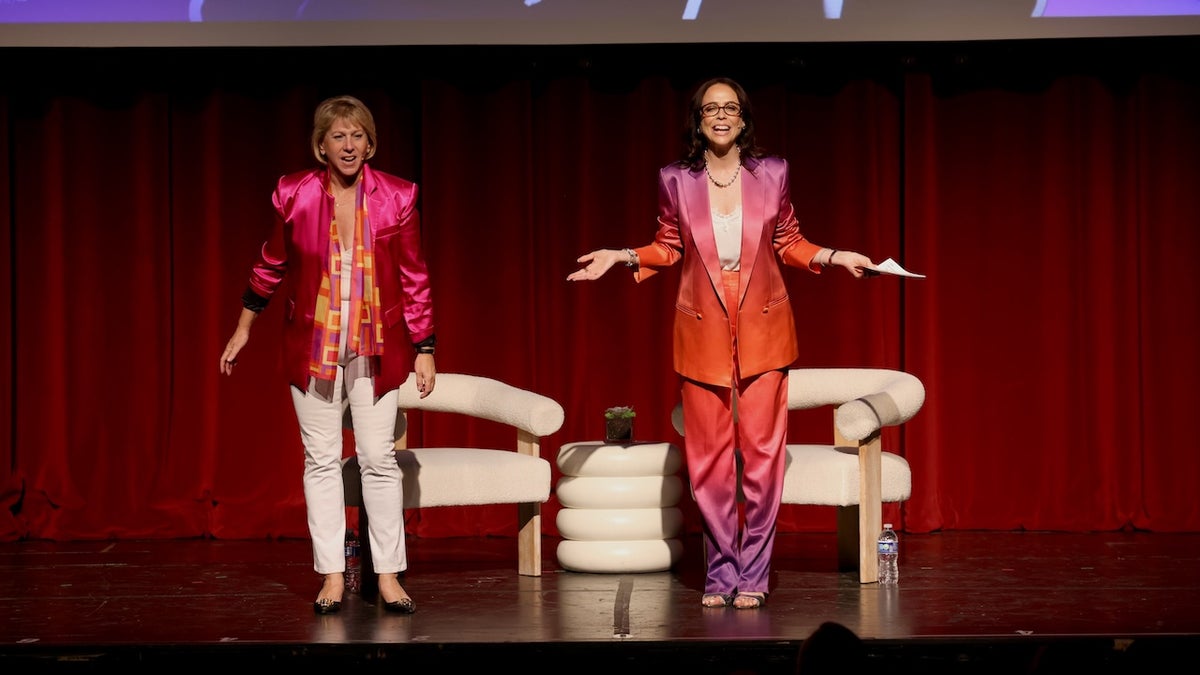
TheWrap’s CEO and editor-in-chief Sharon Waxman shouted out the creators in the room as the next generation for the entertainment industry, celebrating their self-starter nature. Waxman encouraged the audience to participate in the day’s activities, which included active Q&As throughout the event’s panels.
“A reminder: this conference isn’t an AI conference about creators. It’s a creator conference about AI,” What’s Trending CEO and founder Shira Lazar clarified before kicking off the inaugural AI Creator Day full of conversations, workshops and product demos exploring the future of AI and the creator economy.
Keep reading for a breakdown of everything from AI Creator Day:
AI’s State of the Union
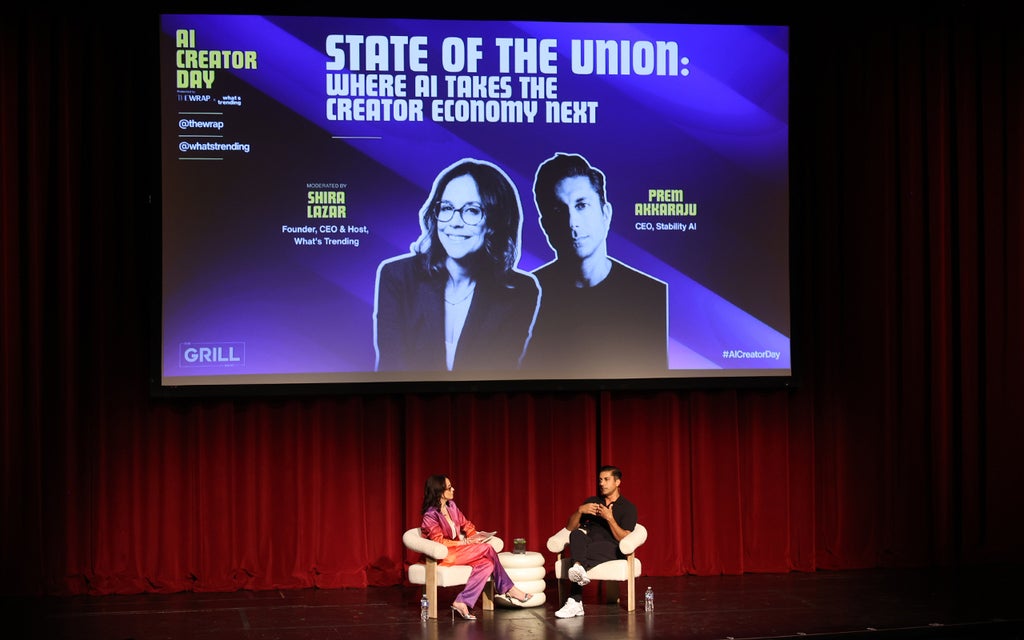
Stability AI CEO Prem Akkaraju unpacked how his AI company specifically works as a partner to the entertainment and creator industries — a marked contrast with other Silicon Valley-based tech giants. He argued that his platform was the “coding model for entertainment.”
Akkaraju noted that the best return on AI investment is with coders because they understand the technology so intimately. The executive said that his company Stability approaches their partnership with creators the same way.
“I find it incomprehensible to create creative tools with actual creators,” he said.
Lazar asked the executive about his partnerships with Sony, Universal and Warner as many music companies have been against AI integration.
“We’re very lucky that we got in early and we came and presented the right type of content, a fully licensed, fully ethical model that we trained from our audio … model from day one,” he said.
The executive also stated that the difference between his company and others is that he places creators at the center of the technology rather than the AI itself, adapting to the creators’ process. Looking ahead toward the next year, Akkaraju said that he expects Stability’s audio platform to become integrated into existing workflows for musicians, filmmakers and creators.
“Our audio platform will be an essential piece of making music and audio for just about every dimensional content piece, whether that be a video game, film too, social media content,” he said.

Who Decides What’s Human?
Executives from IAB, Adobe and 11:11 Media discussed where they draw the line on AI’s role in their workflows.
Karen Robinson, Adobe Inc.’s SVP & deputy general counsel, compared the stigma around AI-assisted and AI-generated content to that of Photoshop in the early days. She argued that simply using tools, such as Adobe’s Lightroom, should not result in a user’s content being labeled as “AI Generated.”
In exploring the dark side of AI, head of impact at 11:11 Media Rebecca Grone shared that she works with Paris Hilton on a series called “Searching for Mr. Deepfake.” The series specifically took down sexually explicit deepfakes of the celebrity.
“We’ve been able to identify with our partner over 105,000 sexually explicit deepfakes on the internet. In the past year and a half, we’ve been able to take down 62,000 of those images,” she said. “That still means that there’s 40,000 and growing every single day that are out in the ether.”
Her team also works in tandem with Hilton on passing The Defiance Act, which gives victims the right to sue the creators or distributors of the image in civil courts, giving them access to potential damages up to $250,000.
James Douglas, IAB’s vice president of experience center, shared that from the brand and agency side AI is most effective when companies disclose the use of AI in their content.
“We certainly believe that the role of slop is not in advertising,” Douglas said.
Creator AI Workshops
Throughout the program, filmmakers Verena Puhm, Chris Capel, and Jagger Waters took the stage to share their AI short films and pull back the curtain on how they brought their visions to life. From “Nobody Dies on Mars,” “Merman,” and “Cinema West,” attendees got a behind-the-scenes look at the creative process and the AI tools and workflows that made each film possible.
Nik Kleverov, co-founder and chief creative officer of Native Foreign, took attendees inside the evolving world of AI-powered storytelling, exploring how brands and Hollywood are using AI to transform everything from creative development and production workflows to the business models shaping the future of entertainment.
Dorothy Pang, a creative director and AI filmmaker, walked audiences through a demonstration of AI tools provided by CapCut.
What It Actually Takes to Make an AI Series
Simone Ferretti and Darin Stewart discussed how they made their AI series “The Arc.” The executive producer and director, respectively, screened part of their series for the attendees of AI Creator Day.
Their collaboration began after Stewart contacted the creator, and Artlist approved three series with the first episode due on a tight timeline of just three and a half weeks. The content creators discussed the pressure of delivering episodes every two weeks, despite coming from traditional production backgrounds.
“Darren normally takes two weeks to develop a treatment minimum, but we usually need a week for post-production, color, sound effects,” Ferretti said. “But after a little arm twisting and convincing, eventually we all agreed to jump all in and be ready to deliver every episode.”
They taught the audience how they used AI image tools for characters, locations, and development, and embraced script changes during production, specifically with Artlist’s AI toolkit.
The Agent’s Playbook: Building the Creator Business
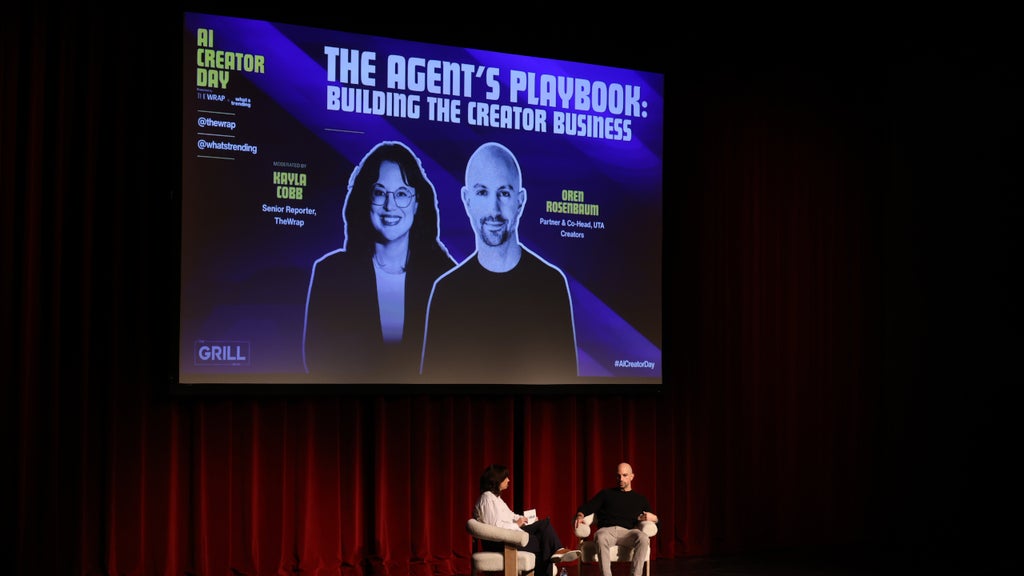
UTA’s co-head of the creator division Oren Rosenbaum got candid about the creator economy and some of the early misfires that led to its eventual success.
“The beauty of UTA and our group, specifically, is we have 20 years of experience, and what I mean by that is you f–ked up so much s–t early on,” he said.
His biggest takeaway was that the creator economy and his approach to UTA’s client roster, including Alix Earle, Jake Shane, Mel Robbins, Markiplier and more, is never one size fits all.
He noted that his and UTA’s agents approach creator deals, not just from a monetary interest but by matching the creator with the brand that is the best fit.
“We don’t look at it as just like, ‘Let’s get paid.’” he said. “I wish I could say this is about our competitors – I don’t think we have any.”
As for the growing relationship between creator and legacy media, Rosenbaum said there is much more trust in creators than ever before. UTA has several creators on its roster whose podcasts now stream on Netflix, including “Therapuss with Jake Shane,” Stephanie Soo’s true crime show “The Rotten Files” and an “Untitled Harlan Coben Podcast.” Rosenbaum stated that his team reached out to Netflix and other streamers years ago to discuss licensing content.
TheWrap’s Kayla Cobb asked how the podcasts were performing, and the agent did not reveal specific details but said that some are “doing incredibly,” even outpacing YouTube viewership – adding that it depended on the podcast. He also said that Netflix made the specific decision to invest in creator and podcasting content in the sports, true crime and pop culture buckets.
Rewriting the Studio Model: Upskilling Talent for an AI-Powered Future
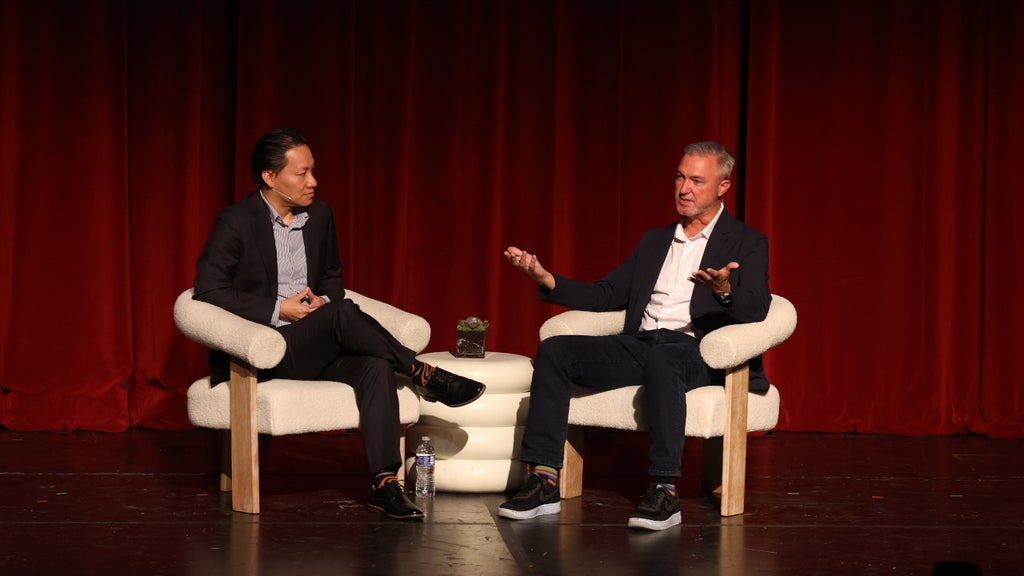
Though there has been a great deal of chatter about how AI may change the future of Hollywood, according to Jon Flynn, the executive vice president and head of FoxNXT for Fox Entertainment, the technology is already changing it. During a panel moderated by TheWrap’s Managing Editor for Business and PRO Roger Cheng, Flynn revealed that at least one creative has incorporated using AI tools into their feature pitch.
“I’ve never seen anybody do this. They did five different meetings, all in one feature meeting,” Flynn said during Tuesday’s panel. “They said, ‘This is the typical budget for what we want to make our feature, but we want to use these [AI] tools, which we think is going to rationalize about 15% of the budget, which we would like to put back in because we do want to go to these two locations … We think we found a way not to break that budget that we’re putting in front of you as a proposal.’”
Flynn noted that, while the average cost savings from AI tools is typically reported as being 20%, the real savings from using these tools come down to reallocating time. Those cost savings can then be reinvested into a project, such as adding in an explosion using AI for a fraction of the cost the effect typically takes and using that saved money on a more expensive location shoot. Flynn emphasized that educating the next generation of filmmakers about the AI tools studios are currently using is a “big responsibility” that Hollywood as a whole needs to undertake.
And that the real value of creative talent — the experience — can’t easily be replaced.
“We can teach you those tools, but I cannot teach you 20 years of industry experience,” Flynn said. “When we make content, there’s still a showrunner that runs the show. There’s still a director that directs the show. The editor still cuts. AI is simply a tool in a fast toolkit that is ever changing.”

The OGs: YouTube’s First Wave Takes on AI
Two decades after YouTube first launched, some O.G. creators like DeStorm Power are embracing AI and how it can bring their content to the next level. But for the entrepreneur, creator and innovator, evolving is necessary to stay in the conversation, with Power noting “a lot of people don’t change with the times … you don’t really hear from them anymore.”
Of course, embracing AI can come with increased scrutiny, with the conversation, moderated by Lazar, pointing to the controversy surrounding science YouTuber Hank Green over his use of AI. “When you know you’re doing right, everybody’s hating … that’s because people wouldn’t hate it if they didn’t fear it,” Power said. “They’re afraid of it because they don’t understand it, and that’s the same thing that happened with YouTube.”
“The game is changing,” Pickford head of creative Bernie Su whose series “The Lizzie Bennet Diaries” won YouTube’s first Emmy. “What tickles my imagination is … how does the art form change? How can I get the audience to be in it?”
The Creative Possibilities of AI Tools for Creators
Curious Refuge co-founder Caleb Ward gave the audience a rundown on AI tools creators can use to assist with their workflows, from recording meetings with an AI notetaker to using a Claude bot to review comments on posts and synthesize newsletters to using a bot to organize files from a content shoot.

From AI Tools to Audience Hits: Building What’s Next
While some traditional entertainment companies might be wary of embracing AI films or creator-based content, pocket.watch founder and CEO Chris M. Williams reminds skeptics, “if it works on YouTube, it will work everywhere.”
“Stars, characters, IP content on YouTube that is competing with 20 million videos a day … if it comes to the other end and millions of people love it and are engaged with it — that’s not luck … It’s magic,” he said. “That magic will translate when …. we put it somewhere else on a shelf that doesn’t have 6 billion things.”
Building the bridge between traditional TV companies and creators is exactly what Fairground is there for, with founder and CEO Colin Petrie-Norris noting the new creator economy sees talent behind the camera rather than in front of it.
And for actor, producer and director David Bianchi, AI is the ultimate tool. “I can create these massive epic moments that speak to those individuals or the client that can be done for a minimal amount of money,” he said.
Beyond the Brief: Creators Get Real About Working With Brands in AI
It’s not just filmmakers who have started using AI in their pitches. Don Allen III, director of A.R.T (Asteria Research and Technology), revealed that he’s used AI tools when it comes to client briefs.
“One of the main differences is that, in the past, we did a lot of pre-work of what the idea might become whereas now we might start off making the final, generating it, getting like the sign-offs early and then reverse engineering how we got to that final result over weeks or months,” Allen said. “Now I come into the consulting meeting with a working prototype for that company, for that entity, that brand.”
Jenny Stojkovic, the co-host of “The AI Download,” elaborated on how she’s used the technology for a more emotional project. Ahead of the panel, she shared a first look at a documentary using AI that she’s filming with her father, who is blind.
“He has been using technology since I was a child, and it hasn’t been until the last really five or six years that technology is caught up to a blind person,” Stojkovic said. “I was approaching it as I’m looking to tell a real story that needs to be out there that could effectively save millions and millions of lives because the vast majority of blind people are homebound. They don’t realize that voice AI could allow them to leave their homes.”
Allen also gave advice to people who are opposed to creators using AI. “Just be better storytellers,” Allen advised. “If we’re making garbage, then we deserve all the hate that we get. But if you’re going to tell AI stories, then you have to have really good stories.”
In a panel moderated by Paige Piskin, an AR creator and innovator in the digital beauty space, creator and founder of MavGPT Maverick Maltin also emphasized that, though he creates AI-focused content, he’s intentional about making that content in a way that feels authentic to his audience.
Creativity, Extended: How AI Opens New Vistas for Creators and Their IP
Because there’s been so much discussion about AI taking people’s jobs in Hollywood, Vincent Marcus, a content creator, comedian and influencer, has fully started to embrace AI in order to showcase his characters. Specifically, he uses the AI character creation platform Cantina.
“The technology is already here. I do voice acting as well, and so I’m already preparing for my job to not exist,” Marcus said. “People are going to want organic creators, like human creators. That’s not changed. But I recognize that could limit job opportunities in the future, and it would be ignorant for me to not get ready for that … So how do we get ready for this technological advancement since it’s here already?”
Marcus said he hopes to one day make a show using two of his AI-created Cantina characters — Bubba Patriot and Leftist Lucy — and that he’s thinking about titling “Politically Charged.”
A few Cantina accounts have already reached over 200,000 followers on the platform, even though “we haven’t even publicly released that much,” Katherine Rundell, the senior director of partnerships for Cantina, said during the panel, which was hosted by Lazar.
“It’s starting to happen where we’re bringing people on who are starting to grow their Cantina followers, and now they have hundreds of thousands of followers,” Rundell said. “They’re starting to notice and say, ‘OK, I can scale my content really quickly within Cantina and AI. I can get to thousands of creators in the app.’ And they even create their own brand characters in Cantina too. So we’re doing a very traditional brand partnership model with AI.”
The panel was opened by Mike Gioia, the co-founder of conference organizer AI on the Lot, who argued that people who say that AI limits human creativity are missing the full story. “The full story is that it actually broadens the scope of human talents, skills, dreams and ambitions that can be achieved and we appreciate,” he said.
Scaling the Creator Business With AI
Content creator couple Rebecca Zamolo and Matt Slays joined Chris Detert, chief creative officer of Influential, to discuss how they integrate AI into their business on YouTube and beyond.
Zamolo quipped that her husband has been the leader of the AI movement, but she has embraced it in her content, especially as they scale their content globally. The couple has integrated AI dubbing into their content, reaching Spanish-speaking audiences.
The couple’s four-year-old daughter appears in some of their family-friendly content. And so, Detert asked how they approach protecting their daughter’s likeness as she grows up in the age of AI. They noted that YouTube protects their content, flagging individuals trying to use their images, but didn’t offer any easy answers for how AI could affect their child.
“But moving forward, yeah, it’s very interesting because you know I think that the younger generation they know AI more than we do,” she added. “I don’t think my four and a half year old understands the difference, so it’s being very involved in what she’s watching and letting her know things aren’t real because I think it’s very blurry for kids.”
Lazar popped in to ask the couple if they get pushback from their audience for integrating AI into their content and for speaking so candidly about the benefits of the tool.
“This is where the future is heading. I think it’s important that we acknowledge that,” she said. “If [the AI] gets crazy, they usually will call us out in the comments, but I think that’s just part of learning how to use it correctly.”
