
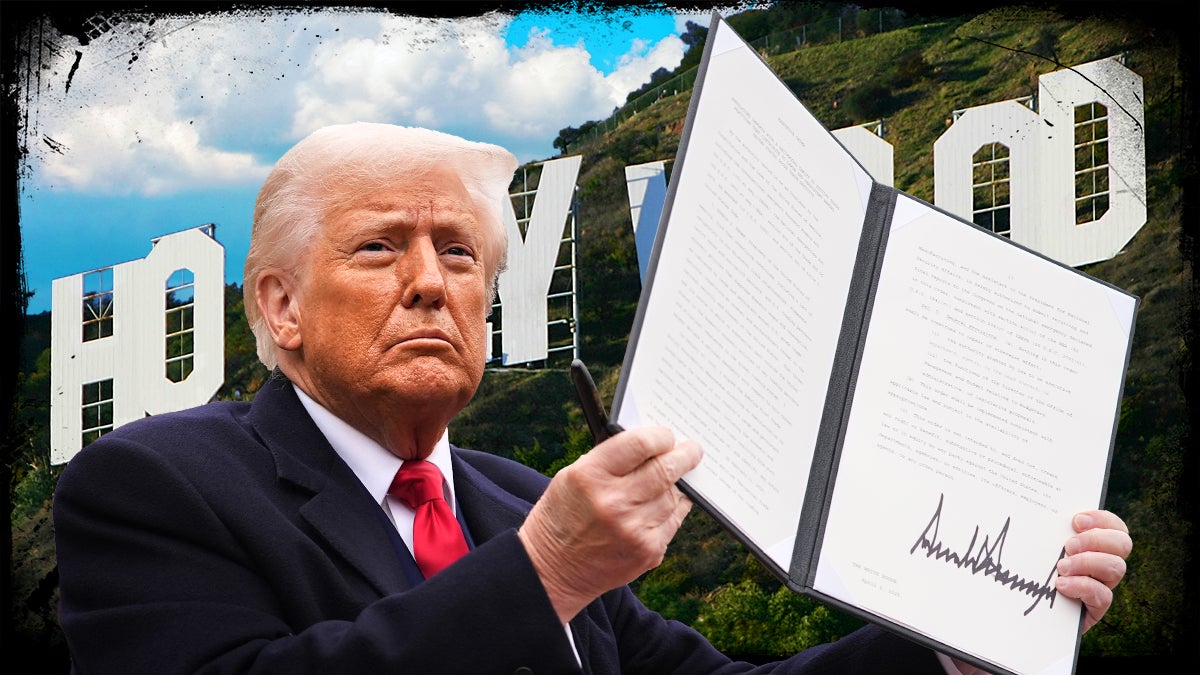
As Hollywood and the American film industry at large fights to claw back productions from global competitors like Canada, the United Kingdom and Australia, there is one piece of policy that has been lobbyists’ great white whale: a federal production tax incentive.
Given that many of the biggest production hubs in the country, namely California and New York, are deep blue bastions, it once seemed unlikely that such an incentive would get bipartisan support.
But more than a year into a sustained, industry-wide lobbying push that might soon get Capitol Hill appearances by top executives thanks to the Directors Guild of America’s recent contract negotiations, several entertainment unions told TheWrap that they feel there’s an understanding that such a tax credit would benefit Americans across the country, not just liberal-friendly Hollywood.
Now they just need to get President Trump onboard.
“I do think that the next time you see the White House make another comment about this, it kind of stirs the pot among Republicans to say, ‘Hey, this is something worth pursuing,’” said Jeff Bennett, general counsel at SAG-AFTRA.
While production incentives are available in 39 U.S. states as well as Washington D.C. and Puerto Rico, the only federal aid that American productions can take advantage of is Section 181, a Bush-era incentive that allows studios to take a tax deduction on up to the first $15 million in production spending, or $20 million for shoots in low-income areas.
But that pales in comparison to what other countries offer for federal tax incentives on top of any local or provincial credits. The U.K., for example, allows productions to include salaries for above-the-line talent such as actors and directors towards its national tax credit, while productions that have a U.K. partner can get additional rebate payments after a film’s release to cover back-end deals.
Recent boosts in the caps for incentive programs in some states like California, New York and New Jersey have helped stem the tide, but states can only do so much. The production boom in Georgia in the 2010s has largely subsided, with the number of Peach State productions dropping from a peak of 412 in 2022 to 245 in 2025. Disney and Marvel Studios were part of the exodus, moving the next two “Avengers” films to the U.K. after previous installments like “Avengers: Endgame” were filmed at Trilith Studios just outside of Atlanta.
The wrong solution, but a new opportunity
The issue of production flight unexpectedly came to the White House’s attention after a visit in May 2025 from longtime Trump supporter Jon Voight and his production partner, Steven Paul. After the visit, Trump expressed a desire on Truth Social to help America’s film industry.
But with tariffs.
“The Movie Industry in America is DYING a very fast death,” Trump wrote on Truth Social as he threatened to apply tariffs to any production shot outside of the U.S.. The White House later walked back that tariff threat, though the president brought it up again this past January in an interview with the California Post.
“I’m going to be putting tariffs on movies from outside of the country — if they’re made in Canada, if they’re made in all these places, because Los Angeles has lost the movie industry,” Trump said. “And so I’m going to put tariffs on and we’re going to be doing bonds, some bonds, some low-interest bonds, for the movie industry. We’ll bring it back.”
When Trump first floated film tariffs last May, it became an instant topic of discussion both among Hollywood unions and the industry’s top lobbying org, the Motion Picture Association. While such a proposal was a non-starter, insiders with knowledge of the unions’ discussions saw the national attention that Trump’s posts stirred as an opportunity to steer the conversation in Washington towards a federal film tax credit.
Over the past year, entertainment industry lobbyists from unions like IATSE and SAG-AFTRA, as well as other stakeholders, have held continuous meetings with lawmakers on both sides of the aisle, educating them on why tax incentives are so critical to the film industry and why so many of Hollywood’s biggest films and TV shows aren’t filmed on American soil anymore.
“There has been a lot of work educating people in Washington that probably don’t pay a lot of attention to our industry, and it has been happening in a steady, continuous way that it wasn’t before,” Bennett said. “I think it is paying off because when we talk with lawmakers about a federal tax credit, there’s a basic familiarity that they have in every conversation that we didn’t have before.”
While the unions wait for a series of commissioned studies that will show the economic impact of a federal incentive, the DGA and its president, “The Odyssey” director Christopher Nolan, negotiated a sideletter with the studios’ labor rep, the AMPTP, agreeing that the studios would make some of their top executives available to publicly push for a federal credit.
While there was some initial reluctance when the DGA made that request, three insiders with knowledge of the talks say that the AMPTP brought the MPA into the conversation to discuss the strategic value of having CEOs throw their weight behind the lobbying efforts. The AMPTP did not specify in the sideletter which executives might appear — Paramount Skydance CEO David Ellison recently appeared with Trump at the UFC’s Freedom 250 event at the White House — but the studios promised continued dialogue with the unions on how and when it would be most advantageous for the C-suites to get involved.

Not just Hollywood
Several prominent California lawmakers like Sen. Adam Schiff, Gov. Gavin Newsom, and Burbank Congresswoman Laura Friedman have frequently urged Congress to pass such a tax credit as the Golden State has fought to become a competitive production hub again. Schiff has drafted legislation that would offer a 15% federal tax credit for labor costs, an incentive similar to the federal equivalent offered in Canada, with room for various uplifts for productions that meet criteria such as whether it is a production relocating from another country.
But two lobbyists who spoke to TheWrap on condition of anonymity are hoping that if and when such legislation gets moving through Congress, California’s delegates take a backseat. While Trump told The California Post that he wants to “bring the movie business back to Los Angeles in particular,” there is concern that if Hollywood’s reps take the lead on pushing it through that it will run against the message the industry has tried to send that this tax incentive is not just a handout to liberal states.
“Schiff and Friedman are going to advocate for their constituents, and they should,” one lobbyist said. “But this can’t be all or even mostly about California, the state that has put itself on the forefront of the anti-Trump resistance. This needs to be about how this is going to help entertainment workers everywhere in this country.”
That’s a message being pushed by one producer with knowledge of both Hollywood and the Beltway: Chris Fenton. Once deeply involved in Hollywood’s big push into China in the 2010s, Fenton has now been focused on bringing productions back to the U.S. His upcoming indie comedy, “Bad Counselors,” which will get a limited theatrical run from Fathom starting July 23, employed approximately 1,200 workers in North Carolina, Tennessee and California. Encouraged by former colleagues in Washington, Fenton has been using his media appearances in promotion of his film to also urge support for a federal tax credit.
And though Fenton is a Democrat, he has focused his media appearances on right-wing media. He’s recently appeared on Fox News to raise awareness of production flight, and he is set to be interviewed by Lara Trump on her podcast this week.
“As much as some people in Hollywood may not want to hear this, the only way to really make this country into a place where studios want to shoot again is to get President Trump on our side, and that means highlighting where production is being done in the U.S. outside of the coastal hotspots,” Fenton told TheWrap. “I think it’s a big opportunity for both sides, on the 250th birthday of our country, to come together in support of an industry that employs thousands of crew workers nationwide and is a critical part of our economy.”
When reached for comment, a spokesperson for Sen. Schiff said that the senator is “actively working to gather bipartisan support” for his drafted legislation, which the spokesperson said “would benefit every U.S. state and territory.” The spokesperson also pointed to an interview Schiff made with Matthew Belloni while in Los Angeles to promote the legislation this past March.
“This has to be bipartisan, it won’t be successful otherwise. You really can’t do much of anything in the Senate or the House unless you have bipartisan support, so we’re really making outreach and trying to be flexible in those terms,” Schiff said.

Tax credit timing
Fenton is holding out hope that a tax incentive could still be advanced sometime this year, as does IATSE Legislative Director Tyler McIntosh, who sees a few options for passage in this Congress.
“There is sometimes a rush after the midterms and before the holidays, especially if lawmakers know there’s going to be a split Congress, to get bills passed. There could be a desire to do a tax extenders package at the end of 2026 that this could potentially be attached to, so we are keeping our options open,” McIntosh said.
But other insiders believe that it is most likely that a federal incentive will be introduced to Congress in 2027 after a midterm election that is expected to end with Democrats taking control of the House and possibly the Senate. In that case, Hollywood lobbyists will have to wait for the next Congress to complete committee assignments before they can determine who some of the key Democrats and Republicans will be.
For the Republicans, longtime entertainment industry Senate allies Marsha Blackburn and Thom Tillis won’t be among those key figures. Both senators are co-sponsors on the anti-deepfake NO FAKES Act, which just cleared the Senate Judiciary Committee with full support from several areas of the media industry. But Tillis announced his retirement last year, while Blackburn is the favorite in Tennessee’s gubernatorial race.
That leaves freshman Georgia Rep. Brian Jack as one of the primary Republicans on the incentive. Sources say that Jack, a former Trump aide who now serves as a liaison between House Republicans and the White House, has been in regular contact with Trilith Studios head Dan Cathy, as the massive Fayetteville soundstage complex is located in his district. But Jack has spoken little about the tax incentive, waiting for signals from Trump to support it.
A spokesperson for Rep. Jack did not respond to TheWrap’s requests for comment.
Union insiders expressed confidence that whenever legislation for the incentive is formally introduced in Congress, there’s more than enough support in both chambers to get it passed. But as one lobbyist put it, passing legislation in the era of Trump is far different than how Washington usually does business.
“It’s a chicken-and-egg thing. Do we introduce the incentive and then try to get Trump onboard? Or do we have to convince the president that this will be beneficial for him and then introduce the bill once he says he’s in favor of it instead of tariffs?” the lobbyist said. “I think the Republicans in Congress favor the latter, but that really ties our hands.”
