

A year ago, California was facing an existential crisis over the future of one of its most defining industries, losing film productions left and right to other states and, more so, to other countries.
In response, state lawmakers approved a dramatic expansion of California’s production tax incentive program that has been one of the biggest changes to the global race for film shoots over the past 12 months and has allowed Hollywood’s backyard to stem the tide. As a result of that and other updates in major American production hubs, data from the first quarter of 2026 shows signs that the United States is halting the exodus of film and television productions to other countries.
But it is doing so as greenlights on high-budget productions continue to decrease worldwide, leaving dozens of major production hubs fighting for slices of a smaller pie.
First, the good news. In July 2025, California’s tax credit cap was more than doubled from $330 million to $750 million, with the list of productions that can qualify dramatically expanded. Since then, 147 film and television productions have been approved for tax incentives in the Golden State, a 53% year-over-year increase from the same 10-month period a year ago.
Among the movies approved for the incentive are Searchlight’s “Behemoth!” from “Andor” creator Tony Gilroy, Netflix’s remake of the 2000s comedy “13 Going on 30,” the independent film “Black Is Blue” starring Laverne Cox, and Daniel Kwan and Daniel Scheinert’s follow-up to their 2022 Oscar-winning sci-fi film “Everything Everywhere All at Once.”
For the first time, animated productions are also eligible for California’s tax credits, and projects like Disney/20th Century’s theatrical sequel to “The Simpsons Movie” and an under-wraps original project from DreamWorks Animation have already been approved and will be produced entirely in California. It’s a major shift from the decade-plus-long trend of outsourcing a significant portion of Hollywood animated feature production out of the country.
For instance, Walt Disney Animation’s “Zootopia 2,” now Hollywood’s highest-grossing animated film of all time, was animated partially at a recently opened satellite studio in Vancouver.
And while the full impact of the program won’t be known for at least another year, there are some early signs that it is helping Los Angeles’ local film industry stem the tide. Shoot days for the first quarter of the year in Los Angeles reached 5,121, a 10.7% increase from the last quarter of 2025. Still, that total was 3.3% down year-over-year due to continued drops in shoots for reality TV, which are down 33% across the United States compared to 2022, according to entertainment analytics firm Luminate.

“We are slowly starting to see the effects of the expanded program come into effect,” said Philip Sokoloski, VP of Communications at permitting organization FilmLA. “We have 52 feature films coming, and a lot of those are going to be on the independent side. I think in the coming months you will not only see more incentivized projects come online, but you will also see more producers consider filming in Los Angeles as the city and the county work with us to clear obstacles around filming.”
Beyond California, other big changes on the tax incentive landscape include New York’s increase of its program cap to $800 million, with $100 million of that total allocated to independent productions with a 30% base credit on eligible spending plus up to an additional 20% for productions that do film scoring in the state and/or hold shoots in upstate counties.
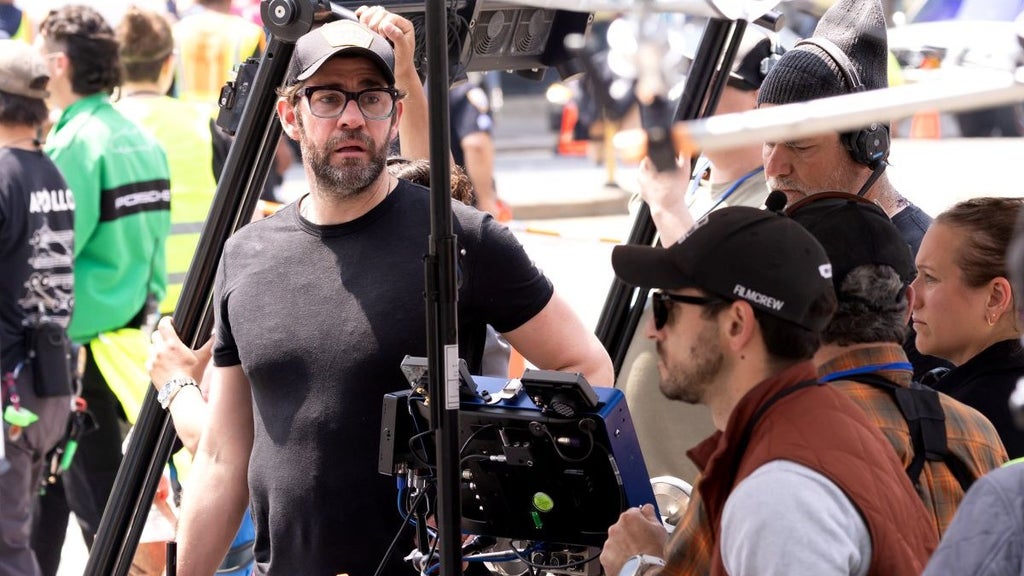
The result of these changes? In its annual survey of studio executives, production consultant company ProdPro found that no U.S. states were listed among the top five production hubs that were preferred in 2025. In 2026, New York, where John Krasinski’s “A Quiet Place Part III” is among the productions now shooting, was the top preferred hub among surveyed execs, with California in third and Georgia in fourth.
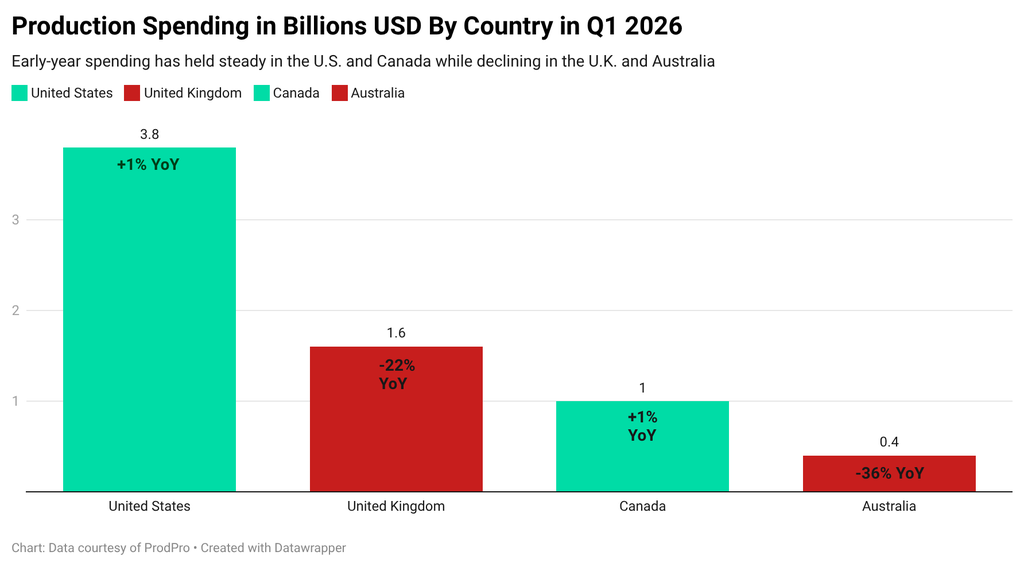
In second place in the survey is the leading international production hub, the United Kingdom, which ProdPro reports saw a 15% increase in production spending for high-budget projects to $6.97 billion in 2025 but saw a 22% year-over-year decrease in first quarter production spending to $1.6 billion in the first three months of 2026.

Though Britain’s below-the-line workforce is struggling to find employment as domestic television greenlights have slowed down, the offer of a 40% tax credit and vast soundstage capacity has kept the country as Hollywood’s favorite place to shoot its biggest blockbusters. Most notably, Marvel Studios moved the upcoming “Avengers: Doomsday” to London’s Pinewood Studios after filming the previous “Avengers” films primarily in Georgia.
In continental Europe, countries like Germany, Czech Republic and Hungary have also seen significant increases, with ProdPro reporting a 78% year-over-year increase in production spending to $1.53 billion. Entertainment Partners SVP Joseph Chianese says that Hungary in particular offers flexibility when it comes to how much production work is done outside its borders, given its relative lower soundstage capacity.
“Along with a generous 30% rate, something that Hungary does which is rather unique is that 25% of the eligible spend can be outside of Hungary, which allows producers to basically double dip,” he said. “This has been very attractive to producers who want to do their shooting in Hungary and then do their post somewhere else, perhaps in other production hubs that offer a tax credit for post work.”
Beyond those major hubs, Chianese also points to new markets that are entering the global race, namely Mexico. This past February, Mexican President Claudia Sheinbaum announced the country’s first nationwide tax incentive set at 30% of eligible spending with a cap of 40 million pesos, or $2.3 million USD.
“Mexico has already been attractive, especially for television, because of its low labor costs and low production costs in general. So if you layer a 30% incentive on top of that, we’ll see how much of a shift in production goes in that direction,” Chianese said.
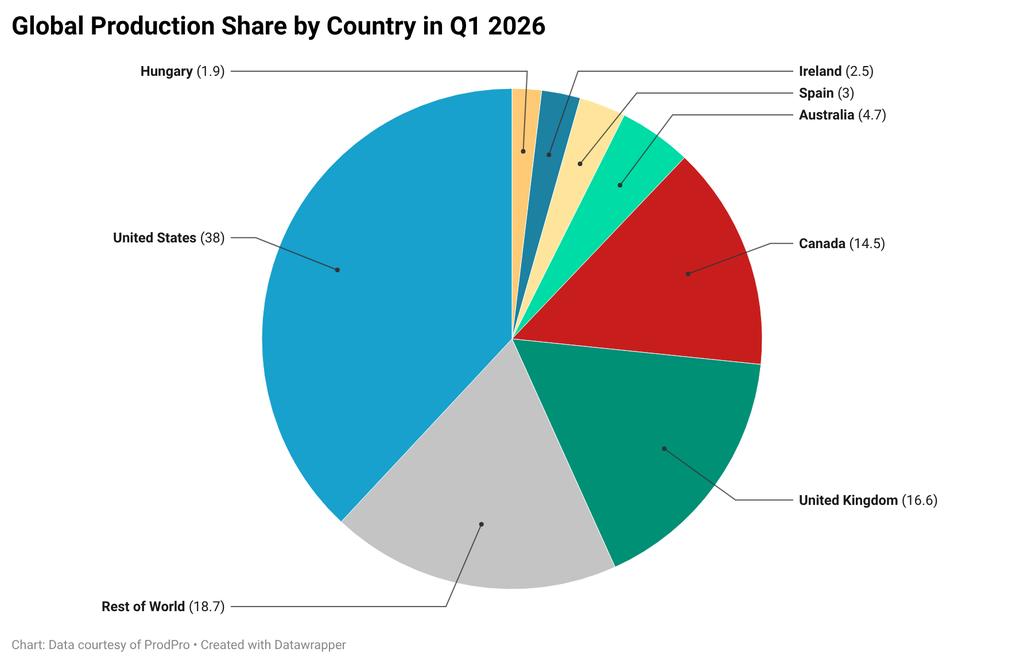
So how is this playing out with shoots so far this year? Data from the first quarter of 2026 provided by ProdPro found that U.S. production spending held relatively even year over year at $3.8 billion. The American share of global production also held at 38%, though that is still well below the 52% share recorded in 2022.
And in 2027, there may be more to come. One studio executive who asked to remain anonymous expressed optimism that the next Congress, which is expected to see Democrats take control of the House and possibly the Senate, could see some traction on the country’s first federal tax credit, which would give production hubs across the U.S. an additional layer of tax incentives that the U.K. and Canada have enjoyed for years and helped build those countries into top blockbuster production hubs. Republican Steve Hilton, candidate in California’s gubernatorial election, has pledged to work with the Trump Administration on passing a federal tax credit.
While President Trump has been pushed by supporters within Hollywood like Oscar winner Jon Voight to aid American production, his administration has yet to put forth a policy proposal.
But even if that happens, there would need to be a reversal in the decline in global greenlights for production workers to truly reap the benefits. ProdPro found that the only reversal so far has come in the independent space, as production spending on films with budgets of less than $5 million grew from $880 million worldwide to $1.22 billion.
But that is outweighed by spending on production with budgets of $40 million or more, which declined last year in North America. In 2025, high budget spending in the U.S. declined 20% to $12.1 billion, while Canada, which has seen steady increases over the last decade, fell 13% to $4.6 billion.
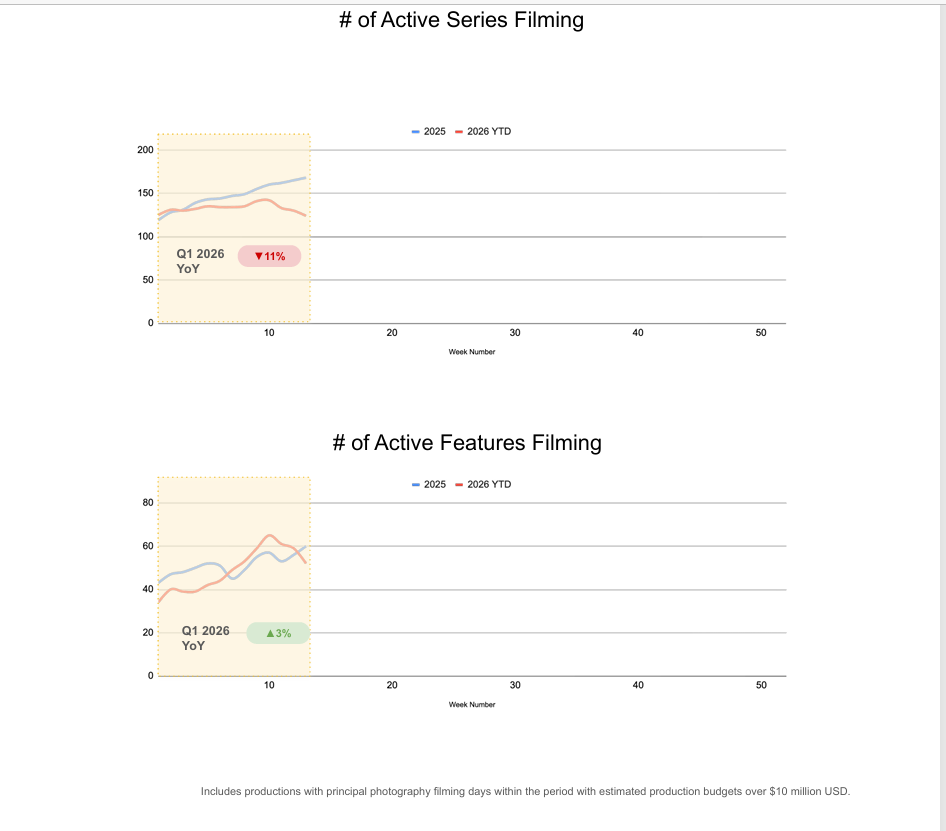
The overall decline continued in the first quarter of 2026, as global production spending declined 6% year-over-year to $8.7 billion, while the total number of film and TV productions that began shooting slipped 7% to 332.
With production costs still rising and Hollywood facing continued consolidation, it is uncertain whether this global scale back in major productions will continue. But what does seem to be certain is that the tax incentive arms race won’t be dying down anytime soon.
