
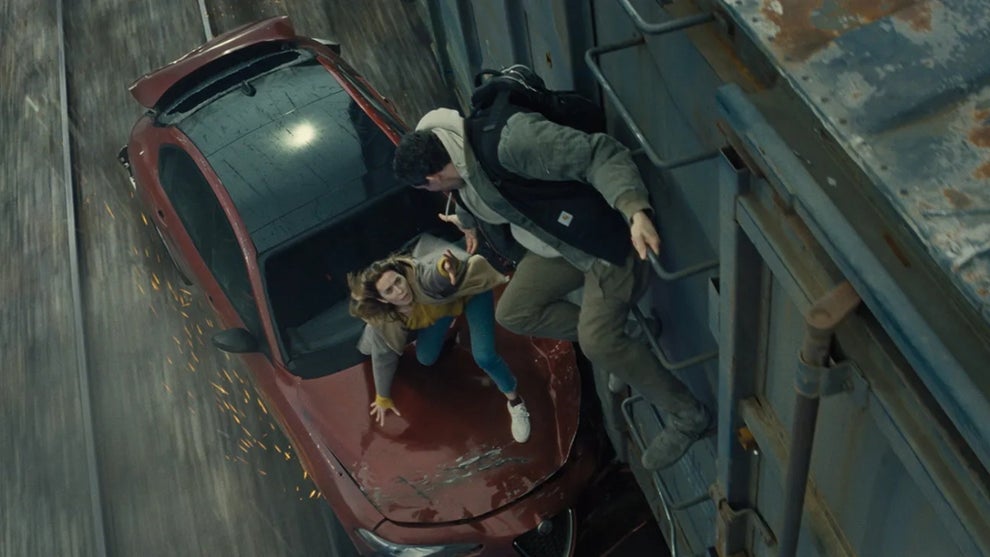
Steven Spielberg’s latest symphony of awe and wonder “Disclosure Day” is about many things.
It is, ostensibly, the kind of paranoid thriller that used to be all the rage in the 1970s, except instead of post-Watergate unease, it’s fueled by a far stranger and older secret that the government has been obscuring for decades – the existence of extraterrestrial life and the interaction between our own government and those beyond the stars. But it is also about the connections we make as people; more specifically a nearly mystical bond formed between two seeming strangers – a television weatherwoman (Emily Blunt) and a cybersecurity expert-turned-whistleblower (Josh O’Connor), who is threatening to expose the truth about the American government’s long-held interactions with extraterrestrials.
And much like the bond forged by Blunt and O’Connor’s characters, the movie was birthed from an otherworldly connection between two people – Spielberg and writer David Koepp.
Koepp was 29 when he wrote “Jurassic Park” for Spielberg. Based on the best-selling novel by Michael Crichton, who had originally taken a stab at the screenplay, when it was released in 1993, it would become the biggest hit of all time (at the time). And throughout their respective careers, they have returned to one another – for the “Jurassic Park” sequel “The Lost World” in 1997 (again based loosely on a Crichton book), 2005’s Tom Cruise-led “War of the Worlds” and the fourth “Indiana Jones” film, “The Kingdom of the Crystal Skull,” which was released in 2008. Koepp returned to the “Jurassic” franchise last year for “Jurassic World: Rebirth,” which Spielberg produced. And they’ve even had a couple of movies that didn’t happen – a fifth “Indiana Jones” film with a very different MacGuffin, which Spielberg was planning to direct before handing it over to James Mangold, and another Crichton adaptation that was ultimately canceled.
“Disclosure Day” started in the summer of 2023, when Koepp received a 40-page document from Spielberg. According to Koepp, Spielberg said, “Hey, I’ve been working on this story. Will you read it and tell me what you think?” Koepp asked, “What’s it about?” And Spielberg replied, “Aliens again.”
The document, Koepp said, was “very stream-of-consciousness.” “But it had a beginning, middle and end. It was the movie that you saw and the characters that you saw, not fleshed out,” Koepp said.
But what really struck him was the last 10 pages. “I said, ‘This movie is going to work because you have a fantastic ending.’ I felt even reading a treatment – treatments are well known to be the worst documents of all time – I felt so much that it was imperative that they succeed, that they get this information out,” Koepp explained.
He assumed that Spielberg was going to just write the movie himself; it had a terrific structure and Spielberg is “a great writer,” as Koepp said. Koepp gave Spielberg “some notes of the usual kind that you would give to a writer friend – that was confusing, maybe movie this guy here” and Spielberg sent it back a month later with some of those notes implemented.
Finally, Spielberg asked, “Why don’t you write it?” To which Koepp replied, “I thought you’d never ask.”

That began a “constant process of revision” that Koepp said stretched over two years and 42 drafts. “The most substantial drafts are at the beginning and by 42 you’re doing double-goldenrod pages where you change four lines,” Koepp said. Structurally, it remained similar to Spielberg’s original document. “Steven very much wanted to start in media res and have it be a kind of breathless thing. I felt like it was definitely influenced by ‘70s paranoia cinema. It felt like ‘Three Days of the Condor’ to me – they have this information, they have got to get it out and everyone is trying to stop them,” said Koepp.
What’s particularly fascinating about “Disclosure Day” is how much real-world ephemera Koepp and Spielberg were able to fit into the movie. An early scene – no spoilers – recounts an often told story about the time that Richard Nixon showed Jackie Gleason the bodies of several aliens at an army base in Florida. (In the real story, they’re kept in formaldehyde -filled jars, here they’re on a coroner’s slab.) There are other bits of “historic” UFO tales, beginning with the Roswell crash of 1947, sprinkled throughout. If you are the tin-foil-hat type (like I am), there’s a fun bit of recognition at what they have chosen to use and recreate.
Koepp said that the process of deciding what to include in the screenplay came down to choosing anything “remotely credible.” “If it was too extraordinary and clearly the product of someone’s imagination, we didn’t want to do it, but it was important to Steven that we use as much existing lore as possible, because the movie’s not supposed to be one of those movies that says everything you always thought you knew was wrong,” said Koepp. “The movie’s supposed to be one of those that says everything you always thought was true is, and here’s proof. Every bit of lore that we found we would put in, I viewed it as sort of, you know, how physicists talk about a unified theory of everything. I saw, this is the unified theory of everything for UAPs. This is a story that explains how all that could be true.”
He paused and said, “My dream is 10 years from now somebody says, ‘You know, you guys got most of that right.’”

While Koepp was eager to take on the project, he said that there was still some trepidation in terms of taking on a Spielberg UFO movie, even after he had done “War of the Worlds.”
“Yeah, I said it to him,” Koepp said of his worry. “War of the Worlds,” he said, “ is like ‘E.T.’ but if E.T. came to kill everybody in the subdivision – a radically different tone.” “This was always going to be, not a sequel of course, but a kind of bookend to ‘Close Encounters of the Third Kind.’ And ‘Close Encounters,’ aside from being a beloved classic, is one of my personal favorite movies of all time,” Koepp said. He remembered thinking, God, I would love not to screw this up.
In one of their first meetings Koepp told Spielberg, “I think it’s going to be great. I’m very excited. Let’s do it. As for doing UFOs again, listen, they’re either going to say, ‘Wow, he’s done it again, he’s found this incredible area to explore in something that he feels so deeply passionate about.’ Or they will say, ‘It’s ‘Cheyenne Autumn,’ he went to back to Monument Valley one too many times.’” Spielberg looked at Koepp and just said, “Ouch.”
(“Cheyenne Autumn,” for those without a film major, was a 1964 John Ford western that received withering reviews when it was released, with many diagnosing it as a dull retread. A contemporaneous Time review said the movie “has everything it takes to make a great western epic, except greatness.”)
“Fortunately, I think it’s the former, not the latter,” said Koepp.
Koepp was recently spotted with Spielberg in New York City and he confirmed that, yes, they are working on something new together. (He wouldn’t say what.) But that it helps that one of his closest creative collaborators is also one of the few people in Hollywood who can decide to make a movie and … just make it. “It is nice to know that the moment your movie is greenlit is when the director calls and says, ‘I’m going to make this my next film,’” said Koepp.
We wondered how Koepp and Spielberg’s relationship has changed – evolved, maybe –over the years.
“Well, I was 29 when we did ‘Jurassic Park,’ and it was my fourth movie, but it was going to be the biggest and hardest, and now they’re all hard, but so it was, you know, it took me a couple movies to get over the I-can’t-believe-I’m-in-the-room-with-this-guy feelings, and that doesn’t make you a great collaborator,” said Koepp. “I realized quickly he doesn’t need a fan, he can go to a convention if he wants to get talked to by fans, he needs a collaborator, and I think over the years I’ve become more and more comfortable with throwing out whatever ideas in my head, even if it’s stupid, because stupid ideas might have a kernel of goodness in them and that’s how you work. I love making stuff up with him. It’s my favorite thing to do at work.”
“Disclosure Day” is in theaters now.
