
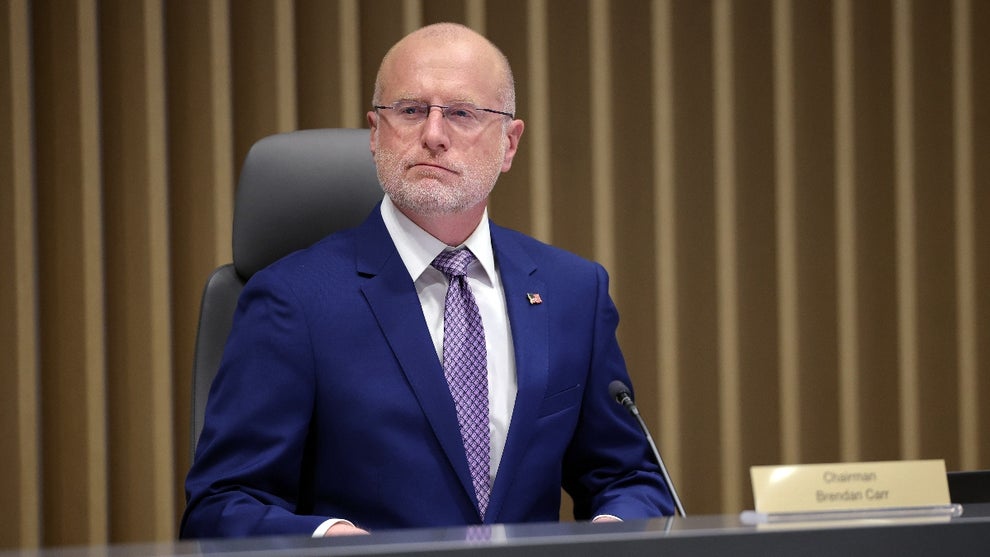
FCC Chairman Brendan Carr brushed off concerns about a potential legal challenge as the regulator plans to hold a vote on ending the national broadcast ownership cap and adopt a case-by-case review system.
The cap, which was implemented by Congress in 2004, limits entities from owning or controlling broadcast television stations that, in the aggregate, reach more than 39% of TV households in the United States. Specifically, the cap has been a key hurdle in Nexstar’s pending $6.2 billion merger with rival Tegna, which is currently in legal limbo after a group of state attorneys general and DirecTV sued to block the deal and were granted a preliminary injunction.
Critics of the FCC’s move, including Sen. Ted Cruz (R-TX) and the FCC’s sole Democrat Commissioner Anna Gomez, have argued that the cap can only be lifted by Congress. When asked about that criticism during his monthly press conference on Wednesday, Carr told reporters that he is “regularly and actively in conversation” with Cruz and other lawmakers’ teams all the time about different issues the agency is working through.

“We’ve been pushed hard, including by a lot of members of Congress that say that the FCC, in their view, obviously does have the authority to do this. And historically, the FCC, on a bipartisan basis, Democrat and Republican leaders, have been of the view that the 39% is not a hard statutory limit. In fact, when this issue was last before the D.C. Circuit, the court said that 39% was merely a starting point,” Carr explained. “There were statutory changes made subsequent to that, but as we walk through in our decisional document, those subsequent statutory changes and the view of the FCC did not eliminate the FCC’s longstanding authority to modify the rule. But we’re regularly in contact with Chairman Cruz and his team and we’ve heard from lots of members of Congress on this.”
During her monthly presser on Wednesday, Gomez said the move to repeal the cap is “unlawful on its face and certain to face court challenge” and said she would be “extremely surprised” if it passes judicial review. But Carr didn’t appear to be concerned.
“I think we feel comfortable about where we are as a matter of statutory interpretation. We’re writing against the backdrop of the D.C. Circuit looking at this language already, where the FCC took the opposite position,” he said. “So in a world in which there was Chevron and the court was supposed to be deferring to the FCC, the FCC said we can’t change the 39% cap in our view because we think it’s set by statute. The D.C. Circuit said no. You’re wrong about that. So even when that position had been deferred to, the court overruled it. So I think that’s instructive as how the court would address in a post-Chevron world.”

In addition to the national broadcast ownership cap, Carr fielded multiple questions about President Donald Trump’s calls for broadcast licenses to be revoked for media companies who limited broadcast network coverage of his primetime address last week.
“When you have the president of the United States standing inside the White House delivering an important speech, I think that’s something that broadcasters should be carrying, and so obviously this is an issue,” Carr said. “There have been lots of concerns raised, including by members of Congress, about whether broadcasters and their decisions there comply with public interest.”
Carr specifically name-dropped Disney’s ABC, noting it already has an open investigation into the network’s broadcast licenses.
“With respect to Disney ABC in particular, we have an open proceeding right now on whether they’ve been operating the public interest. I’m sure that there are going to be points raised in that proceeding that relate to Disney’s decision there,” he said. “We’re going to hold all broadcasters to the public interest obligations, and we’re always looking to make sure that they’re doing exactly that.”

Gomez argued the FCC has “no authority to punish broadcasters for exercising their First Amendment right to choose what is newsworthy.”
“They made those same editorial decisions under presidents of both parties without any complaints, and in this case, the remarks were freely available online to anyone who wanted to watch them,” she said. “It’s censorship one way or another if we tell them they can’t broadcast something, and it’s forced speech if we tell them they have to do so. So, there is nothing here that violates any rule or or statutory provision with regard to these networks.”
Gomez added that the “vague public interest standard” is being used to “punish speech that this administration doesn’t like to reward speech that it does like.”
“That’s inappropriate and it’s contrary to the law and to the Constitution,” she said.
When asked about what she’s expecting from the outcome of the FCC’s investigation into Disney, Gomez said she’s worried the agency will “cherry pick among the commenters in order to punish ABC.”
“Whether it’s with regard to ‘The View,’ whether it’s regard to this early license review, this commission needs to understand the limits of its authority and not use it in order to influence how broadcasters broadcast what they broadcast, who they broadcast over the airwaves, and the content of their news,” she said.
