
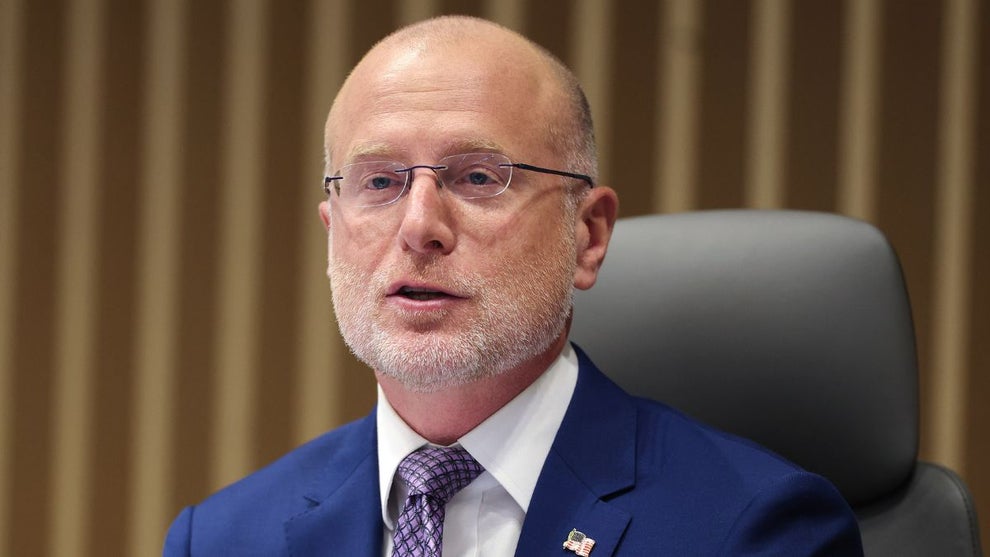
FCC chairman Brendan Carr has expressed skepticism that a lawsuit by 12 state attorneys general to block the $110 billion Paramount-Warner Bros. Discovery merger will be successful.
During an interview at the Hill Nation Summit on Wednesday, Carr was asked whether he thought the lawsuit would have any chance of succeeding in court, to which he replied: “I doubt it.”
He proceeded to point to a report that California Attorney General Rob Bonta would be open to a divestiture of CNN to address their concerns over the merger.
“I don’t understand what antitrust theory you have that says there’s a problem with this acquisition that is made or broken based on one cable channel being included,” Carr said. “So I think that’s a bit of a tell that this really isn’t a legitimate antitrust case, but ultimately that’ll be up for the courts to decide.”
Bonta, who previously told TheWrap in April that “red flags are everywhere” in this type of merger, has downplayed the reporting of his interest in a CNN divestiture, arguing that he has “no idea” where that came from.
“The gossip machine is on overdrive right now. People are saying things that have no relationship to the facts, to the truth,” Bonta said during a press conference announcing the lawsuit on Monday.
The state AGs have argued that the merger would create an entertainment giant with increased leverage over movie theaters, as well as cable and streaming platforms. They estimate that the combined company will control 27% of the wide-release theatrical distribution market, 30% of the submarket comprising “anticipated blockbuster films,” and 27% of the basic cable bundle. The group has also warned that deal’s approval could lead to an increase in prices for consumers and reduced content output.
On Tuesday, the case was assigned to U.S. District Judge P. Casey Pitts, who has been asked to rule on state AGs’ request for a temporary restraining order before July 22. A hearing has been set for Friday morning.

Carr’s remarks come as the FCC is reviewing the foreign investment in the Paramount-Warner Bros. deal. He did not provide an update on the status of that review on Wednesday, but previously noted during his monthly press conference in June that the agency was running a “standard process” and had not yet made a decision.
“There’s a Team Telecom process that is running and we will go where the facts take us based on those reviews,” he said at the time. “We’re running the process, we’ll see what Team Telecom says, we’ll see what our own proceeding shows, and then we’ll make a final decision.”
Per Paramount’s petition with the FCC, foreign investors would account for 49.5% of the equity of the combined company. The David Ellison-led media giant also asked the FCC for approval for foreign investors “in the aggregate to indirectly hold up to 100 percent of its equity and/or voting interests in light of routine fluctuations in publicly held equity interests and to account for potential future investments.”
Three Middle Eastern sovereign wealth funds will own a total of 38.5% of the non-voting equity in Paramount. Saudi Arabia’s Public Investment Fund will own 15.1% after the deal closes, while L’Imad Holding Company will own 12.8% and the Qatar Investment Authority will own 10.6%.Other foreign equity owners include “passive limited partner investors” in funds managed by RedBird Capital Partners, which would account for 5.8%, and foreign-based entities that have acquired the company’s Class B stock, who would control 5.2%.
Paramount has emphasized that the ownership stake would not result in a transfer of control and that they would not hold any governance rights or board seats.
When asked about a ProPublica investigation that found that the FCC accepted thousands of dollars worth of gifts from Paramount as it has reviewed the company’s mergers with Skydance and WBD, Carr replied: “I have no idea what that basis for that is. It sounds like it has no basis at all.”

The Paramount Warner Bros. deal remains on track to close by the end of the third quarter. It has already received approval from the U.S. Department of Justice and Warner Bros. shareholders.
Other countries where the deal has received clearance or where relevant waiting periods have expired include Australia, Austria, Canada, China, Kuwait, Saudi Arabia, Serbia, South Africa, Ukraine, Montenegro, New Zealand, and North Macedonia. Foreign direct investment authorities in Spain, Germany, Slovenia, Belgium, Czechia, Italy, France and Romania have also signed off.
Meanwhile, the European Commission’s review period on the foreign investment in the Paramount-Warner Bros. deal expired on Tuesday. However, the EC is still examining the deal’s impact on competition and will decide whether to clear it or refer it for a more in-depth Phase 2 investigation by July 22.
The United Kingdom’s Secretary of Culture, Media and Sport Lisa Nandy has also informed Paramount and WBD that she feels “minded to intervene,” with a decision on whether the regulator will clear the merger or move to a Phase 2 investigation expected by Aug. 7. In addition, the Writers Guild of America has filed a separate lawsuit to block the merger.
In the event the transaction does not close by Sept. 30, WBD shareholders will receive a 25 cent per share “ticking fee” for each quarter until closing. In the event that the deal does not close at all due to regulatory matters, Paramount will pay WBD a $7 billion termination fee.
