
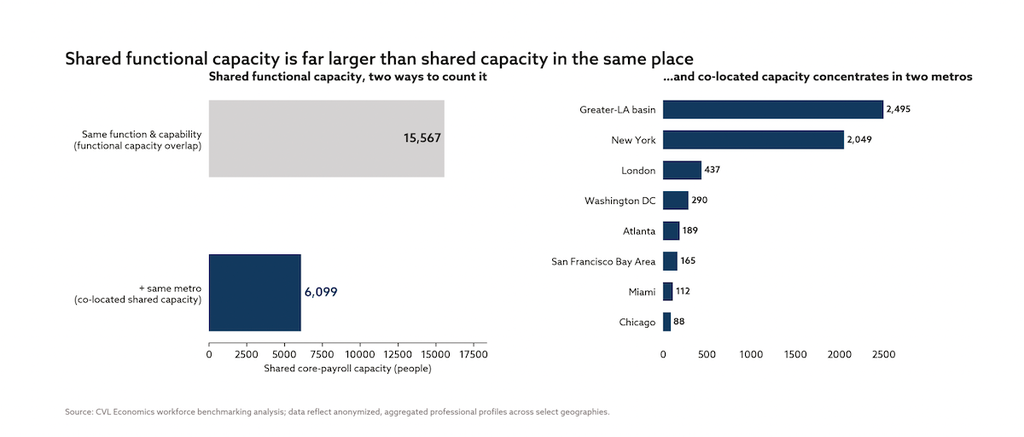
Paramount’s pending $110 billion merger for Warner Bros. Discovery could place 2,495 jobs in Los Angeles County and roughly 6,000 jobs globally at potential risk due to consolidation.
The estimated figures, which come from an interim analysis by the Department of Economic Opportunity, cover duplicative roles in corporate, tech, real estate and other shared functions across the two companies.
“This estimate should not be read as a layoff forecast; it only defines the scale of possible employment impacts that may be subject to consolidation,” the DEO’s report states. “These roles are the most immediately exposed to consolidation.”
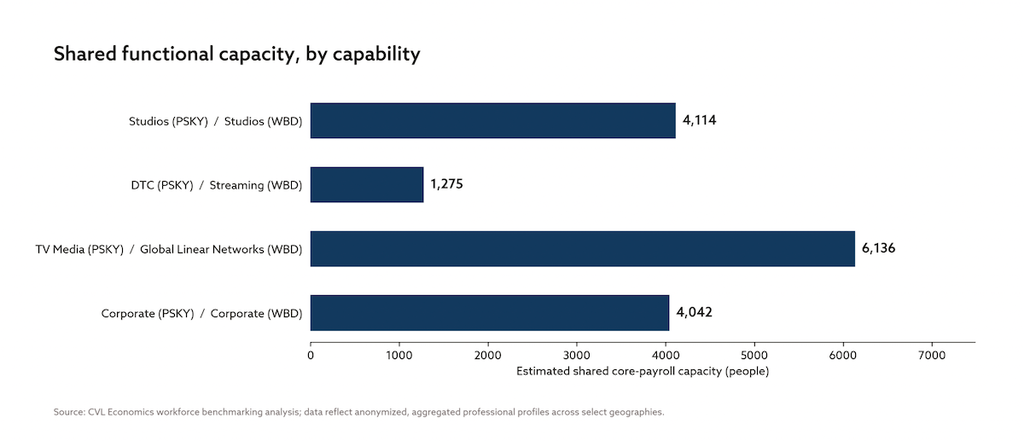
Paramount has projected that the WBD merger would result in over $6 billion in cost savings, primarily from duplicate corporate functions, streamlining technology and cloud systems, and consolidating real estate and procurement.
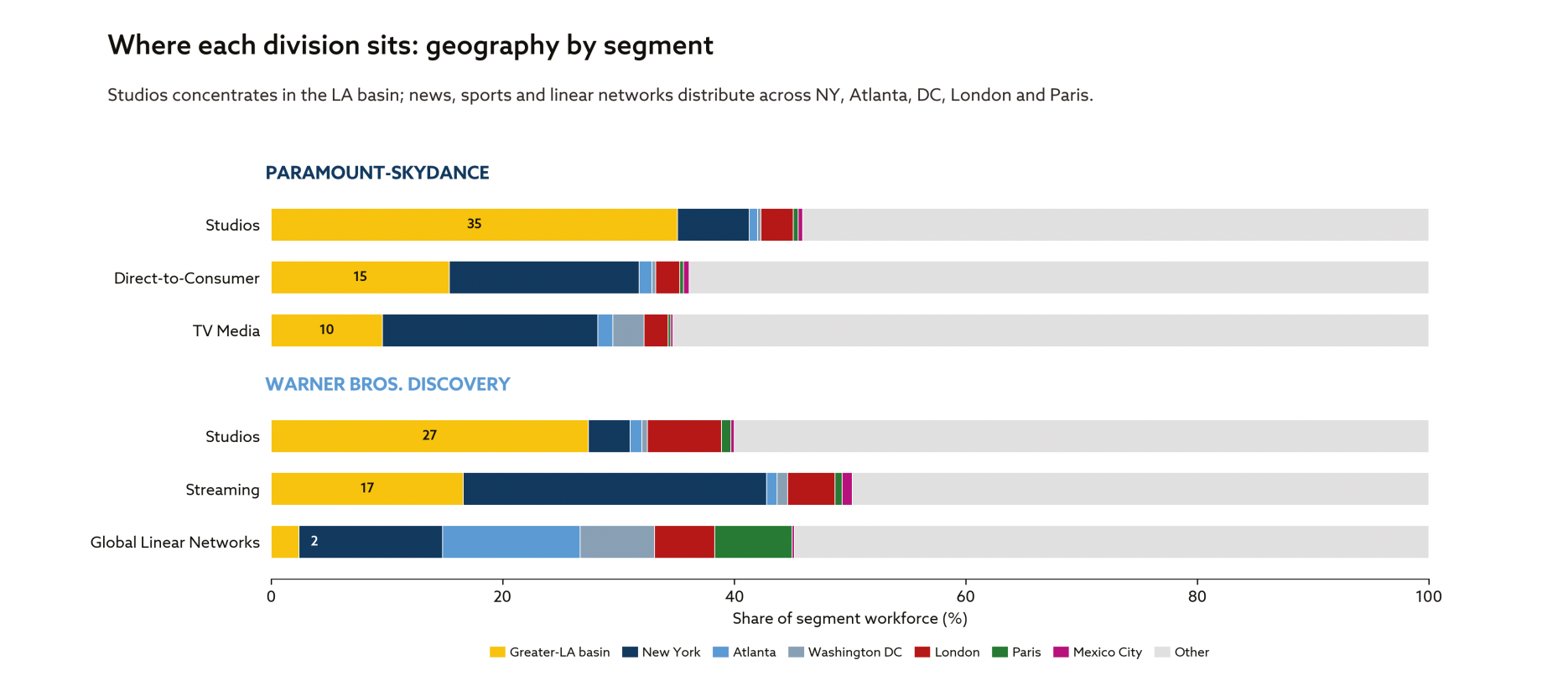
The DEO’s report estimates that 17% of Paramount’s total workforce and 13% of WBD’s total workforce are located in LA County. When looking by unit, 35% of Paramount and 27% of WBD’s studios unit workforces are based in LA, while direct-to-consumer/streaming make up 15% and 17% and TV/media and global linear networks make up 10% and 2%, respectively.
David Ellison has also pledged to release 30 theatrical films per year, though that doesn’t guarantee production work will remain in the Los Angeles area. According to DEO, out of 19 Paramount Skydance and Warner Brothers Discovery theatrical releases in 2025, only “One Battle After Another” was primarily shot in California, while the remainder were produced out of state or overseas.
Additionally, L.A. County warned that the combined company would carry approximately $82 billion in gross debt — roughly seven times their current annual profits. DEO pointed out that the decline in traditional television could widen the gap between earnings and debt as audiences shrink.
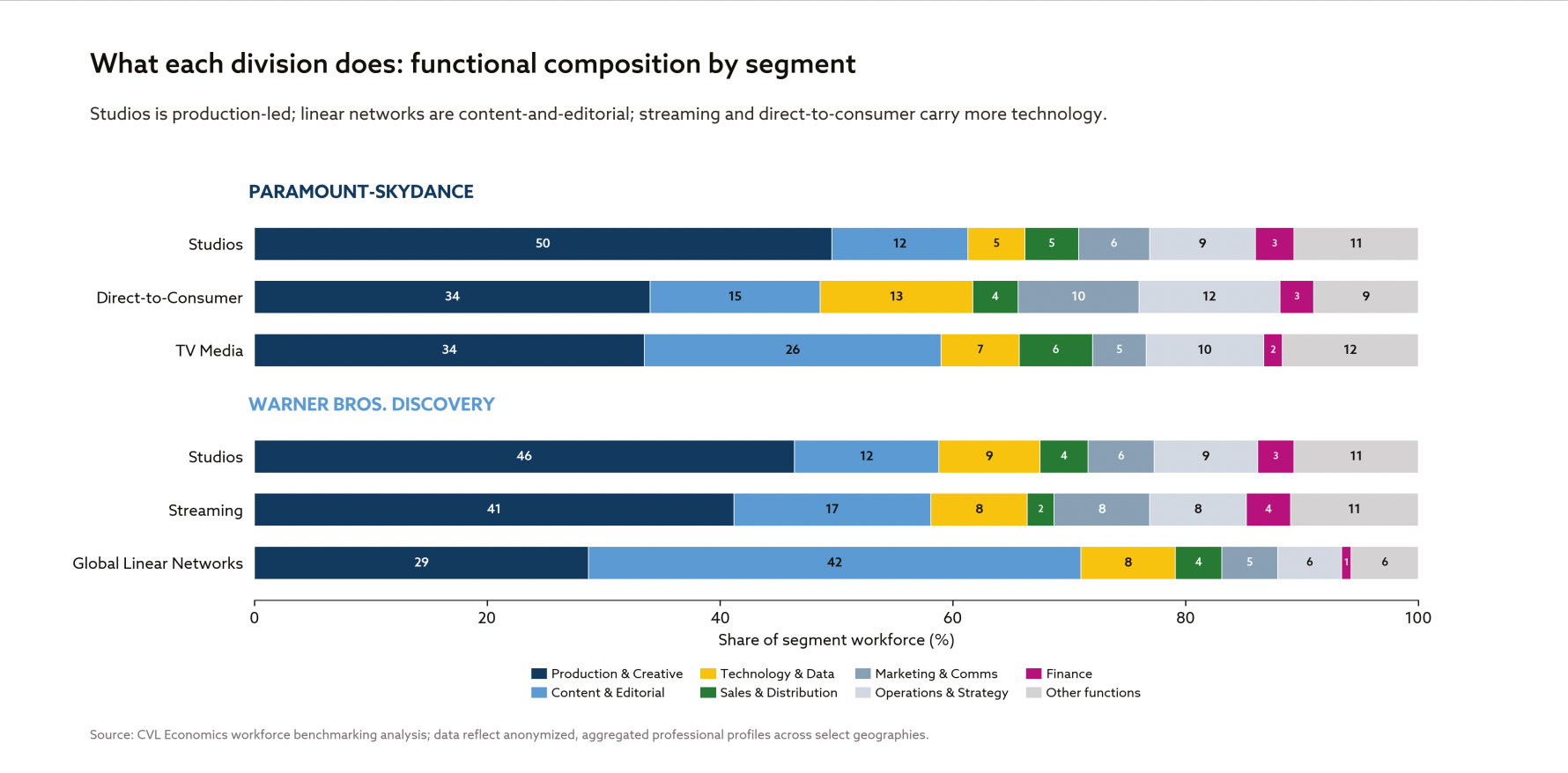

The interim analysis was conducted by the Los Angeles-based economic consulting firm CVL Economics after being ordered by L.A. County’s Board of Supervisors in March.
“In Los Angeles County, the entertainment industry has long been our economic and cultural engine, and we have to fight like hell to protect it. This deal increases the threat to jobs, workers and communities that are already under attack,” Third District Supervisor Lindsey P. Horvath said in a statement. “Nothing is off the table when it comes to protecting our workforce, our economy and the future of the entertainment capital of the world. We’ve already seen this movie and know what happens when corporate consolidation puts billionaires’ interests ahead of working people – no need for a sequel.”
“The findings reinforce what workers, employers, and small businesses have been telling us for years: our entertainment economy remains in a fragile recovery period,” DEO director Kelly LoBianco added. “Under the leadership of the Board of Supervisors, DEO and the L.A. County Film Office are taking a proactive approach to understanding potential risks and preparing solutions that protect workers, businesses, and the long-term competitiveness of our creative economy.”
In a statement, Paramount said that the DEO’s report “underscores the multiple ways in which the status quo continues to fail Los Angeles’ entertainment economy,” including reduced output, declining linear TV revenue and “competing incentives from other jurisdictions have left consumers and creatives subject to the whims of the dominant technology and streaming platforms that rule Hollywood today.”
They added that the Paramount-WBD merger is a response to those realities and will have the scale and resources needed to compete more effectively in a rapidly evolving global media marketplace and invest in content, technology, and jobs.
“Paramount is proud to call Los Angeles home. For more than a century, our historic Melrose studio lot has been at the heart of Hollywood’s creative economy, and California, which is where our headquarters is based, remains central to our future,” Paramount added. “This transaction is about strengthening that legacy—creating a more competitive company that can invest in storytelling, support creative talent, and help ensure Los Angeles remains the global capital of entertainment for generations to come.”

On Aug. 18, DEO will release a more in-depth analysis on the merger’s impact on production workers, including the longer-term erosion of local production, the role of competing incentives from other jurisdictions, and potential effects on crews, crafts, post-production workers, vendors and production-serving small businesses.
It is also coordinating with state agencies including the Employment Development Department and the California Film Commission to create an action plan to provide job training, placement and other workforce programs, as well as access to unemployment insurance, public benefits and health and mental health services to any displaced workers. DEO currently oversees $1.57 million in the Arts, Media, and Entertainment High Road Training Partnership (HRTP), which supports over 100 apprenticeships in editing, production, gaming and animation.
Additionally, the DEO said it would submit formal comments to the U.S. Department of Justice regarding antitrust concerns and monitor the investigations into the deal by state attorneys general, including California’s Rob Bonta.
“The proposed merger of Warner Bros/Paramount has been met with widespread concern from legal experts, creatives and journalists, and people around the country. There is concern that the deal could harm workers, consumers, and our economy,” A spokesperson for Bonta told TheWrap. “We are aware of the LA County economic impact report. Beyond this, to protect the integrity of our ongoing investigation, we have no updates at this time.”
Los Angeles County’s creative economy supports more than 312,000 workers, including approximately 171,155 entertainment sector jobs.

The interim report comes as the merger has been cleared by the Justice Department and Warner Bros. shareholders. It also was granted clearance by regulators in China, Australia, New Zealand, Saudi Arabia, Ukraine, Serbia and North Macedonia and foreign direct investment authorities in Spain, Germany, Slovenia, Belgium, Czechia, Italy, France and Romania.
However, regulatory hurdles surrounding the Paramount-WBD merger remain. The European Commission and the United Kingdom’s Competition and Markets Authority have formally launched reviews of the deal. Ellison previously met with U.K. Secretary of Culture, Media and Sport Lisa Nandy and other European regulators in January. The EC and the U.S. Federal Communications Commission are also reviewing the foreign investment in the deal, with those investors set to account for 49.5% equity of the combined company.
The EC has set an initial deadline of July 7 to decide whether to clear or order a Phase 2 investigation of the merger and a July 14 deadline on its foreign investment review. The CMA will decide on whether to launch a Phase 2 investigation by Aug. 7.
The Paramount-WBD merger is on track to close by the end of the third quarter. In the event the transaction does not close by Sept. 30, WBD shareholders will receive a 25 cent per share “ticking fee” for each quarter until closing. In the event that the deal does not close at all due to regulatory matters, Paramount will pay WBD a $7 billion termination fee.
