
When NBCUniversal addresses Madison Avenue next week for its annual upfront presentation, it will have much to celebrate.
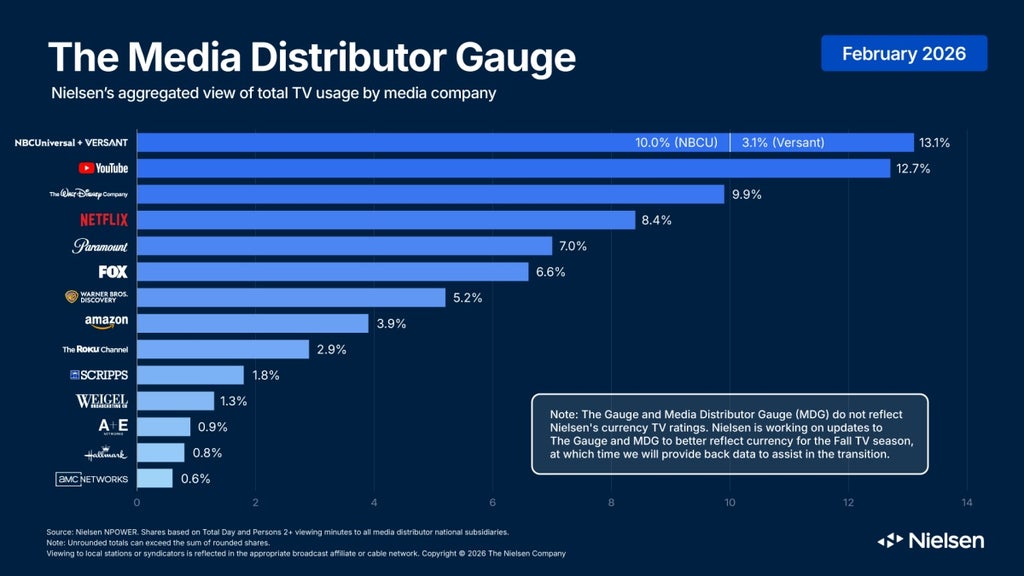
Among the major milestones that the Comcast-owned media company will tout are its 100th anniversary, the 20-year anniversary of the launch of the Housewives franchise and the 75th anniversary of NBC’s “The Today Show.” It also recently scored a victory in Nielsen’s Media Distributor Gauge in February, notching 13% of TV viewership for the month across its various platforms, primarily driven by its Super Bowl and Winter Olympics coverage. About 3% of that figure came from cable networks that were spun off into Versant in January.
“This is a fun year for us,” global advertising chairman Mark Marshall tells TheWrap’s Office With a View. “We’re proud of our legacy, but you don’t hang around 100 years unless you’re driven by innovation and evolution. So we’re excited to get to tell the story of what we what got us here and then what’s going to get us going forward into the next century.”
In early conversations with advertisers, Marshall says the major trend emerging is a “return to trying to find scale.”
“So many advertisers had really tried to start to use their data to get very narrow and I think they started to see that was fine for retention, but it wasn’t bringing in new consumers. So you saw this push back to bigger: Broadcast was bigger, sports were bigger, bigger streaming events as well live events,” he said. “We’ve seen categories like insurance, financial, tech that have all been very strong and they’ve gone into those big events. It wasn’t just about the Super Bowl or Olympics. We really started to see this about eight months before the Super Bowl and Olympics happened for us. So we see that trend continuing.”
Also looming large over the industry and upfront conversations is the $110 billion Paramount-Warner Bros. Discovery merger, which is slated to close by the third quarter. The deal is poised to give the combined entity more leverage to siphon off ad dollars, which are increasingly shifting away from linear TV and towards streaming and social media.
Marshall, who is no stranger to industry change, got his start in Chicago at the cable network Family Channel in 1992, which would go on to become Fox Family, ABC Family and then Freeform. In 2013, he joined Turner Broadcasting, where he would serve in a variety of positions, including advertising senior vice president and national sales manager, and oversee clients relationships for the NBA, MLB, NASCAR, PGA Championships and the NCAA Men’s Basketball Tournament in Chicago, Detroit, Los Angeles and Atlanta.
“When I was at Turner, we were purchased by AOL, which then eventually was purchased by AT&T, eventually purchased by Discovery and now purchased by Paramount. Change has always happened and, at the moment, it always feels like it’s a seismic change. But when you look at Warner Brothers, it’s traded four times in 25 years,” he said. “I don’t think [the Paramount merger will] be material, that it’ll change the [ad] industry dramatically. What probably changes more materially is how people aggregate scale.”
Since 2014, Marshall has served in various roles at NBCUniversal, including senior vice president of portfolio sales, executive vice president of entertainment, president of advertising and partnerships and global advertising and partnerships chairman. He noted that the company now reaches 286 million people across platforms every month, with over 100 million unique users at Peacock.
“That’s part of the secret sauce that we do have and what everyone is chasing,” he said. “Marketers need to be looking at who has the advertising reach, instead of just pure reach.”
Read on for the full conversation with Marshall below.

Comcast executives recently said that Peacock is “approaching” profitability. How do you see advertising helping the streaming service make it across that threshold and fueling its growth in the quarters and years ahead?
It’s funny because Peacock is only a portion of our total streaming. Everyone likes to focus on Peacock, but we also have all of our other digital assets and then linear. So we try to look at it as what we call one platform, all of it together. But I think Peacock has probably not gotten the credit it has deserved over time, because we’ve taken a little different approach.
We came fully with advertising when we first started it. It also looks more like a broadcast network in the sense that you have originals, sports, news, Telemundo, all of these different assets. So it’s not just focused on one genre. The monthly reach is over 100 million unique users and part of the secret sauce is it brings in all of these different consumers throughout the week.
The strategy we’ve always had is that dual revenue strategy of subscription as well as the advertising piece. So advertising has played a huge role in growing it to where we are today and we need to continue to do the things we’re doing moving forward.

This is also the first upfront since the Versant spinoff, though you’re still partnering with them in this cycle. What does advertiser demand look like in broadcast and cable? Are there customers looking solely at streaming or linear versus buying both?
There are absolutely people who would rather just buy one piece or the other and those are discussions that we have with all of them. But what I say is, if someone’s only buying streaming and if you add these linear networks, you can increase your reach by 43%. So we’re stopping the bifurcating of the two of them and starting to piece them together. What we want to be able to show them is a path where they can increase the reach.
People use broadcast differently. Even though the ratings aren’t what they were when there were only three networks and no streaming and all of that, it’s still delivering instantaneous reach, whereas on cable a lot of people have shifted to really driving against data-driven linear. Sometimes we forget cable was the original targeting way back when before we had all these tools.
There are very specific audiences that still exist. The MS Now audience is a big audience of people that are loyal to that network. CNBC is the same thing. Bravo has their fan base. So that’s why we try to make it easier for clients and say you shouldn’t have to decide between linear or digital or even if you want to buy USA Network versus E! or whatever it might be. You should get all of it in one package and we should be able to measure it together.
One of the things we’ve previously announced is the performance insights hub. It’s linear and digital on the same dashboard. You’ll be able to look at reach on both of those and you’ll be able to look at how do you increase reach. For most people, dashboards are typically only on the streaming side. The fact is, if 70% to 80% of all the ad impressions are on the linear side, you’re actually missing all of those impressions. So this will be the first thing that aggregates everything together.

Speaking of measurement, I wanted to get your thoughts on the recent methodology changes with Nielsen’s monthly Gauge reports, especially as you notched a major viewership win in February?
It’s a challenge for all of us right now because we don’t really feel like we have consistency as an industry of how everything is being measured. So while something might look more positive one month, it will change.
One of the things that has been a challenge is a lot of people will refer to the Gauge as an idea of consumption. But the fact is, the Gauge really shouldn’t be used for advertising, because it includes areas of YouTube that are ad free, Netflix has ad-free pieces in there. It doesn’t include the new DASH numbers. So I think we were confusing the marketplace overall.
I know they’re pulled back and they’re going to try to reformulate what they’re doing. We look forward to getting some consistency in these numbers and I think we, more than anything, have to make it easier for our agencies and our clients to have a single source of truth. What we’re trying to work with Nielsen on is to get a a real consistency of how we’re reporting what is for advertising and what isn’t. So we’re really looking at things apples to apples.
The fact is, when you look at the numbers from the Gauge, between 70% and 86% based on what number you’re reading of all ad impressions are still on linear television. When you look at the Gauge, it does not look like that. And so there’s a dramatic disparity between what an iSpot is saying versus what a Nielsen is saying. And so if you’re a client, you’re just confused. So we’ve got to make it easier for everyone.

What do you make of increased competition from big tech players like YouTube and Amazon’s Prime Video in the media & entertainment space and how do you see that impacting your upfront conversations with advertisers?
They’re a little bit different propositions. The majority of YouTube’s ads are biddable short form ads. They’ve increased some of their content investment, but they don’t invest a whole lot in content, whereas Amazon is investing more in content, but their model is using their [demand-side platform] to drive more people into their ecosystem to try to package together more shopper marketing and bring some of those budgets together as well. So all of them are different.
For us, the unique sauce is we get we don’t need to play in any other pool other than produce great content and measure it in brand new ways, provide full transparency of where every single unit runs, which you don’t get on some of the platforms we discussed, and letting the clients decide what’s working best for them, and do it in a fully transparent way.
One of the things we will be rolling out on this front that’s in early testing is Live Total Impact. We’ve always talked about these big live moments and you hear many of the tech platforms trying to get in this business of big live events, because it does create an immediate impact for a brand. This live total impact capability we have is we can look at the live exposure and follow the advertiser across linear and digital and retarget them to show what impact that big live event did to your every day moments and bring that all back together. We haven’t had that capability as an industry and that’ll be a trend that more people will jump on.
What are some of the major takeaways from your career that helped you get to where you are today? What is your advice for professionals looking to level up in their career or young people looking to break into the industry?
Part of it is a willingness to move and get outside your comfort zone. Leaving existing clients and relationships and going to a completely different market was a big challenge at the time, but I think it is beneficial in the long run.
I always say to people, if you can have the opportunity to move to a different market, it’s a great opportunity because you typically learn about different ad categories. Chicago is a big for package goods and insurance. Then you move to the West Coast and it’s tech and movie studios, and then East Coast is more financial. So the nice part is I’ve really got to touch almost all the categories from a client perspective.
Wherever you end up to go to work, I would make sure of two things. One is make sure you respect the people that you work for. And two is, I would have some scale at the company you’re going to work for. In this time of aggregation, your scale is going to be more important than ever. For young people, what I usually will say is we’re very lucky to work where we are, but the one thing you have 100% control over is how hard you work and how you show up. Those will be the two things that usually will differentiate who is the person who moves ahead in their career.
