

As Hollywood continues to shift away from quarterly subscriber metrics, all five of the major media companies saw streaming revenue rise, with most of the platforms now serving as a key growth engine, according to second quarter earnings results reported over the last couple of weeks.
All of the major platforms also turned or grew their profit, with the exception of Peacock, though Comcast executives told Wall Street the service is “approaching” profitability next quarter.
Netflix continued to reign supreme among the major players on subscribers, revenue and profitability, while Disney continues to be the legacy media competitor best positioned to give the streaming king a run for its money.
However, the competitive dynamic among the legacy media players could shift if Warner Bros. Discovery’s merger with Paramount goes through. On a combined basis, Paramount-WBD would have 219.6 million subscribers – just 200,000 shy of Disney’s latest available combined count of 219.8 million across Disney+, Hulu and ESPN+.
The deal is slated to close by the third quarter, although mounting opposition from Hollywood and the state attorneys general could throw a wrench in the process. If the deal is not closed by Sept. 30, WBD shareholders will receive a 25 cent per share “ticking fee” for each quarter until closing. In the event that the deal does not close at all due to regulatory matters, Paramount will pay WBD a $7 billion termination fee.
The latest numbers are an indication that media companies’ efforts to institute a lot more financial discipline around their streaming businesses to ensure their long-term longevity is paying off. At the same time, the decreasing transparency around subscriber disclosures signal that the streaming industry is nearing maturity on that front, leading to a shift in focus to engagement.
This analysis does not include Apple TV and Amazon’s Prime Video, which do not break out streaming subscriber, revenue or profitability metrics on a quarterly basis since they remain a small part of each respective tech giant’s business. However, during its first quarter earnings call, Amazon chief financial officer Brian Olsavsky said Prime Video has grown into a “large and profitable business in its own right.”
The tech giant previously revealed that Prime Video’s ad-supported tier reaches more than 315 million monthly viewers globally. According to a presentation by the NFL shared with the FCC, the service has roughly 180 million subscribers, though Amazon has not publicly confirmed that. Meanwhile, Apple Services vice president Eddy Cue has said that Apple TV has “significantly more” than the 45 million subscribers estimated by analysts, but declined to disclose a specific figure.
Check out the full breakdown of the numbers below.

Subscribers
Netflix and Disney, which stopped breaking out quarterly subscriber figures, continue to lead the pack with 325 million and 219.8 million, respectively, as of their last available disclosures.
Netflix stopped disclosing its subscribers on a quarterly basis at the end of 2024, but reported the latest milestone in January, while Disney phased out its subscriber figures at the end of 2025. Disney’s figure includes 131.6 million Disney+ subscribers, 64.1 million Hulu subscribers and 24.1 million ESPN+ subscribers.
Warner Bros. Discovery has joined the pair in no longer breaking out subscribers on a quarterly basis, but noted it surpassed 140 million streaming subscribers in its latest quarter and remains on track to exceed 150 million by year end. HBO Max’s international expansion is “largely complete” following its latest launches in the U.K., Ireland, Germany and Italy.
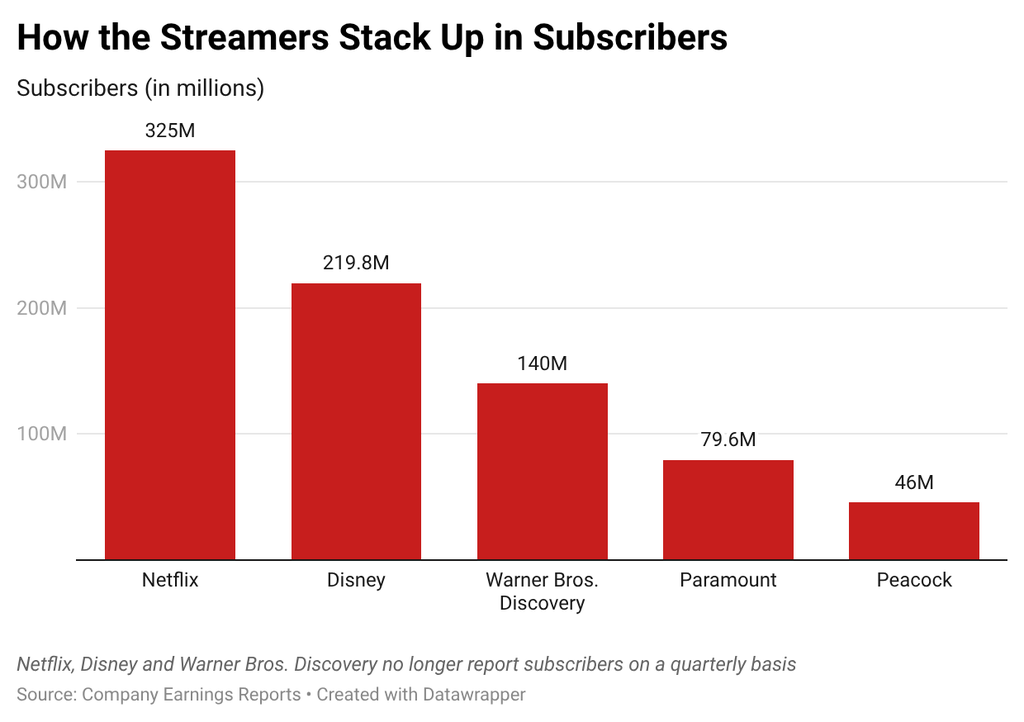
As for the rest of the major streamers, Paramount+ added 700,000 subscribers for a total of 79.6 million. Excluding the impact of the exit of international hard bundle subscribers – a set of lower revenue-generating customers – the service added 1.9 million subscribers.
While it continues to expect subscriber growth at Paramount+, it will be flat quarter over quarter due to the exit of approximately 2 million hard bundle subscribers. For the full year, subscriber growth is expected to remain healthy and accelerate year over year, though total paid subscribers will only be modestly higher compared to 2025 due to strategic hard bundle exits.
Finishing in last was Peacock, which added 2 million subscribers for a total of 46 million. Comcast co-CEO Mike Cavanagh has said that Peacock would remain a domestic-only streaming service, but that it would look to expand its subscriber base through bundles and other partnerships.
Peacock is available through individual bundles with Walmart+, Instacart and Apple TV, as well as Comcast’s Xfinity’s StreamSaver offering, which gives users the option to customize bundles with Disney+, Hulu, HBO Max, Apple TV and Netflix. Additionally, Peacock’s ad-free Premium Plus tier is available as an add-on through Prime Video Channels and Roku and will roll out on YouTube’s Primetime Channels in the coming months. DirecTV and Charter both offer Peacock as well.

Revenue
The major streamers have phased out quarterly average revenue per user disclosures. As a result, TheWrap’s analysis has switched to total streaming revenue for its quarterly comparison.
Netflix is still the clear winner on this front, with its revenue climbing 16% to $12.3 billion in its latest quarter. It is forecasting that revenue will grow 13.5% to $12.6 billion in the second quarter.
Disney landed in second, with Disney+ and Hulu’s combined revenue increasing 13% to $5.5 billion. Disney Chief Financial Officer Hugh Johnston confirmed that the company is now generating more revenue from its streaming business than its linear TV business.
While acknowledging that ESPN’s direct-to-consumer business is still ramping up, Disney said that revenue generated by digital subscribers during the quarter “more than offset the secular declines in the linear subscriber universe.” The company does not break out figures for ESPN streaming revenues.
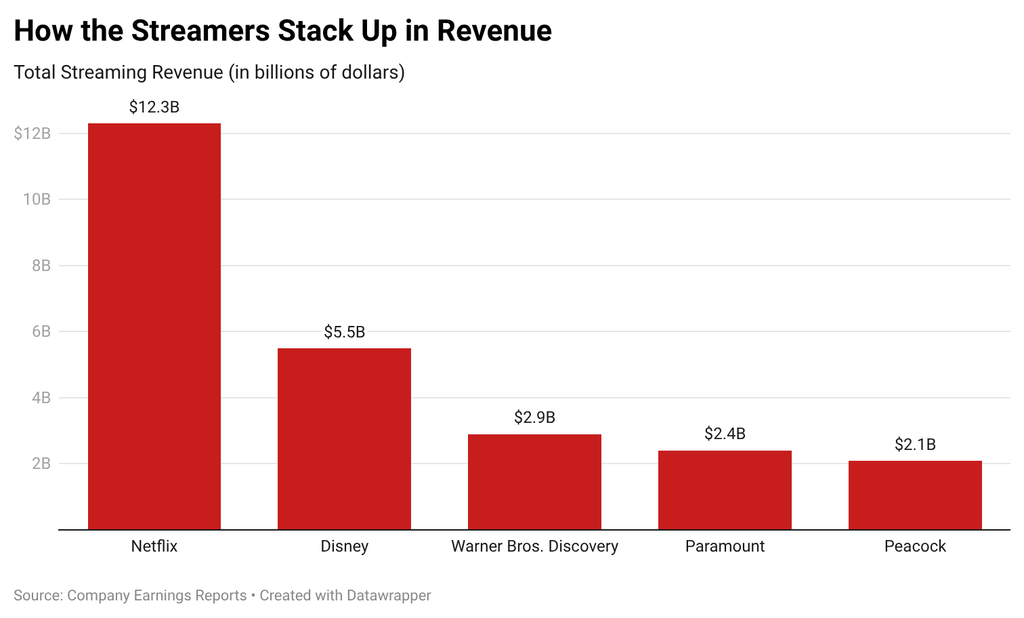
Meanwhile, WBD grew streaming revenue 9% to $2.9 billion. The absence of the NBA is expected to continue to weigh on streaming ad revenue in the second quarter. Executives also anticipate a “healthy acceleration” in subscriber-related revenue growth, which will pick up “real pace” starting in the second quarter.
Paramount’s streaming business grew total revenue 11% to $2.4 billion in the first quarter, with Paramount+ revenue increasing 17% to $1.97 billion. Peacock surpassed $2 billion in quarterly revenue for the first time, up from $1.2 billion in the prior year period.

Profits
On the profitability front, Netflix remains well ahead of the competition, with its profits growing 82% to $5.28 billion in its latest quarter. It is forecasting $3.3 billion in profit in the second quarter, compared to $3.13 billion in the year ago period.
Disney+ and Hulu also grew their combined profit 88% to $582 million and is on track to deliver a streaming operating margin of at least 10% in 2026. The company does not disclose profits for ESPN+.
WBD’s streaming profit increased 29% to $438 million. The direct-to-consumer division is expected to continue to improve profitability for the full year, though the absence of the NBA could weigh on its growth.
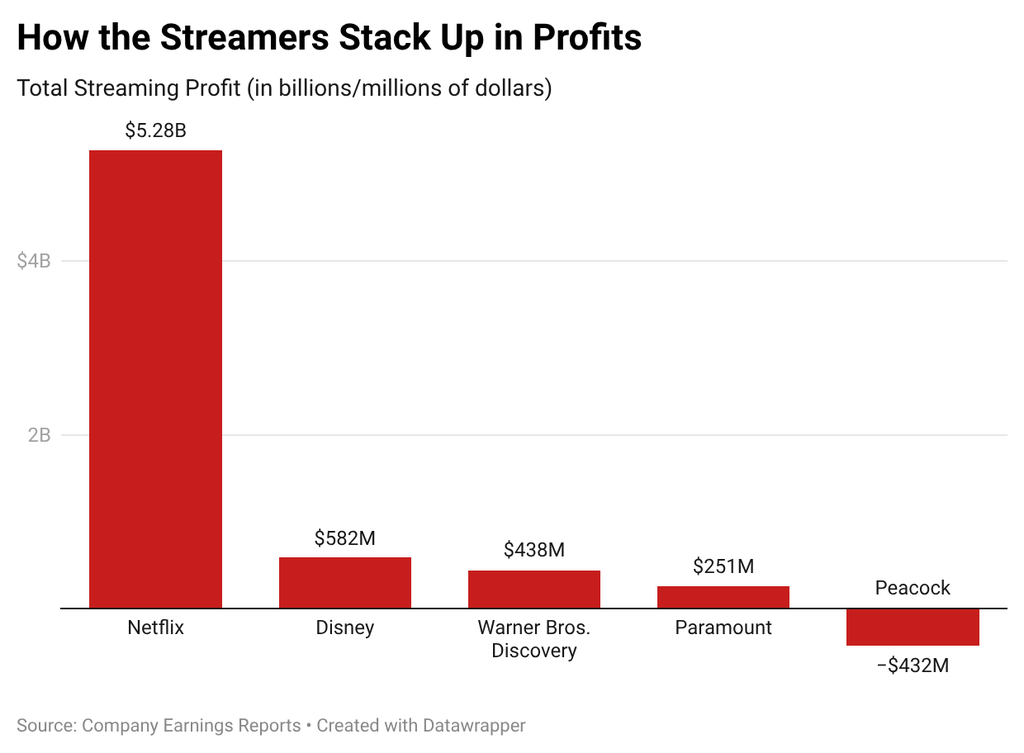
Paramount+ swung to a profit of $251 million in its latest quarter, from a loss of $4 million a year ago, and is expected to continue to make improvements in total profitability going forward.
Peacock remained the only one of the major streamers to post a loss, which widened to $432 million in its latest quarter. The service has lost more than $10 billion since launching in 2020. But Comcast executives argued that the latest quarter represented “peak EBITDA dilution from NBA costs” and that it is “approaching” profitability next quarter.
