
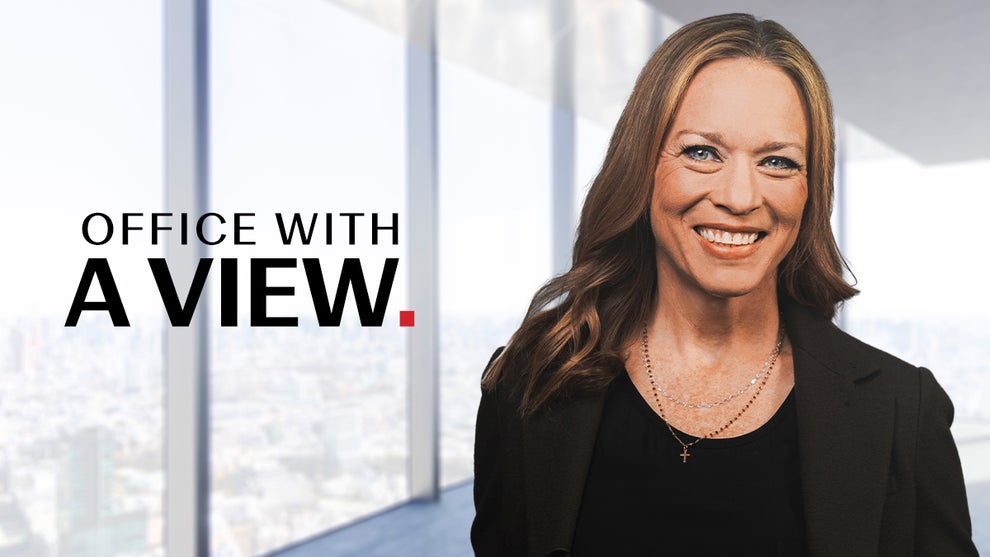
As Hollywood increasingly looks to leverage fandoms to boost their growth, Jon Erwin’s Wonder Project is looking to corner the market on the “faith and values” audience.
Since its founding in 2023, Wonder Project has raised over $100 million, closed a first look film and TV deal with Amazon’s Prime Video and launched its own streaming service through a partnership with the tech giant.
In addition to Erwin, the company’s strategy is overseen by CEO Kelly Merryman Hoogstraten, a veteran of Sony Pictures Entertainment, Netflix and YouTube who started her career in consulting and private equity, but longed for an opportunity to become a decision-maker instead of an advisor. Over the past 20 years, her accomplishments have included helping Netflix expand its international business, overseeing YouTube’s content teams, excluding music, and helping to launch YouTube TV and other subscription products to diversify its business.
“When I wanted to enter the arena, I was really drawn to transformation. [Netflix and YouTube] changed the type of programming that was being made in the marketplace, as you shifted from ad-supported linear television to subscription businesses and from mass market entertainment into finding the most deeply loyal audiences,” Hoogstraten told TheWrap’s Office With a View. “The result of that for me was in some ways a fracturing of the entertainment industry. The fracturing of content meant that we started to tell stories that were either all dark or all white and didn’t really represent life for me.”
In 2022, Erwin would come calling with an opportunity to help build Wonder Project, which Hoogstraten describes as a “co-viewing experience for the whole family” that “brings storytelling back around the fire the way it was meant to be.”
“That really resonated with me. It was about unity, not division. It was about restoration of faith, but it wasn’t restoration of faith solely in biblical stories. It was in God, but it was also in family, in country and in dreams,” she explained. “When Jon pitched it, I thought ‘Well that’s what I want to do, I want to create authentic, courageous stories’.”
Hoogstraten declined to disclose how many subscribers Wonder Project’s streaming service has to date, but noted there were 500,000 sign-ups in its first three weeks, driven by “House of David” Season 2.
In addition to “House of David,” Wonder Project’s content includes the film “Sarah’s Oil” and series “It’s Not Like That” and “The Old Stories: Moses.” It has also teamed up Angel Studios on the film “Young Washington,” which premieres in theaters Friday and sold over 150,000 tickets two weeks prior to its release. Additionally, the company launched a new technology division Innovative Dreams, which combines performance capture, virtual production and generative AI tools.
“As we look to the future of Wonder, we really love this idea of curating categories of programming through franchises that can meet different needs of audiences,” Hoogstraten said. “[The goal is to] really turn those audiences into communities, and then super serve a subset of those through our channel, through early access and curation and then drive more programming out into the world through Innovative Dreams.”
Read on for the rest of TheWrap’s conversation with Hoogstraten below, which has been lightly edited for clarity and brevity.

How does hybrid filmmaking out of Innovative Dreams work and where have you used the technology?
In the very structured way of making film, we’ve got multiple weeks of pre-production, we’ve got multiple weeks of production, and then we’ve got multiple weeks of post-production. Those numbers can be 12 [weeks] in each space, so it’s a very long process. So a lot of times what happens is that the VFX happens after picture lock.
What we’re seeing with hybrid filmmaking is pulling those things into a parallel fashion versus serialized, so you can start to stack pre-production, production, and post-production on top of each other and create a virtuous cycle where you’re testing and iterating in real time when you have the actors there. Instead of shooting in front of a green screen, you’re actually putting something up on a wall, and the actor is playing towards that. You’re creating an environment that you’re going to amplify over time. So you have more interaction on the creative elements in real time. You can solve problems while the actors and the whole crew is on set, instead of having to do reshoots three months later.
The coolest part about the hybrid technology is it can be used in a scene or across the entirety of a story. Inside both “House of David” and “Young Washington,” it was used on location as a way to enhance and amplify certain scenes. Then what you’re seeing inside of “Old Stories: Moses” is our first opportunity to really work closely with our partners at Amazon and Luma to try and figure out how to create an end to end solution where we actually did the full filming on the stages in Manhattan Beach.
How do you see AI’s use in production evolving in the coming years?
In six to 12 months, we’re going to look back at Cannes this May as a real transformational time in AI. Lots of people went to Cannes and there were lots of conversations around AI during that time. At least for me, I felt a shift in the marketplace coming out of Cannes from mostly fear and a little bit of curiosity to mostly curiosity. That curiosity is going to spur lots of testing and iteration and questions and education over the course of the next 12 months, which I believe is going to start leading us down the path of adoption.
You never quite know how long it’s going to take, but this feels like it’s moving very quickly from a technology standpoint to an adoption standpoint. It will be interesting to see how quickly adoption takes hold. They’re not going to say, like, “Oh, I’m going to take this entire film and drop it into a new process.” They’re going to say, “How do I integrate the process into the world that I currently operate in, in a way that allows me to really learn,” and I think we’re going to see a lot of filmmakers leaning into that testing and education process over the next 12 months.

In addition to AI, we’re also seeing the competitive landscape shift through consolidation such as the Paramount-Warner Bros. merger. How do you see consolidation impacting the work that you do and the partners you’re able to work with?
I like to start by saying, let’s keep the audience at the center. If we can keep the audience at the center, then the goal is how do we best serve the audience in the most commercially viable ways. Production has gotten really expensive and so we’ve got to figure out ways to bring the cost of production down so that we can make more programming for the audience and it’s possible that consolidation at the supplier side can be useful there.
I also think these conversations are complicated because these are not just suppliers of programming, but they’re also distributors of programming. I don’t have any visibility or knowledge around trying to solve supply side production cost efficiencies or trying to aggregate eyeballs to broaden demand and distribution, but I think both of those things are probably at play and what we want to always be careful of is that we don’t create consolidation at the cost of creativity, we don’t do consolidation at the cost of the audience’s desires for diversified programming out there. I would hope that the consolidation that we’re seeing today actually creates flourishing in creativity and in storytelling and the diversity of that storytelling.
When looking ahead, what are some of Wonder Project’s long-term goals? Do you see the offering evolving beyond just TV series and films into areas like podcasts? What about mergers and acquisitions or going public on the stock market similar to your partner Angel Studios?
When I was at YouTube, I was a huge proponent of having conversations with creators and saying YouTube shouldn’t be your sole source of revenue, you should try and create a 360 business and a brand, and I wholeheartedly love that strategy. So as we think about building Wonder and the brand, what are the opportunities beyond film and television over time that our audience gives us permission to do? You can’t just do anything for any reason, you’ve got to do it because the audience really gives you that permission.
The second piece is your investors are always asking you to have as many options as possible. So, from my perspective, if you dream big and you have a big opportunity in front of you, which is what we have with Wonder, then the size and scope of that opportunity gives us a lot of freedom to imagine remaining private over time and taking capital through private ventures and being independent. It also allows us the possibility to go public if we chose to do so over time and the opportunity to do a strategic acquisition — either pulling people into our environment or moving into somebody else’s environment — over time.
As a CEO, my job is to keep those three roads open and clear as long as I can and I feel like we’re building a business that absolutely has the potential and the possibility to have pretty broad reach over time and be attractive in all of those markets. I want Wonder to be a major player in the marketplace 50 years from now. If that’s the case, then over the course of the next 10 years we should be evaluating lots of different opportunities to scale the business both organically and inorganically.

What is your advice for young people looking to break into the industry and for industry professionals looking to advance in their careers?
My first piece of advice is actually a quote from “Young Washington,” where it says, “Failure is a great teacher.” For so many folks coming out of college and finding their first jobs, they view risk and failure as something to stay away from. They just want to do the job, be great at the job and I would say being a great executor has a ceiling. Being a great innovator and being willing to take smart, thoughtful risks allows you to learn and you can have a much faster trajectory when you do that. We as managers and leaders need to actually encourage that failure more often, because it will help us to get to the next place quicker and innovation is driving our business right now.
The second piece is work with people you like. So often, folks are really anchored on the name of the company or the name of the job title, and I would say that a career is very rarely a straight line. It is very windy and you will have moments in your career where you get a chance to learn an exponential amount and transform as an executive. Look for those opportunities and for the people that you want to spend time with while you’re on those journeys.
Also, acknowledge that you are probably most successful when you have a healthy respect that work cannot be the only thing in your life. What is that person or animal or experience or place that grounds you beyond work? I am a better leader because I am a wife and a mother.