

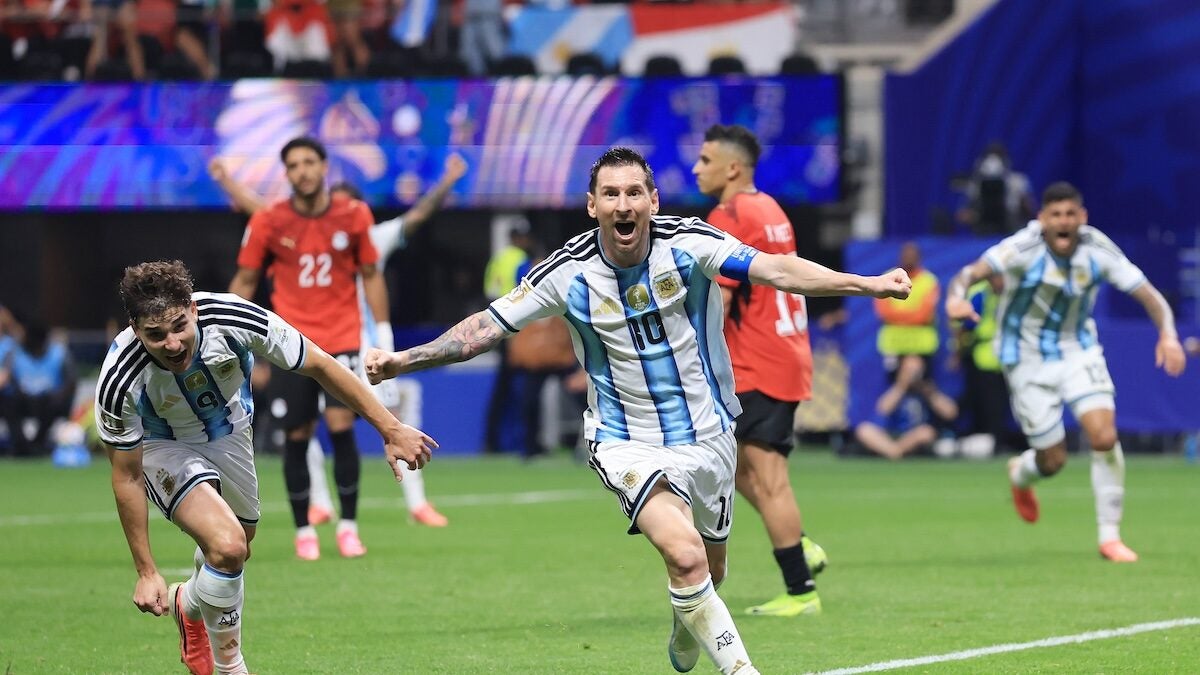
The World Cup has generated pricey tickets, record ratings, huge levels of beer consumption and new respect for ranch dressing. The excitement is also sparking investor interest in soccer, even if it’s already a crowded field.
In recent years, celebrities like LeBron James, Matthew McConaughey and Michael B. Jordan have bought stakes in soccer (sorry, football) teams. Some, like Eva Longoria, Tom Brady and Ryan Reynolds and Rob Mac, have turned their investments into content, with “Welcome to Wrexham” the prime example. Rich Americans and big investment firms have been buying stakes in the best-known English Premier League teams.
Like the game itself, soccer has peculiar rules that make investing in teams risky. At the same time, some countries are opening their clubs to outside investment and creating rules that make it less likely an owner will have to swallow big operating losses while hoping the team’s equity value rises.
In other deal news, following the July 4th weekend, billionaires and media moguls flew to Sun Valley, Idaho, for the annual Allen & Co. retreat where potential media deals will be discussed. Those high-level conversations will add fuel to an M&A environment that is already racing at a frenzied pace.
Thanks for reading.
Jon Lafayette
P.S.: Send your tips and pitches to jon.lafayette@thewrap.com
THE DEEP DIVE

Soccer’s Complicated Investor Playing Field
The popularity of the World Cup in the United States could lead more investors to put money into the beautiful game. But soccer is a fragmented, niche business.
A handful of the top teams are public and international. Other international teams are smaller and private. In the U.S., Major League Soccer is hoping to get a boost from the World Cup, especially from an increase in younger players and fans. Each segment offers different opportunities for investors, deal makers said.
Alex Michael, managing director at LionTree, said the benefits of the World Cup have already been priced in to team valuations.
“We’ve seen a breathless acceleration of sports properties at large over, in particular, the last five years,” said Michael. “MLS, European soccer, even Mexican soccer have all seen upticks in value.”

Sports serves as an antidote to AI because it involves real people at an in-person event, and that factor has powered interest for sports ownership, he said.
- Some international soccer teams are part of publicly held companies, including Manchester United. The Glazer family is reportedly considering selling its interest in the perennial EPL powerhouse.
- Investors risk unsuccessful teams getting relegated to a lower-level division, where media rights fees are lower and revenues can’t cover the salaries of top players.
- Teams in the U.K.’s lower-level League Two may present a good opportunity for investors. It’s a way to get in while prices are relatively low.
- Teams in North America’s Major League Soccer are already selling at prices of about $700 million. Teams that are building new stadiums complexes might be good investments.
While soccer isn’t a big four sport in the U.S., it’s still attracting a healthy flow of capital.
“You see that in the valuation of these teams. These values are nothing to scoff at,” Michael said.
The World Cup has only added to that momentum (although some of that excitement may have been dampened after Team USA got decimated by Belgium this week).
“It’s hard to draw a direct line from the World Cup to the value of those teams, but over time it should play out,” said Chris Marangi, president and co-CIO of GAMCO Investors. “Sports teams are generally asset plays, much like gold or fine art. They’re viewed as stores of value and not based on a PE or cash flow basis.”
Despite their global popularity, the most valuable soccer teams trade at lower multiples than U.S. sports teams (think the Los Angeles Lakers or New York Yankees), with the threat of relegation a big factor.
Relegation is when an underperforming team on a European circuit gets dropped to a lower-level division. The result is lower media rights payments, the loss of popular players and a sudden loss in equity value.
Contrast that with the underperforming Colorado Rockies from last season. Having the worst record in the MLB doesn’t mean it gets dropped into the minor leagues.
Marangi noted that some of that valuation gap for soccer teams might be narrowed because of excitement over the World Cup in the U.S., he said.
A handful of international teams are publicly held but thinly traded. Those include Manchester United in the U.K., Borussia Dortmund in Germany, Lazio in Italy and Juventus in Brazil. Those stocks have been mixed since the beginning of the year. (GAMCO offers funds that include positions in teams.)
One deal on the horizon could come from Manchester United. The Glazer family, which also owns the NFL’s Tampa Bay Buccaneers, is reportedly discussing its 29% stake in the team. ManU shares rose last month on the reports.

American inventors might be drawn to popular European teams that play in storied historic buildings, Marangi said. Those facilities need to be upgraded, which means those teams are looking for new sources of financing, with the most likely coming from the U.S. and the Middle East.
Meanwhile, in Canada, Rogers Communications this week agreed to pay $3.06 billion for the 25% it doesn’t already own of Maple Leaf Sports & Entertainment, whose assets include the NHL Toronto Maple Leafs, the NBA Raptors, the CFL Argonauts and Toronto FC, which plays in Major League Soccer.
Marangi expects Rogers to sell a minority interest in MLSE to individual or institutional investors. An IPO could be down the road eventually.
Think Smaller
Andre Da Costa, founder and managing partner of Expedition, a football advisory and investment firm, sees value in European teams not playing in the highest-level leagues.
“The most interesting opportunity in English football right now is League One, the third tier, ” Da Costa said. “Entry points are still accessible, many of these clubs carry over a hundred years of heritage and some are the only club in their city.”
On top of that, the impact of a relegation from League One to League Two isn’t as catastrophic as being dropped from the Premier League. The upside is the possibility of getting promoted to the EPL.
Da Costa said one could become a passive investor in a team by putting as little as $250,000 into a special purchase vehicle along with other backers and get modest ownership perks and benefits.
“Investors can realistically expect returns of two to six times capital if they hold onto the investment for five to eight years,” Da Costa said. “These clubs need patient money. Private equity funds typically face pressure to return capital to their LPs on a tighter timeline, while family offices can hold longer, even if there’s sometimes a trophy asset motivation layered on top of the financial thesis.”
American interest is also growing in Mexico’s Liga MX, the most-watched soccer league in the U.S. because of its popularity with Hispanic fans, Da Costa said. Longoria, for example, is an investor in Club Nexaca, which competes in that league.
Da Costa said the popularity of the World Cup has accelerated interest in investing in soccer, but what really moved the needle for serious investors is the introduction of better financial control systems by some leagues.
“That signals the sport is addressing its sustainability problem instead of just bleeding money indefinitely, and that’s what gives institutional capital confidence,” he said.
“The biggest mistake outside capital makes is underestimating how niche this industry really is,” Da Costa added.
Field Level
Meanwhile in North America, prices for teams in Major League Soccer are already high, with valuation at more than $700 million, according to Bruce Lefkowitz, co-founder of Field Level Advisory Group.
He’s not sure that the big ratings Fox is getting for the World Cup will create more long-term soccer fans or additional viewers for MLS games.
Additional fans and viewership would boost the value of the league’s media rights, now with Apple as part of a $2.5 billion streaming deal that runs through the 2028-29 season.
Investors might be interested in teams that are building new stadiums as part of a bigger development, including the New York Football Club. “That’s where the real money is. It’s a real estate play,” said Lefkowitz, a former Fox executive.
Ultimately the decision to invest in soccer in the U.S. comes down to value vs. vanity, Lefkowitz said. “Are you looking for economic value and return on investment, or do you want to be in the owner’s box, wear a scarf and say you own a professional soccer team?”
DEAL SHEET
- Versant, the Comcast spinoff that owns the Golf Channel, made a deal to acquire Full Swing, which makes high-tech golf simulators, for $530 million in cash. “Sports are becoming more interactive, more data-driven and more connected, and Full Swing allows us to build on that momentum,” said Versant CEO Mark Lazarus. “Starting from our strength in golf, we see an opportunity to scale a multi-sports technology platform for athletes, coaches, consumers and fans.”
- Vista Equity Partners and Quinti Capital offered to acquire ad-tech company Criteo, according to Bloomberg. The bid is reportedly pegged at a 50% premium to Criteo’s recent stock price. Criteo closed at $22.83 on Wednesday. Criteo has not decided how to respond to the takeover effort, Bloomberg said.
- Holders of $1.5 billion in debt owed by Echostar’s Hughes Network Systems have tapped restructuring lawyers, according to the Wall Street Journal. The debt will mature on Aug. 1. EchoStar’s Dish pay-TV unit filed for bankruptcy last week.
- The Federal Trade Commission has greenlit James Murdoch’s $300 million purchase of Vox Media assets including its podcast network, New York magazine and Vox.com. The earlier-than-expected decision was disclosed on the FTC’s website. Vox sold its remaining assets to Penske Media Corp.

WRAP 20 INDEX
TheWrap 20 Index took another hit this week as media continues to be in the red as we enter the second half.

FINANCIAL ROUNDUP
Billionaires Hit Summer Camp
Media moguls and tech titans converged at Allen & Co.’s annual summer media conference in Sun Valley, Idaho.
The guest list is officially confidential, but photographers spotted execs including Disney CEO Josh D’Amaro and his predecessors Bob Iger and Michael Eisner, Comcast co-CEOs Brian Roberts and Mike Cavanagh, Netflix co-CEO Ted Sarandos, Barry Diller of IAC, Warner Bros. Discovery CEO David Zaslav, Sony Pictures’ Ravi Ahuja along with YouTube head Neal Mohan, OpenAI chairman Bret Taylor and Yahoo co-founder and former CEO Jerry Yang.
GM CEO Mary Barra, MLB Commissioner Rob Manfred, Red Sox owner John Henry, producer Brian Grazer and Wendi Deng (Rupert Murdoch’s ex) were also spotted at the gathering.
There has been a frenzy of M&A activity in the media business, with Paramount Skydance buying Warner Bros. Discovery, Comcast spinning off NBCUniversal, and Fox buying Roku. Observers expect that at some point, cash-laden tech giants will start to buy media assets. Potential deals could start as conversations at what’s known as billionaire’s summer camp.
Watch This Space
MoffettNathanson, the equity research firm well respected for its coverage of the media business, is venturing into a new sector with coverage of Elon Musk’s SpaceX. Julie Zhu will lead coverage of SpaceX, with Nick Del Deo focusing on its AI infrastructure business and founder and cable maven Craig Moffett analyzing its connectivity business Starlink.
In its first report, MoffettNathanson notes that Wall Street has looked at SpaceX in two main ways.
“One camp has fawned over the sheer audacity of the enterprise and the spectacular size of SpaceX’s addressable market. The other has relentlessly lampooned the utter ridiculousness of so many of the numbers thrown around in the company’s S-1 and analyst commentary. We’re in neither camp,” the report said.
“For now, with ample reason for skepticism about forecasts, but with equal reason for optimism about the optionality that comes from the space segment’s enormous moat and undeniable flywheel, we find ourselves conceding that today’s astronomical (yes, forgive the pun) valuation is perhaps not entirely unreasonable after all. “
Bottom line: MoffettNathanson is neutral on SpaceX shares, with a target price of $131. SpaceX went public at $150 a share and after a short burst, has fallen back to a Wednesday closing price of $148.26
The Paramount-WBD Saga (Continued)
Oregon Attorney General Dan Rayfield said he will ask a court to delay the closing of Paramount’s $110 million acquisition of Warner Bros. Discovery by 60 days. The AG claims it needs extra time to order Paramount to turn over records.
Paramount agreed not to close the transaction before July 22. It previously said it wouldn’t close before July 16.
“We’re not going to let Paramount Skydance play hide the ball so they can rush through their massive merger,” Rayfield said in a statement received by Reuters. “Oregonians have a real stake in this deal – in our film industry, in our economy, in the choices they’ll have as consumers.”
A Paramount spokesperson said the information Oregon seeks “has nothing to do with whether this transaction complies with Oregon’s antitrust laws and is not a legitimate basis to delay a plainly lawful, pro-competitive transaction.”
A group of attorneys general from states including California, New York and Pennsylvania are expected to file an antitrust suit against the deal as soon as next week.
FROM THEWRAP
M+C Saatchi North America Launches Entertainment Marketing Practice, Taps Jen Bacchus to Lead
The Hill Launches Paid Subscription Service With Premium Content, Journalist Access
Does Disney Need a One-Stop App for Streaming and Theme Parks?
HEARD AROUND
What Microsoft Is Offering Laid-Off Employees in Severance
Arnold Ventures Awards $2.6 Million for Universities to Research Sports Betting