
Warner Bros. Discovery CEO David Zaslav’s eye-popping golden parachute for selling the company to Paramount — worth as much as $887 million — is rich enough that even the gatekeepers of corporate governance are taking notice.
As shareholders prepare for the company’s special meeting on April 23, influential proxy advisory firms Institutional Shareholder Services and Glass Lewis have taken aim at Zaslav’s pay. ISS recommended shareholders vote against the “extraordinary” and “problematic” compensation package, calling it “inconsistent with common market practice.” Glass Lewis added Zaslav’s tax reimbursement “represents a considerable and unnecessary cost to shareholders.”
That they’re speaking up is significant — ISS, for example, agreed with management of S&P 500 companies 96% of the time during the 2025 season — and raises the question of whether Zaslav’s compensation package goes overboard. Critics have argued that Zaslav was never really an effective leader of the media company, with its stock continuing to languish before all the M&A activity. But some company observers say that’s all that really matters, and Warner Bros. did have a banner 2025 with a box office winning streak, several Oscars (including Best Picture) and smash streaming hit “The Pitt” alongside HBO Max continuing to post a profit.
“In a way, Zaslav deserves an Academy Award for Best Performance of a CEO in terms of raising this stock price,” MarketWatch co-founder Derek Reisfield told TheWrap, with shares still in a rut as late as September. “But it was due to somebody coming and buying the company, not because it was being managed and had great prospects on its own. It was languishing.”
This isn’t the first time Zaslav’s pay faced scrutiny, as shareholders previously voted to reject his $51.9 million pay package in 2024. That package, when compared to the median WBD employee’s annual compensation of $130,316 that year, put Zaslav’s pay ratio at 398 to 1. At the time, WBD said it takes the results of the executive pay vote “seriously” and that it would continue its “regular practice” of engaging in a “constructive dialogue” with shareholders.

These kinds of shareholder votes aren’t binding, but a rejection of the pay package could convince the board to make changes in order to avoid investor outcry and reputational damage down the line.
What’s gotten proxy firms up in arms specifically is the part of the compensation package that relates to tax reimbursement, which had a maximum potential value of $335 million on top of the $552 million in stock, cash and benefits he was set to receive.
That massive pay day comes at a time when Hollywood and WBD’s workforce are anxiously bracing for more cuts under Paramount’s ownership, with David Ellison’s $110 billion deal aiming to close by the third quarter. Paramount executives have said they expect over $6 billion in merger cost cuts from the deal – the majority of which they maintain will come from “non-labor sources” – but layoffs are inevitable.
But ultimately, it’s the shareholders who will decide whether Zaslav has earned his pay for securing that final offer price of $31 a share — quadruple WBD’s 52-week low of $7.75 a share.
A WBD spokesperson declined to comment.
How much is Zaslav getting?
Under the terms of the package tied to the Paramount merger, Zaslav will receive a total of $34.2 million in cash, $517.2 million in equity and $44,195 in “perquisites and benefits.” The cash component includes $6 million in salary severance and $28.2 million in bonus severance. The equity component includes $443.1 million in options, $60.9 million in restricted stock units and $13.2 million in performance-based restricted stock units.
Additionally, Zaslav is eligible to receive a tax reimbursement, though the final amount will “significantly decline with the passage of time” under IRS rules depending on when the deal closes. Had the Paramount merger closed on March 11, Zaslav would’ve been eligible for a $335.4 million tax reimbursement, bringing his estimated total compensation package to $887 million.
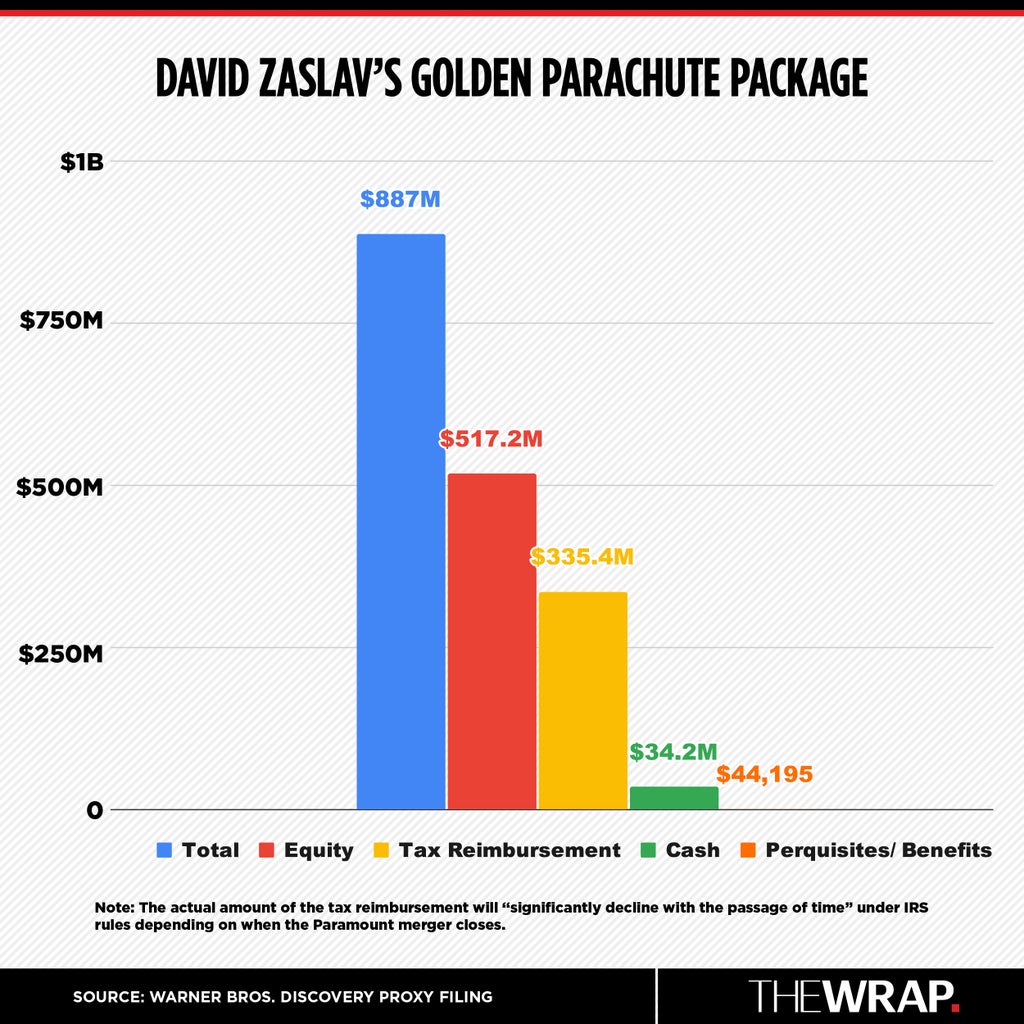
Based on current estimates from WBD’s outside tax advisers, if the Paramount-WBD closing were to occur in 2027, no tax reimbursement payment would be expected to be made to Zaslav.
ISS said the payout “represents one of the highest golden parachute estimates ever observed” due to a “problematic” tax reimbursement and “single trigger vesting acceleration” for the vast majority of the package’s unvested equity awards, meaning that Zaslav would be paid as soon as a change in control occurs, which the firm said is not the best practice.
Glass Lewis argued that the “decision to implement gross-up provisions on the eve of a transaction deprives shareholders of the ability to consider and weigh such provisions fully and appropriately” and raises “severe concern.”

Did Zaslav earn it?
While Zaslav’s payout is a significant sum, Jeffrey Sonnenfeld, founder and CEO of Yale School of Management’s Chief Executive Leadership Institute, argued that ISS and Glass Lewis’ recommendations were taking a “rigid checklist approach” that “often reflects institutional superstition rather than financial fact.”
Sonnenfeld and CELI senior research fellow Stephen Henriques estimate that Zaslav and the WBD board’s decision to reopen negotiations added $31.6 billion in value for shareholders — a 65% increase over the initial offer — and said the resulting reward is “well within market rates for such high value creation.”
“By refusing the floor price and shrewdly forcing the Ellisons to present their best offer before opening a bidding process, Zaslav secured $31/share,” Sonnenfeld told TheWrap. “Zaslav’s $550 million payout represents only 1.8% of the additional $31 billion he secured. For comparison, an investment banker would typically command a 2–3% fee for the same result. In this instance, Zaslav outperformed what any traditional banker could have delivered.”
Glass Lewis also acknowledged that, when excluding the tax reimbursement, the payments represent approximately 2.9% of the equity premium of the merger, which it said is “not excessive.”

Might shareholders vote no?
Zaslav and the board can’t simply dismiss the conclusions of firms like ISS or Glass Lewis, which hold weight with shareholders, experts told TheWrap.
“[ISS and Glass Lewis] can sway a meaningful chunk of institutional investors directly,” Lisa Solbakken, co-founder and managing partner at Arkin Solbakken LLP, told TheWrap.“But they also have sway over other shareholders more indirectly that, at the end of the day, can move a needle by double digits in a closer, controversial vote that can be decisive.”
“They might carry 30-some-odd percent of the vote. That’s a big number and, certainly for management, not a good thing when both of them say no,” Charles Elson, the founding director of University of Delaware’s Weinberg Center for Corporate Governance, added. “I suspect a lot of institutions who might not have their own group evaluating it will probably think similarly.”
If shareholders end up rejecting Zaslav’s compensation, experts said it could put unwanted pressure on the board to try to modify the package. Regulatory attorney Braden Perry told TheWrap it can “accelerate calls for governance reform, fuel shareholder litigation over fiduciary duty and create real headaches for the compensation committee going forward.”

What happens if shareholders vote no?
The shareholder vote is non-binding. The risk is more of a reputational concern than a legal one if the board opts to stick with Zaslav’s compensation package.
“If it’s a resounding no, then it’s going to follow these directors reputationally no matter what boards they serve on,” Solbakken warned. “People may vote with their feet in the next board election.”
Though Say-on-Pay and golden parachute advisory votes are more symbolic, it’s not uncommon for companies to modify pay packages in order to mitigate their exposure to potential litigation.
One notable example where adjustments occurred is with Netflix, who promised “substantial changes” and a “more conventional model” after its executive compensation packages were rejected by shareholders back in 2023. After the pushback, Netflix decided to cap its co-CEOs base salaries at $3 million and required that 50% of their pay be in stock options.
“[An advisory vote] gives the board a sense of where the shareholders are, and if they reject it by a margin or a decent margin, then you really need to rethink what you’re doing. I’ve seen situations where shareholders have rejected a pay package and the board did an about face,” Elson said. “The shareholders own the business. It’s their money and you can’t tell someone what to do with their money.”
“I can understand why [Zaslav] wants to get as much as he can on an exit. But he’s in a different position than the directors,” he added. “A good director doesn’t need or want those kinds of complications because they’re unhealthy for the business and unhealthy for their own reputations.”
While experts didn’t rule out the possibility of shareholder lawsuits, they noted that investors would have to prove that the board breached their fiduciary duty, which would not only be a high burden but a costly endeavor to pursue. It’s also unlikely that this vote would impact the actual approval of the Paramount-WBD merger, especially as both ISS and Glass Lewis have recommended the deal itself despite rejecting the payout.
“It’s in nobody’s interest to have a protracted legal wrangling over this,” Reisfield said. “It’s pretty much in everybody’s interest to settle this and move on.”
