
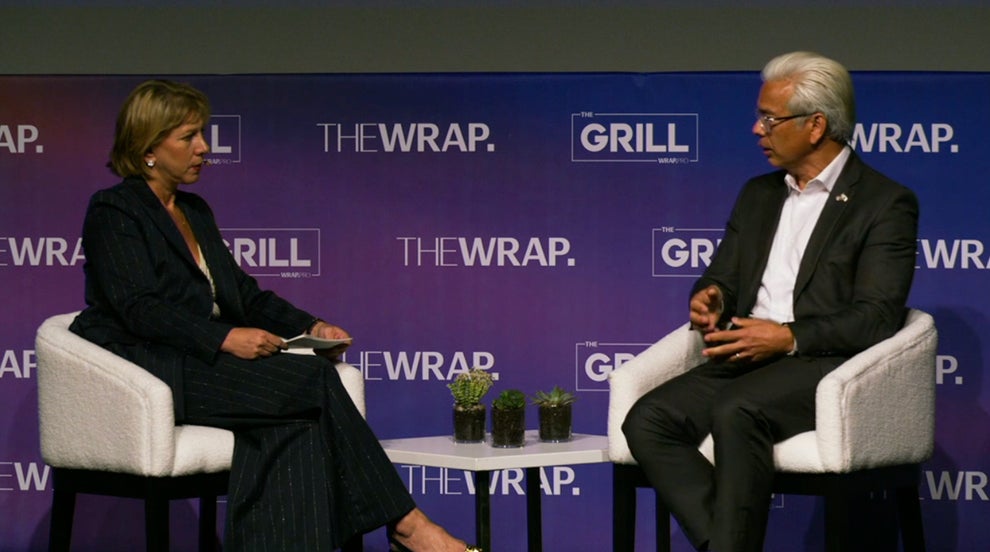
California Attorney General Rob Bonta defended himself over claims that he and 11 other state AGs caved on their settlement resolving antitrust litigation against the $110 billion Paramount-Warner Bros. Discovery merger.
“I appreciate and understand the diversity of perspectives on this proposed settlement. I will certainly vehemently, respectfully, disagree with with those positions,” Bonta told Sharon Waxman during TheWrap’s 2026 TheGrill conference on Wednesday. “We set out to solve an antitrust problem that we saw in two markets that were impacted by this proposed merger in the distribution of wide-release films market, including blockbuster films, and the basic cable channel licensing market. For a long time there was no proposed solution and then Paramount came to the table in good faith to act sincerely to settle the antitrust case.”
He also pushed back on claims that California Gov. Gavin Newsom, Los Angeles Mayor Karen Bass, the Democratic nominee in California’s gubernatorial race Xavier Becerra or Paramount CEO David Ellison’s threat to move the Hollywood studio out of the state pressured him into settling. The latter could’ve resulted in up to $21.2 billion loss in annual economic output, per Los Angeles’ Economic Development Corporation.
“My job is to focus on the antitrust concerns and getting a resolution. So what a company may or may not do, what a governor or a next governor says or doesn’t say, has no influence,” Bonta continued. “I’m the attorney general of California. I need to make a decision about the case that I brought with my 11 other attorneys general, and if we get a resolution to that case, as we did when Paramount finally came to the table in good faith, then we take it and we resolve the case.”
He added that it was ultimately a “unanimous” decision for the states to settle the case, though Connecticut AG William Tong unsuccessfully pushed for Paramount-WBD to divest CNN and CBS News during negotiations.
Under the terms of the settlement, Paramount-WBD must release at least 30 films a year in theaters for two years and 32 per year for the following three years. At least four films per year must be independent films and at least 20% must be blockbusters. If Congress passes a federal film tax credit, Paramount agreed that 20% of all film production must be in the U.S. for the first two years of the merger and 30% of the next three.
Bonta further stated this requirement is the “opposite” of the Disney-Fox merger, noting that the two companies made about 28 films per year before the combination, which would later drop to 14 films per year.
The combined company is also required to invest a minimum of $1.5 billion over five years in domestic TV and film production and negotiate the distribution agreements for each company’s suite of cable networks separately. Additionally, it must set up an independent editorial board to oversee the CNN and CBS News operations, which Bonta said would help “ensure journalistic integrity and fact-based, non-biased, objective reporting.”
“I’m an American. I care about our information ecosystem. I think it’s broken. I think there’s too much misinformation. There’s too much disinformation,” he said when asked about the future of CNN, news and free speech. “I think we can only move forward as a society, as a country, if we share the same facts, so that we can base our solutions on those facts. But we don’t share the same facts, so of course I’m concerned about it, which is the reason that among the AGs we had a rightful concern in the settlement process, which is more flexible and more provides more opportunity for creativity.”
Other settlement terms include continuing to operate Paramount and Warner Bros. Discovery’s studio lots for five years, honoring collective bargaining agreements with Hollywood’s unions and making community investments, including a $5 million-per-year contribution to an independent film fund and $9.5 million annually for film and TV career training and development programs to benefit qualified educational institutions and community arts organizations.
Failure to comply with the various commitments in the settlement range from a $30 million penalty per film that misses the theatrical goal to forced divestitures of the company’s 49% Miramax stake within a 12-month period as well as BET, Comedy Central, VH1, Smithsonian, Destination America and Science Channel within a 120-day period.

Despite Bonta’s comments, the settlement has raised concerns among the Block the Merger coalition, which believes it is “weak and unenforceable.” Sen. Corey Booker also asked the court to subject the consent decree to an “independent public-interest review” before entering it.
But Judge Araceli Martinez-Olguin approved the agreement on Wednesday, calling it a “fair, reasonable, and good faith approach” to addressing the harms alleged in the AGs’ lawsuit. Ellison has said that the deal would close within two weeks of reaching the settlement, or early October.
Paramount’s Class B stock listing is expected to move from the Nasdaq to the New York Stock Exchange on Oct. 5 and begin trading on the NYSE on Oct. 6. Paramount would distribute warrants to purchase those shares on Oct. 13.
However, the merger is “subject to further closing conditions, and the ultimate timing for the closing of the WBD merger, if any, is not yet certain,” the company noted in a Friday SEC filing. As a result, Paramount may choose to cancel or postpone the move.

In addition to the Paramount-WBD settlement, Bonta addressed an up to $17 billion settlement with Meta, which requires the tech giant to introduce rules for teenage users, including a default daily time limits, blocks on nighttime use that can only be lifted by a parent, enhanced parental supervision tools, age assurance measures to detect users under the age of 18 and children under the age of 13 and the appointment of an independent auditor who will oversee compliance.
The proposed settlement will pay the states involved in this case over the course of 10 years, and California alone is expected to receive between $1.5 billion and $2.1 billion. In agreeing to settle, Meta denied wrongdoing.
“Meta knew that its designs and its features created mental health harm to the kids. They knew about it and they doubled down on them instead of stopping it,” Bonta said on Wednesday. “They knew they were hurting kids and they kept doing it. That was wrong. That had to be stopped. AGs across the country worked together to stop it, and we got important commitments.”
He called the settlement a “good blueprint for what other states should do,” but urged others in the industry to come on board.
“YouTube needs to comply with the same requirements that Meta is. TikTok needs to comply with the same requirements as as Meta,” Bonta said. “We’re speaking through a lawsuit to TikTok. Yes. And we expect YouTube and Snap to come into compliance as well. So we are actively engaged in helping manifest that outcome across the industry.”
“I think the federal government can play an important role in providing a floor of protection, and then other states can raise raise the floor and have a higher ceiling of protection, as California often does,” he continued. “But [the mental well-being and safety of our kids] is a shared responsibility, a shared problem.”

Bonta is also investigating OpenAI over a hack that its AI programs carried out on their own against another artificial intelligence company, Hugging Face.
“We should all be alarmed. We should all be vigilant in what we demand happen next. There needs to be guardrails. There needs to be enforceable safety protocols that keep us safe,” Bonta said. “No one should be thinking that you know this existential threat of AI is inevitable. It is not. It’s based on what we do next. And so, as the California AG, I have one of the most important enforcement roles in making sure that our homegrown companies, Anthropic, OpenAI, are complying with existing law, are making sure that their product is safe.”
He emphasized that his office is looking “very closely” at what OpenAI and Anthropic are doing, calling it a “top priority.” While he declined to comment on the pending investigation, he isn’t ruling out legal action and said he’d be “fair, firm and aggressive in making sure that we’re safe from AI.”
“There will be no lack of clarity if and when we act. But we we care deeply about the risks to safety,” he said. “We’re looking at Hugging Face now, so we could act at any time. We would already announce that and we’re broadly concerned about AI’s risks and violations of law generally. I would also say other states are focused on this too, and they should be. This is all hands on deck, in my humble opinion. The more watchdogs, the better. The more regulators, the better.”
His comments come as he is running for re-election as California’s AG.
“I’m focused on being attorney general of this great state. I love it here. My parents brought me here from the Philippines when we fled a dictator and wanted democracy and freedom for me. This gave me a great life, a public school education, a place to raise my kids and build my career. I want to give everything I can to California,” he said. “If my bosses, the people of California, you decide to vote me back in, it will be the honor and privilege of a lifetime to keep fighting for you and for the future of this great state, and whatever comes next, we’ll just have to see. But I love serving, as long as the people want me to serve in public office to represent them and fight for them. It would be my great honor.”
