
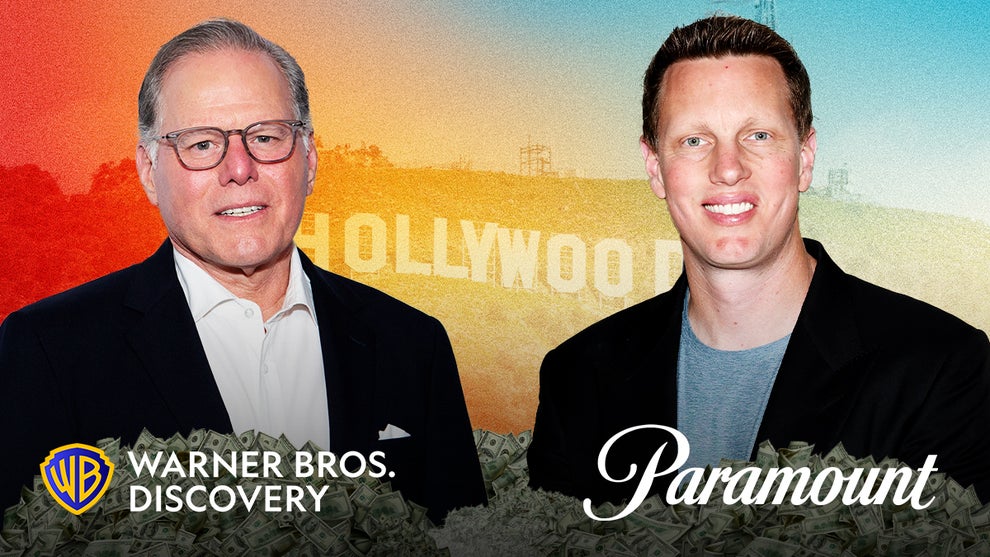
Warner Bros. Discovery on Tuesday restarted talks with Paramount to buy the legacy Hollywood studio, giving CEO David Ellison seven days to come up with a better offer.
Warner disclosed that a senior representative for Paramount informed WBD’s board that it would pay $31 per share if they reopened sales talks, but emphasized that it isn’t Ellison’s “best and final” proposal. Paramount’s prior bid was $30 a share in cash for the entire company vs. Netflix’s $27.75-per-share cash offer for just the studio and streaming business.
The move to reopen discussions comes after Netflix agreed to grant the David Zaslav-led media giant a “limited waiver” to explore other options under the terms of their $83 billion deal. However, Warner Bros. Discovery’s board continues to unanimously recommend that shareholders vote in favor of the Netflix deal and is urging shareholders to reject Paramount’s $108.4 billion hostile takeover bid.
Netflix retains the right to match any offer. The streamer put out its own statement blasting Paramount’s “antics” and reiterated the superiority of its deal.
“While we are confident that our transaction provides superior value and certainty, we recognize the ongoing distraction for WBD stockholders and the broader entertainment industry caused by (Paramount)’s antics,” the streamer added.
The talks potentially kick off a new round of bidding that could further drive up the price of Warner Bros. It comes after a vocal minority of shareholders have thrown their support behind Paramount, with some agitating for a sweeter bid.
“Throughout the entire process, our sole focus has been on maximizing value and certainty for WBD shareholders,” Warner Bros. Discovery CEO David Zaslav said in a statement. “Every step of the way, we have provided [Paramount] with clear direction on the deficiencies in their offers and opportunities to address them. We are engaging with [Paramount] now to determine whether they can deliver an actionable, binding proposal that provides superior value and certainty for WBD shareholders through their best and final offer.”
Shareholders are set to vote on the Netflix deal at a special meeting on March 20 at 8 a.m. ET. Warner Bros. has started mailing its definitive proxy statement to shareholders in connection with the special meeting. Shareholders of record as of Feb. 4 at 5 p.m. ET will be entitled to vote at the meeting.

The ninth bid from David Ellison, which was submitted last week, includes $43.6 billion of equity commitments from the Ellison family and RedBird Capital Partners and $54 billion of debt commitments from Bank of America, Citigroup and Apollo. Oracle co-founder Larry Ellison has also made an irrevocable personal guarantee towards $43.3 billion of the equity financing, as well as any damage claims against Paramount.
It also includes a 25 cent per share “ticking fee,” which is the equivalent of approximately $650 million cash value that would be paid to shareholders for every quarter the transaction is not closed beyond Dec. 31, 2026. The company has also committed to funding a $2.8 billion termination fee payable to Netflix, as well as other debt financing commitments.
Additionally, Paramount said it is open to discussing “contractual solutions to account for the possibility of continuing deteriorating financial performance beyond what WBD is currently projecting for its linear network business.”

In a letter responding to Paramount, the WBD board said that the latest amended offer addresses some of its concerns, but still contains “many of the unfavorable terms and conditions” that were submitted in Ellison’s previous bids. It added that while Ellison has expressed a willingness to address those concerns, Paramount does not do so in the latest offer, leaving the company with “vague assurances of intention.”
“We seek your best and final proposal. To be clear, our Board has not determined that your proposal is reasonably likely to result in a transaction that is superior to the Netflix merger,” the letter concludes. “We welcome the opportunity to engage with you and expeditiously determine whether [Paramount Skydance] can deliver an actionable, binding proposal that provides superior value, transaction certainty and interim protection for WBD’s businesses to Warner Bros. Discovery shareholders.”
The board is asking for Paramount for the following changes to be reflected in its best and final offer:
- Paramount’s agreement to bear expenses in connection with any junior lien notes or pay the $1.5 billion financing fee to WBD that would be due on Dec. 30, 2026.
- No consent requirement for WBD’s bridge loan financing. The bond will have a tenor of no more than 7 years and will be non-callable for no more than 3 years, while the loan component will be non-callable for no more than 1 year.
- A material adverse effect definition that excludes effects attributable to the performance of WBD’s global linear networks business.
- In the event that the Paramount transaction would not close due to its debt financing being unavailable, additional equity financing will be funded to allow the closing to occur.
- No consent requirement from Paramount in order for WBD to operate its business in the ordinary course between signing and closing.
- Proof of equity financing certainty and full information and notice regarding “equity syndication.” WBD’s consent will be required for any direct or indirect syndication that would require regulatory approvals or delay closing.

The resumption of talks comes after tensions erupted between the two sides. In addition to his tender offer, Ellison sued Warner Bros. in January in an effort to extract more details about how the Netflix deal and Discovery Global spinoff were valued. He also launched a proxy fight in an attempt to get shareholders to oppose the Netflix deal and require a vote to complete the spinoff of Warner’s cable networks into Discovery Global, which is already on track for later this year.
As of Feb. 9, 42.3 million shares had been validly tendered to Paramount, though shareholders can withdraw their shares at any time before the tender offer’s Friday deadline. That marks a 75% decline from Jan. 21 and a fraction of the 2.48 billion total outstanding shares.
Some shareholders have accused the Warner Bros. board of not adequately engaging with Paramount, including Ancora Holdings, which has built a $200 million stake and is threatening to launch its own proxy fight, and Pentwater Capital Management, Warner Bros.’ seventh largest shareholder. They’ve also argued that the Netflix deal, which is offering $27.75 per share plus additional “stub equity” from the Discovery Global spinoff, is inferior to Paramount’s offer and raises antitrust concerns.
In addition to Ancora and Pentwater, lawmakers on Capitol Hill and Hollywood creatives and unions have expressed similar concern about the Netflix deal’s potential impact on competition, consumer prices, jobs in Hollywood and the theatrical business.

Netflix and Paramount are both engaging with regulators, including the Department of Justice and European Commission. The former has said it would close its deal within 12 to 18 months, pending regulatory approval, while the latter has argued it would close a potential deal with Warner Bros. within a year.
On Feb. 9, Paramount said it complied with the Department of Justice’s second request for information as part of its regulatory review. The Hart-Scott-Rodino (HSR) waiting period will expire 10 calendar days after Paramount certified “substantial compliance with such request” at 11:59 p.m. ET. However, even if Paramount’s bid clears the HSR review period, the DOJ can still investigate or challenge a potential deal with Warner Bros.
Additionally, Paramount said it received clearance from foreign investment authorities in Germany on Jan. 27, though that only addresses national security concerns and is one of more than a dozen foreign investment clearances needed. European regulators can still investigate the deal for potential antitrust concerns. Netflix has also received similar clearance in Germany and is at the same stage of the regulatory review process.
In its statement, Netflix said that Paramount “is far from obtaining all the regulatory clearances required,” and noted the company’s bid raises “serious national security concerns” due to investment from three Middle Eastern sovereign wealth funds.
“Paramount has repeatedly mischaracterized the regulatory review process by
suggesting its proposal will sail through, misleading WBD stockholders about the real risk of their regulatory challenges around the world,” Netflix said. “WBD stockholders should not be misled into thinking that PSKY has an easier or faster path to regulatory approval – it does not.”
WBD shares popped 2.9% in pre-market trading on Tuesday following the announcement, while Paramount shares rose 3.2% and Netflix shares were up by 0.49%.
