
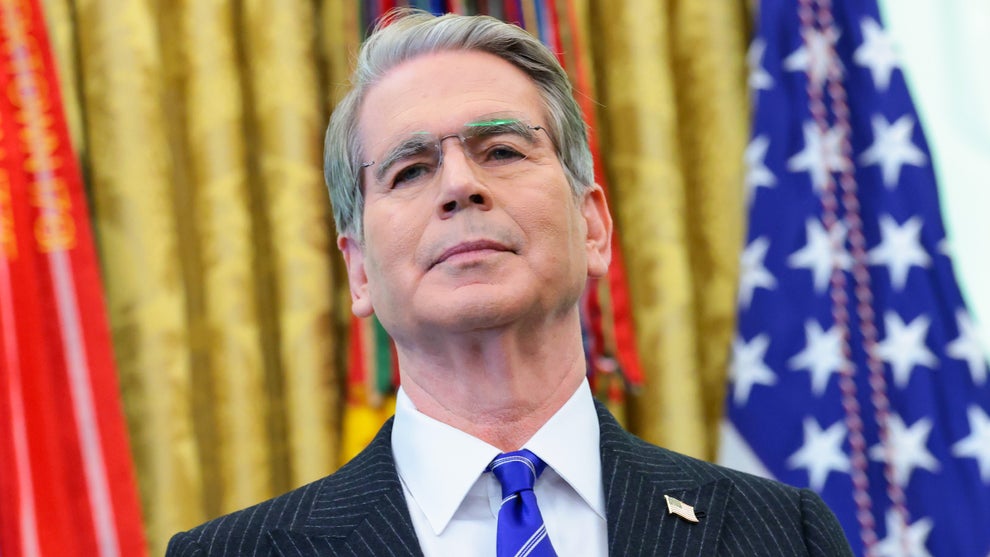
U.S. Treasury Secretary Scott Bessent took a shot at The Wall Street Journal on Friday, blaming his relocation to a military base on the outlet’s “very unfortunate” decision to publish a photo of his Georgetown home.
On Nov. 10, The New York Times reported that Bessent had relocated to a military base, a move that was eventually confirmed by the Trump official himself. U.S. officials said the move was motivated by an aerial photograph published by The Wall Street Journal of Bessent’s Georgetown home that allowed the residence to be geolocated. Iranian threats against Bessent’s life reportedly intensified around this time.
During a wide-ranging interview Friday with CNBC, Bessent confirmed that he is still living under U.S. military protection because of the same Iranian threats.

“I’m not going to be cowered by the Iranians,” the treasury secretary said. “If the Iranians are after me, it means that they are being squeezed. We’re going to continue squeezing them.”
“As I’ve said before, very unfortunate that an irresponsible editor at The Wall Street Journal published a photo of my house with a geo-locate in it the day I bought it,” Bessent added. “But, you know, we’ll move on. Life on the military base is good, and we’re going to continue squeezing the IRGC until they are ready to stick to a deal.”
Bessent is far from the only member of the Trump administration who has reportedly relocated to a U.S. military base due to Iranian threats amid the ongoing war between the U.S. and Iran. Secretary of Defense Pete Hegseth, Secretary of State Marco Rubio, White House Chief of Staff Stephen Miller and Attorney General Todd Blanche are all living on military bases right now as well, according to reports.
Elsewhere in his CNBC interview, Bessent argued that the recent, trilateral summit between President Trump, Russian President Vladimir Putin and Chinese President Xi Jinping helped cement the three countries’ shared stance on Iran. He did not, however, confirm whether or not either China or Russia has agreed to put additional pressure on the Iranian regime.
“The consensus between the U.S., Russia and China in Shenzhen is that Iran can never have a nuclear weapon and that freedom of navigation in the Strait of Hormuz is paramount,” Bessent claimed. “All three countries agree on that.”
