
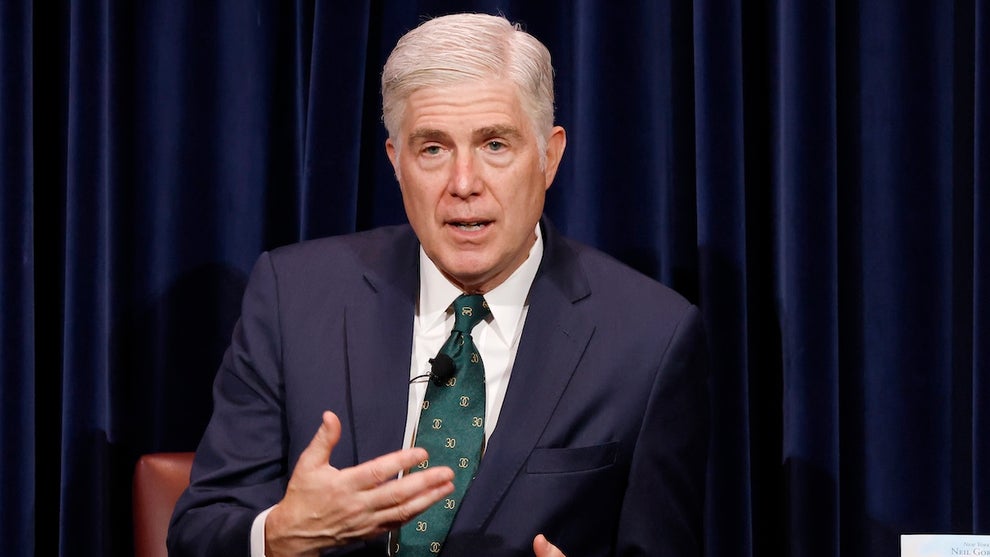
Supreme Court Justice Neil Gorsuch raised concerns that the Federal Communications Commission’s probes into ABC could be politically motivated and warned that a new Supreme Court ruling may give the White House “waxing authority” over radio and television.
In a landmark ruling issued Monday, the U.S. Supreme Court overturned the 91-year-old precedent established in Humphrey’s Executor. The 6-3 decision, written by Chief Justice John Roberts and opposed by the court’s three liberal justices, expands presidential authority over independent federal agencies, including the SEC, FCC and FTC.
The decision in Trump v. Slaughter centered on FTC Commissioner Rebecca Slaughter, who was removed from her position by President Trump without cause. The court ruled that the firing was lawful.

Justice Gorsuch, a Trump appointee, concurred with the majority’s decision but warned that giving the president the power to remove officials who fail to follow his line of thinking could allow that authority to extend to other federal agencies.
“It would be one thing if today’s decision afforded the White House more control over the airwaves, or financial markets, or energy — but presidents will now enjoy waxing authority over all these areas and more,” Gorsuch warned. “A business out of favor with the party in control of the White House might be able to stave off an FCC investigation, but can it survive a subsequent FTC ruling declaring unlawful one of its long-standing trade practices?”
The decision could have consequences for media and entertainment companies, as the FTC and FCC often play active roles in regulating those industries. Justice Gorsuch cited FCC Chairman Brendan Carr’s public criticism of ABC late-night host Jimmy Kimmel as an example of how a federal agency’s authority could become overly expansive.
“Independent agencies today hold tremendous sway over the Nation’s affairs. They regulate our businesses, and our financial markets. They set the rules for the internet and airwaves. They decide how we light our homes, how we run our elections, and the manner of our employment. They determine what toys our children will play with, and how we interact with each other at work. And, as the dissent explains, so much more,” he added. “Often, these agencies do all this with hardly any statutory guidance, based on broad grants of legislative authority.”
“Last year, taking objection to a network host [Jimmy Kimmel]’s on-air remarks, the Chairman of the FCC suggested there would be ‘additional work … ahead’ for the agency if broadcasting companies did not ‘find ways to … take action.’ The Benny Show, Sept. 17, 2025 (‘[W]e can do this the easy way or the hard way’),” Gorsuch wrote.
This is in direct reference to Carr’s threat to Kimmel last year, which led ABC to take him off the air for a week. ABC has several disputes with the FCC, one over the agency’s equal opportunity rules regarding “The View” and another involving a review of the company’s broadcast licenses.
Gorsuch’s hesitancy in granting agencies this much power, despite siding with the majority, shows skepticism among the Supreme Court’s conservative members.
The justice does not provide solutions in his concurring opinion but notes that Americans can defend themselves against such power.
“As we’ve seen, these agencies were never truly independent from politics or even the influence of the president’s appointment powers,” Gorsuch said.
“We have, then, no shortage of tools,” he added. “The only real question is whether we will use them.”
