

When Paramount’s David Ellison outlined the vision for merging with Warner Bros. Discovery earlier this year, Wall Street immediately envisioned a premium content utopia. The prevailing narrative focused on “Harry Potter” and “The White Lotus” sharing a home screen with Taylor Sheridan and the “Star Trek” universe.
But while prestige scripted series generate Emmys and media headlines, they are notoriously expensive. Unscripted content is a less glamorous but potentially more lucrative area where a newly combined HBO Max/Paramount+ would excel.
In Q1 2026, a combined HBO Max and Paramount+ platform would have led the competition in the demand for unscripted content available on the platform.
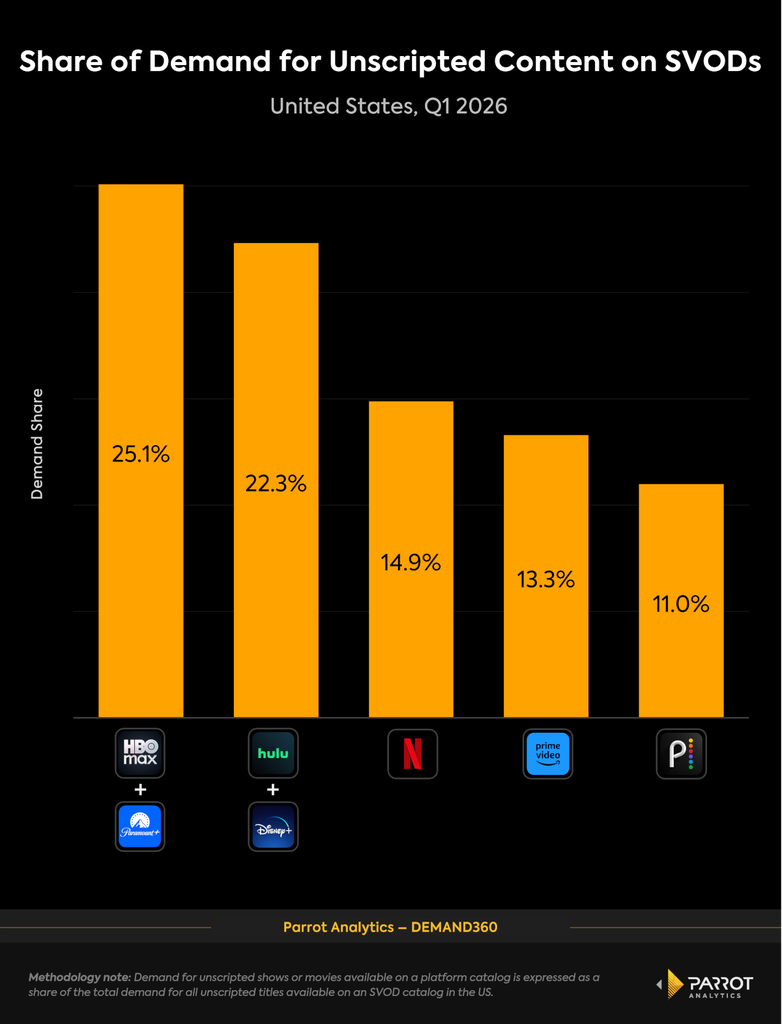
If the two services operated as a single entity in the first quarter of this year, they would have captured a 25.1% share of the total US demand for unscripted content across all SVODs. This combined footprint would reshape the leaderboard, beating out the Disney+/Hulu bundle, which relies heavily on Hulu’s deep reality bench.
That newly consolidated world would leave Netflix trailing in a distant third with 14.9% of demand for unscripted content available on SVODs in the U.S. This is despite years of aggressive, multi-billion-dollar investments in original dating and competition format
Perhaps surprisingly, Peacock ranks last among major platforms in this measure. This is not for lack of successful unscripted programming. Peacock is the home of some of the most in-demand reality series of the past year like “Love Island” and “The Traitors” and sprawling reality franchises like “Real Housewives.”

In fact, as a share of catalog demand, Peacock has the most unscripted-skewing library. Over 25% of demand for content on Peacock was for an unscripted title, the highest share of the above platforms and bundles. The fact that Peacock trails in this metric boils down to size and scale in a consolidating streaming landscape.
For a combined Paramount-WBD entity, this unscripted dominance would be a financial advantage. Integrating WBD’s sprawling lifestyle empire (including the “90 Day Fiancé” universe and Investigation Discovery’s true-crime slate) with Paramount’s linear mainstays (like CBS’s “Survivor”) creates an unparalleled engagement bedrock. Add in a dominant late-night and current affairs block featuring “The Daily Show,” “Last Week Tonight,” and “60 Minutes,” and the platform becomes a daily habit for consumers.
As the industry officially consolidates into a handful of surviving “mega-bundles,” platforms must prove they can retain subscribers without having to bet on high-stakes, huge-budget productions every month. High-volume, highly bingeable unscripted libraries provide the low-cost baseline required to keep churn low and make the math of these mega-mergers work.
In the consolidation era of the streaming wars, the victor won’t just be the platform with the biggest dragons, it will be the one with the stickiest reality television. Right now, that crown belongs to HBO Max and Paramount+.
