

Over the past two years, global audience demand for Spanish and Portuguese language series has risen 25%. While cross-border hits are no longer a novelty in streaming, the nature of this growth marks a fundamental shift. This growth has not been driven by regional neighbors or traditional diaspora markets, but by non-traditional export destinations across Asia, Europe and the Middle East.
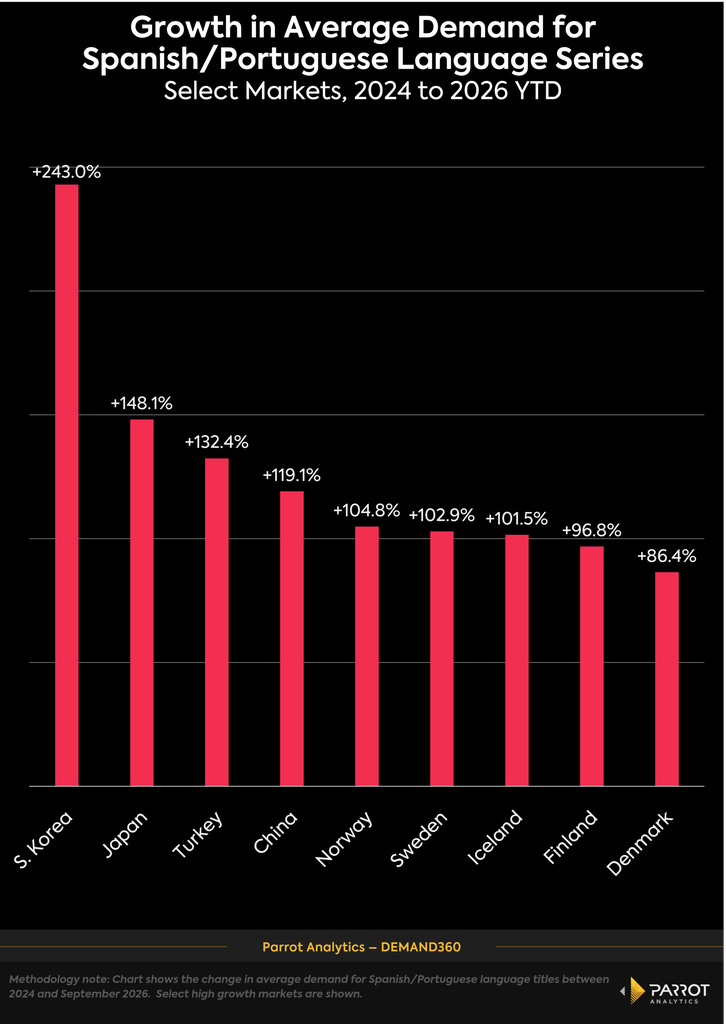
Between 2024 and September 2026, demand for Ibero-American content boomed in several unexpected regions. Major East Asian markets registered some of the sharpest increases globally, led by South Korea (+243%), Japan (+148%), and China (+119%).
Then there’s the Turkish reversal. For years, Turkish soap operas have found eager audiences across Latin America. The trend over the past two years suggests that cultural exchange may now be working in the opposite direction, with Turkish demand for Spanish and Portuguese series more than doubling in that time.
Meanwhile, there was a consistent rise in demand for Spanish/Portuguese language series across Nordic countries over the past two years.
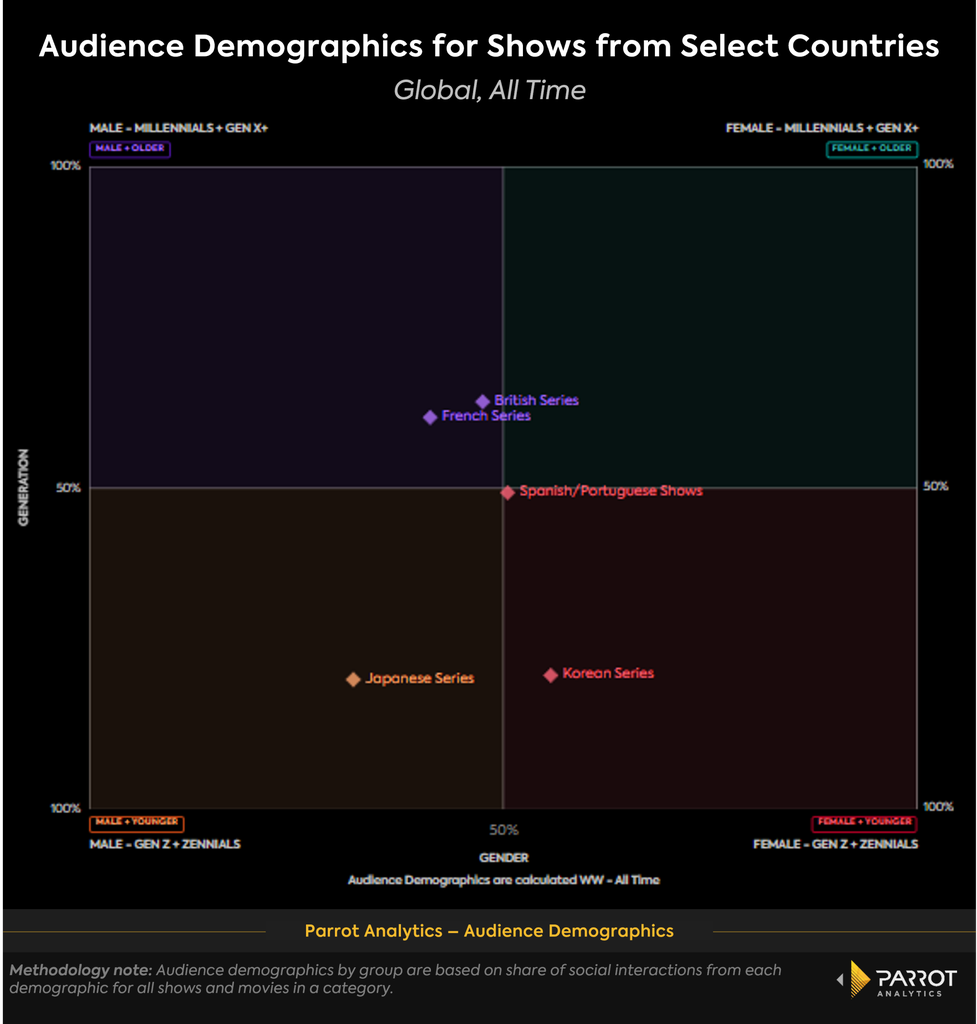
A four-quadrant appeal is likely helping these series travel successfully across wildly different cultural landscapes. Many of the global export success stories of the past few years actually have distinct audience skews. For example, Parrot Analytics’ audience demographic data shows Japanese series, in particular anime, leaning heavily toward young males, while K-dramas tilt toward younger women.
In contrast, Spanish and Portuguese series sit almost dead-center on the demographic spectrum, achieving a near-perfect balance between male and female viewers, as well as across age groups. This four-quadrant versatility makes them broadly appealing as they find new fans globally.
Leveraging existing intellectual property is one way that new shows can cut through an increasingly saturated global market. Some of the most globally successful Ibero-American exports have won with this strategy. In particular, Spanish and Portuguese literary adaptations have had three times higher global demand than non-IP-based original series this year.
High-profile prestige adaptations are proving the power of this strategy. Shows like Netflix’s adaptation of Gabriel García Márquez’s “100 Years of Solitude” and the Argentine sci-fi classic “The Eternaut,” adapted from a classic comic, have demonstrated that local heritage IP can command massive international attention and break through beyond traditional export markets.
Our Streaming Economics model calculates that “The Eternaut” alone has driven over 230,000 new subscriber signups for Netflix globally since premiering and was the most impactful Spanish-language title for the platform at driving subscriber acquisitions during that time.
As streaming platforms prioritize content efficiency and real financial results, Spanish and Portuguese titles are proving they can deliver on a global scale well beyond their traditional markets.
