
It's a baseball movie. More than that, it's a baseball statistics movie, with its focus squarely on things like on-base percentage.
So "Moneyball" is a movie for true baseball fanatics, right?
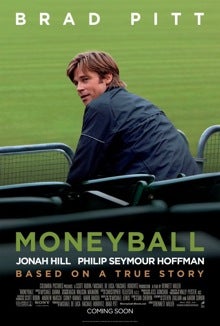 Maybe not. Bennett Miller's dramatization of Michael Lewis's non-fiction book about general manager Billy Beane and the unlikely rise of the small-market, low-budget Oakland A's in the early 2000s, which opens on Friday, has picked up rave reviews in many quarters, including from lots of people who ordinarily couldn't care less about, say, OPS or VORP or even the American League wild-card race.
Also read: Review: 'Moneyball' Knocks It Out of the Park
But it has also picked up a measure of criticism – and much of that, it seems, is coming from the biggest baseball fans, who’ve long had problems with Lewis's book and who have the same problems with the film's omissions and oversimplifications.
"The chasm between the real story of Billy Beane and the manufactured one in the 'Moneyball' movie keep it from reaching the plateaus of its forbearers, no matter how slick the production, interesting the dialogue or arresting the cinematography," wrote Jeff Passan, a baseball columnist for Yahoo Sports. "It's just not a very good baseball movie."
I happen to think that "Moneyball" is a very good movie. It's a twist on the typical cliché-laden sports films, an appealing adult drama marked by a Brad Pitt performance that is a marvel of effortless charm and charisma over a tightly-wound interior.
But as a diehard baseball fan since childhood, I too have serious problems with a story that makes it seem as if Beane and his stats-geek assistant Peter Brand (a fictionalized version of Paul DePodesta, who wouldn't allow his name to be used) turned a small-market team into a winner through brilliant moves like converting broken-down catcher Scott Hatteberg into a first baseman and bringing in unconventional relief pitcher Chad Bradford.
 Certainly, Hatteberg and Bradford contributed to the A's success. Certainly, the statistics-based model (called sabermetrics) promoted by Beane and "Brand" gave the A's an edge over some competitors, and went on to have an impact on the entire game in ensuing years.
But Hatteberg and Bradford are not why the A's won 103 games in 2002, including an American League record 20 in a row. You wouldn't know it from "Moneyball," but that A's team also contained the league's Most Valuable Player and its Cy Young Award winner (an honor given to the league's best pitcher).
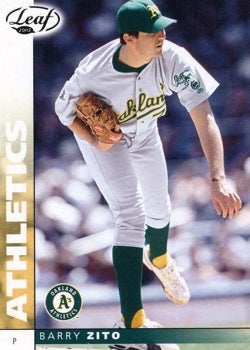
If you’re making a movie about the success of that team, and you ignore its remarkable trio of starting pitchers — Barry Zito (the Cy Young winner, right), Mark Mulder and Tim Hudson – to focus on Bradford, you're not telling the real story.
If you play up Hatteberg and completely downplay the league's MVP, shortstop Miguel Tejada, you're trying to put one over on your audience.
Those omissions — which for the most part come from the book and are not unique to the movie — were why "Moneyball" was greeted with skepticism in baseball circles when Lewis published it in 2003.
"Everybody is a good general manager when you have fucking Hudson, Zito and Mulder," the characteristically outspoken Chicago White Sox manager Ozzie Guillen once said of the book's contention that Beane knew things other general managers didn't. "It's easy to be a GM like that. It's not a fucking secret."
 Added Mike Sciosca, the manager of the team that actually won the World Series in 2002, the Anaheim Angels (now the Los Angeles Angels of Anaheim), "[The A's] did an incredible job of developing those young front-end pitchers and some premium talent in their lineup. But the book was more about the supporting cast. They had a terrific run for several years, and it was fueled by Hudson, Mulder and Zito. They were as good as any three pitchers on any staff at any time.
"To just focus on the peripheral pieces is like talking about the kind of wax you're putting on your Mercedes."
Lewis's book, wrote "Friday Night Lights" writer Buzz Bissinger in 2009, was "smooth, glib, smart, and unfailing in never letting anything get in the way of his argument." And while it's certainly true that sabermetrics is more accepted now than it was in 2002, Beane's and DePodesta's ability to ferret out undervalued players and market inefficiencies was only a part of why the "Moneyball" team succeeded – and only a part of why the A's haven't had a winning season since 2006, when the last of their big three pitchers left.
Also read: Can 'Moneyball' Hit a Box-Office Home Run If the A's Stink?
(As a Dodger fan, I won't even bring up DePodesta's subsequent and mercifully short-lived stint as that team's GM.)
It's hardly a surprise that an Oscar-contending, based-on-a-true-story movie has people questioning its veracity; that's par for the course, as "The Social Network" and "The King's Speech" and "A Beautiful Mind" and many others can attest. And the idea that any of this would (or should) particularly matter to film critics or Academy voters is silly.
But, you know, there's no geek like a baseball geek … so the complaints are accumulating:
Jeff Passan, Yahoo Sports: "It's disingenuous to show how cheap the A's were by suggesting players had to pay for soda – and, even worse, having Beane negotiate a supply of carbonated beverages into a player trade. It's misleading to villainize A's manager Art Howe as an abject insubordinate to make Beane look smarter. It's terribly Hollywood to turn Paul DePodesta – Beane's assistant GM and a former baseball and football player at Harvard – into Peter Brand, the fat, socially inept, nerd-foil played by Jonah Hill."
Bill Shaikin, Los Angeles Times: "Parts of the movie indeed seem fictional, with the scouts being painted as evil caricatures while Beane, as played by Pitt, comes across as this overblown swashbuckling hero despite the fact that 'Moneyball' never really worked, his teams having yet to even reach the World Series."
Geoff Baker, the Seattle Times: "With eight years of hindsight to its benefit, the movie might as well have been made in 2003 for all the effort it makes to put things in proper context … And that's a shame, because the film misses the opportunity to address some of the most valid criticism of 'Moneyball,' while putting the rest of what Beane accomplished into a context that deserves praise."
 Keith Law, the dish: "[T]he lampooning of scouts, which draws from the book, isn’t any more welcome on screen … than it was on the page; they are set up as dim-witted bowling pins for Beane and Brand to knock down with their spreadsheets. It’s cheap writing, and unfair to the real people being depicted. Current Oakland scouting director Eric Kubota also gets murdered in a drive-by line that depicts him as a clueless intern given the head scouting role after Beane fires Grady Fuson in April after a clubhouse argument (that never really happened)."
Still, even the baseball-savvy nitpickers found nice things to say about the film. Aaron Gleeman, writing at the Hardball Talk website, suggested, "what the movie lacked in historical accuracy it made up for in witty dialogue, likable characters, and a surprising amount of humor."
I'm with Gleeman on the wit and the humor, and I found the baseball footage far more convincing than usual for movies that try to depict action on the field.
For me, the bottom line is that "Moneyball" is a terrific film – but one that leaves nagging questions. Would it have killed Miller and screenwriters Aaron Sorkin and Steven Zaillian to admit that Beane was trying to find the pieces to complement an all-star core that was already in place? Would it really have hurt the movie to concede that "Peter Brand" had been on the team's staff for a full three years, rather than inventing a ludicrous scene in which Beane first encounters and then hires him before the 2002 season?
I'd say that the answer to both questions is no – but the more appropriate answer might be, who cares except for you baseball fanatics who are going to see the movie anyway?
Academy members will have their chance to make their own call at its official members' screening on Saturday night at the Samuel Goldwyn Theater – where, it's safe to say, voters will be watching Brad Pitt and Jonah Hill, not missing Miguel Tejada and Barry Zito.