
It’s not exactly a joke that the English title of Ryusuke Hamaguchi’s new film is “All of a Sudden,” but it’s worth pointing out at the start that there is nothing sudden about this movie. At a leisurely three hours and 16 minutes, it’s the longest film in the Main Competition at the Cannes Film Festival, and the second longest at the entire festival to Tiago Guedes’ “Aquí,” which nudges past it by seven minutes.
Built around a night-long conversation between two women from different worlds, the quiet and humanistic drama from the director of “Asako I & II” and Oscar Best Picture nominee “Drive My Car” demands patience and isn’t afraid to ramble — and has as many endings as “The Return of the King.” But it’s a rich experience for those who can settle into its languid rhythms and reams of dialogue.
Along with Asghar Farhadi’s “Parallel Tales” at this year’s Cannes, it finds a director who is not from France making a largely French-language film, though in this case it continually slips between French and Japanese.
At its center is an odd couple of women who are dealing with their own struggles. Marie-Lou Fontaine (Virginie Efira) is a French woman who runs a nursing home in Paris, and who speaks Japanese because she studied anthropology in Japan. Mari Morisaki (Tao Okamoto) is an adventurous Japanese theater director and terminal cancer patient who speaks French because she studied in Paris.

Marie-Lou is trying to introduce a new method of patient care imported from Japan called Humanitude, which aims to treat each patient as a full human being. It also requires a lot of training and takes up more time than usual, which bothers some of her long-serving nurses accustomed to a more brisk way of moving through the patient overload.
For her part, Marie-Lou is overworked, perpetually exhausted and uninterested in trying to separate her work and her life; in fact, she’s volunteered to move into one of four vacant apartments on the grounds of the institution, well aware that proximity will make her the first choice to respond to any emergencies that come up.
When she sees an agitated nonverbal boy chasing after the bus she’s riding through Paris, the caregiver in her kicks in, and she jumps off and keeps him calm until an elderly man and a younger woman show up and explain that the boy, Tomoki, is severely autistic. The three of them are in Paris to put on an experimental play called “Up Close, No One Is Normal” in a local theater. Marie-Lou hears the title and smiles. “Very well put,” she says to Mari, the play’s director.
On a whim Marie-Lou accepts Mari’s invitation to see the play, which turns out to be a one-person monologue about the time that Italy closed all of its mental institutions. It’s both riveting and rambling, and the movie lets it play out at length. Tomoki turns out to be the grandson of Gorô, the actor who delivers the monologue, and he runs onto the stage whenever he feels the urge, with his grandfather incorporating him into the performance.

Marie-Lou is deeply moved by the production, and asks a question in the post-performance Q&A: “Do you think the impossible can be possible?” Mari says yes – and, in Japanese, which most of the audience does not understand, adds that she has cancer and that a year ago she was told that she only had six months to live. “I chose this subject,” she says, “because I needed courage for myself.”
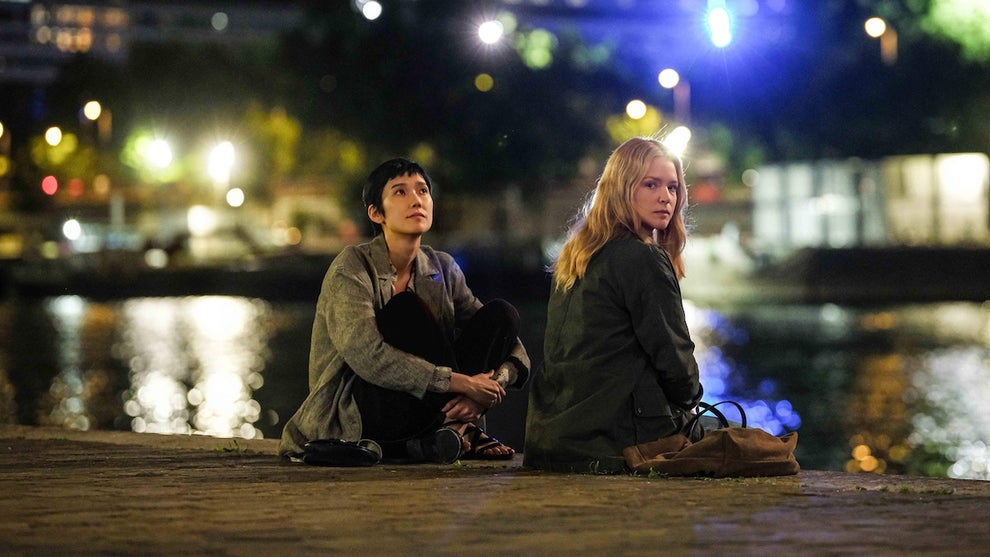
The two women have an immediate bond, and decide to talk further after the show. They meet outside the theater and begin to stroll through Paris, launching a winding conversation about life, art and economics that takes up almost the entire middle hour of the film. It starts with the late-night walk, then goes to Marie-Lou’s nursing home where the women talk in the break room and on a tour of the facility, then to the kitchen as they make toast and soup together, then outside for a smoke…
They talk about countless things, switching from French to Japanese and back as they cover theories of art, the effects of capitalism, the codes of Japanese society and so much more, always aware of their own differences and always warily circling a central question: “Who are you?”
“I am a terminal cancer patient, but that’s not who I am,” says Mari, whose doctor has told her that when her condition starts to deteriorate, she will go quickly. “I resist. That’s who I am.”

The conversation gets intimate but the connection between the women stops just short of being sexual. The camera seems to respect their privacy, at one point backing off and viewing the women from across a late-night street. The film basks in every aside and verbal detour – as they push back their chairs and leave the room where they’ve been talking, the shot lingers on the empty space for a few seconds, as if Hamaguchi expects them to return. He doesn’t let the night-long conversation play out in real time, of course, but it feels as if he’d like to.
In the morning, though, Mari collapses and has to go to the hospital. The film’s first hour was the setup, the second hour was the conversation and the third hour, it seems, will be Mari dying. But it’s not that simple, because there’s plenty of time for twists and turns and massages and physical therapy and more conversations and occasional lessons learned, both in Paris and back in Kyoto.
It’s a foreboding homestretch, and at times a scattered one, but Hamaguchi isn’t one to overplay his hand when it comes to doom. As he did in “Drive My Car,” the director turns to theater as a way to cope with the thorniness of life, and he defaults to moody resonance over explanation at every turn. “All of a Sudden” circles back to the idea of hope in impossible situations; it gently insists that no one is normal, and it helps us find the beauty in that.
“All of a Sudden” is one of the six films in the Main Competition at Cannes, and the nine films in the festival itself, that is being distributed by Neon in the U.S.
