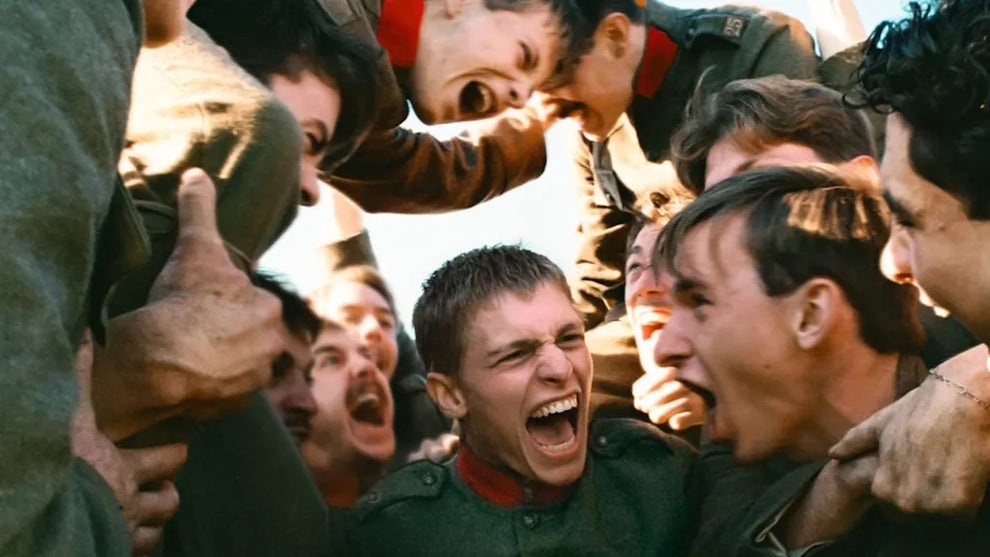
The young leads of “Coward” have two of the most Belgian faces ever put onscreen — catch them in Cancun or Calcutta, and you’d clock their origins in an instant. That’s not an idle thought, mind you, for Lukas Dhont has made an almost elementally straightforward war drama built around queer love and desire. Premiering at Cannes, spoken in French and Flemish, and all but certain to be Belgium’s Oscar submission, this heritage film waves its flag without apology.
The filmmaker behind “Girl” and “Close” isn’t trying to “queer” history — how could he, when same-sex love on and off the battlefield has been so intrinsic to wartime that the very subject is a major plot point in “The Iliad?” Instead, Dhont offers a corrective to a much more recent attempt to erase what was already there, making his case with force, pageantry and outsized patriotic zeal. All the same, the film is rather subversive, moving away from trench-based misery to reimagine the front as a place of great freedom and romantic possibility.
We follow young conscripts Pierre (Emmanuel Macchia) and Francis (Valentin Campagne) as they arm themselves with art — putting on performances to boost morale, fighting the war on their own terms. An opening title explains the Belgian policy of rotating battalions: those on the frontlines one day would fall back the next to recuperate and rebuild, returning to the fight with diminished ranks.
From there, Dhont builds a world ever-so-adjacent to the slaughterhouse, where the artistically inclined could bloom.
Chief among them is Francis — a slight tailor’s son who, born a few decades later, would almost certainly have become a cabaret performer or a Cannes-acclaimed director; in other words, John Cameron Mitchell. But we can’t pick our time, and luckily for this gifted actor, director and drag artist, the war has handed him the perfect stage to deploy his talents, and find love.

His partner isn’t so fortunate: Pierre arrives with a fuller build, the kind that makes a body far more likely to be mangled when sent over the line. “Coward” takes its time, sketching out an ironic utopia where gender performers receive the kind of adulation unavailable in button-down civilian life — especially from a macho military corps for whom homophobia is second nature. That prejudice doesn’t fall away when everyone’s cramped together in close quarters, so for a while our two leads are forced into a very chaste flirtation.
Dhont shot in academy ratio and frames shot after shot around eye-lines: for the first hour, we follow Pierre and Francis as they appraise one another, stealing glances that grow ever bolder. A body-strewn trip up the ladder returns Pierre emboldened to finally act — with Eros never far from Thanatos, as “Coward” tracks teenage sex and death at a very different camp.
From the first scene, Dhont leans on period songs and military chants, to the point where the film could qualify as a musical, given its reliance on a cappella numbers and war hymns. That dovetails with his unambiguous perspective on Francis as the greatest of true believers, an “each according to his ability” hardliner determined to support the effort by any means available. Betrayed by his body, Pierre becomes the titular coward once he decides — understandably — that with love in his life he’d rather not die. But the larger narrative never quite gets under his skin as intuitively as it does his partner’s.
And that’s pretty much it for a film closer in nature to a scrapbook than a novel. It plays as an oral, musical history, rich in period research and detail, laying out its narrative and thematic concerns early and never really moving beyond them. At some point, dreaming up his next revue, Francis says, “If they want patriotism, then we’ll give them patriotism” — without cynicism, and neither from the filmmaker.
Looking back a century, this very 2026 film is a clear product of its moment and its growing rightward shift. “Coward” doesn’t frame the artist — or the queer perspective, though here the two are intrinsically linked — as a counterweight to militarism, but as a complement, arguing for inclusion on rah-rah terms. That’s less a critique than an appraisal, and a distinction that speaks to the present as much as the past.
