
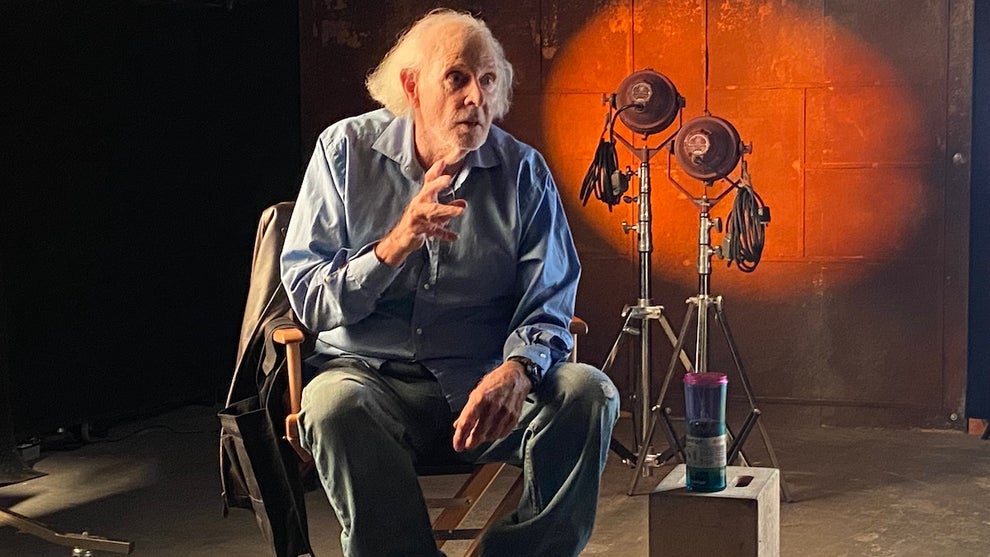
Anybody who’s spent any time around Bruce Dern knows one thing: The guy tells great stories. Really great stories. About a whole lot of people.
“He’s got a crazy story about everybody,” says director Joe Dante in the new documentary “Dernsie: The Amazing Life of Bruce Dern,” which premiered at the Cannes Film Festival on Wednesday. Dante is pretty much right, to which I would only add: If you ever run into Bruce Dern and don’t have time to ask him about everybody, ask him to tell you his Marilyn Monroe/Greta Garbo story. You won’t be sorry.
The Monroe/Garbo yarn isn’t in “Dernsie,” which is too bad. But a hell of a lot of other great stories are in Mike Mendez’s film, which trots out plenty of talking heads and Dern devotees (Dante, Billy Bob Thornton, Quentin Tarantino, Walton Goggins …) but mostly turns the floor over to its leading man to offer a straightforward but entertaining guided tour of a career that has lasted about 70 years.
The title, by the way, is not a nickname for Dern. It’s a description of something that has happened repeatedly over the years, where a director will know that a scene requires a little something extra, a line or a gesture that isn’t in the script. After a couple of takes, the director will turn to Dern and say, “Gimme a Dernsie on this one, Bruce,” whereupon something small, unexpected and magical will happen.

The ultimate Dernsie, according to “Dernsie,” came in the scene in “Coming Home” when Dern’s character, a returning Vietnam vet, take off his clothes on the beach before swimming out into the early-morning surf to kill himself, knowing there’s no place for him in the life that his wife (Jane Fonda) has made with her new lover, a disabled vet and anti-war activist played by Jon Voight. Dern added one tiny moment, making it very difficult for his character to get his wedding ring off. It wasn’t in the script, but Goggins says it made him want to be an actor.
The Dernsies came out of a simple fact: Bruce Dern was always capable of delivering more than what he was given to do. He was born in 1936 into a family that was not supposed to produce show people:His grandfather was the first non-Mormon governor of Utah and FDR’s secretary of war, his granduncle was poet Archibald MacLeish, his godfather was two-time presidential nominee Adlai Stevenson II.
“I was a problem to my people,” says Dern, who decided he wanted to be an actor about a month after he started watching movies. When he made that decision, he added, “I was persona non grata” with his family. “They said, ‘You don’t need to come home for Christmas.’ They didn’t get it, and they sure as hell didn’t get me.”
He got into Lee Strasberg’s Actors Studio at a time when others there included Monroe, Paul Newman, Marlon Brando and director Elia Kazan, who became a big Dern supporter. But when he went to Hollywood, an agent told him he’d be playing “the fifth cowboy from the right” for at least 10 years. He got steady work in Westerns, mostly in bit parts and almost always playing the bad guy. (In “Dernsie,” Quentin Tarantino rhapsodizes about Dern’s work on one episode of “The Big Valley” and another of “Gunsmoke.”)

His career involved a lot of waiting for bigger parts and waiting to play sympathetic characters. “Every show I was in on television, I was playing a prick,” he says. “…You start to believe that’s all you’re ever going to do.”
Jack Nicholson offered him a big role in “The King of Marvin Gardens” that brought him some attention, and the lead in Douglas Trumbull’s good-hearted sci-fi film “Silent Running” might have changed his image – but he took three days off from that shoot to play a small role in “The Cowboys” in which he became the first actor ever to kill John Wayne in a movie. So much for being sympathetic.
“Dernsie” is built around Dern’s stories, which are illustrated by film clips that sometimes fit and sometimes feel a bit off-topic. As the movie goes on, it increasingly devotes time to Dern’s family, largely through his daughter Laura, and to his passion for running, which has led him to cover more than 104,000 miles, according to an estimate from Runner’s World magazine in the mid-2010s.
In fact, running is a metaphor throughout “Dernsie,” a particularly apt one given his success in his late 70s with the 2013 Alexander Payne film “Nebraska.” Dern said he “lost a decade to Vicodin” in the ’90s and had a heart attack three years ago, but he’s continued to work steadily after that.
So yes, the long-distance runner makes sense as a way to look at Bruce Dern – but it’s impossible to forget that “Dernsie” is as entertaining as it is because the guy is also one heck of a long-distance talker.
