
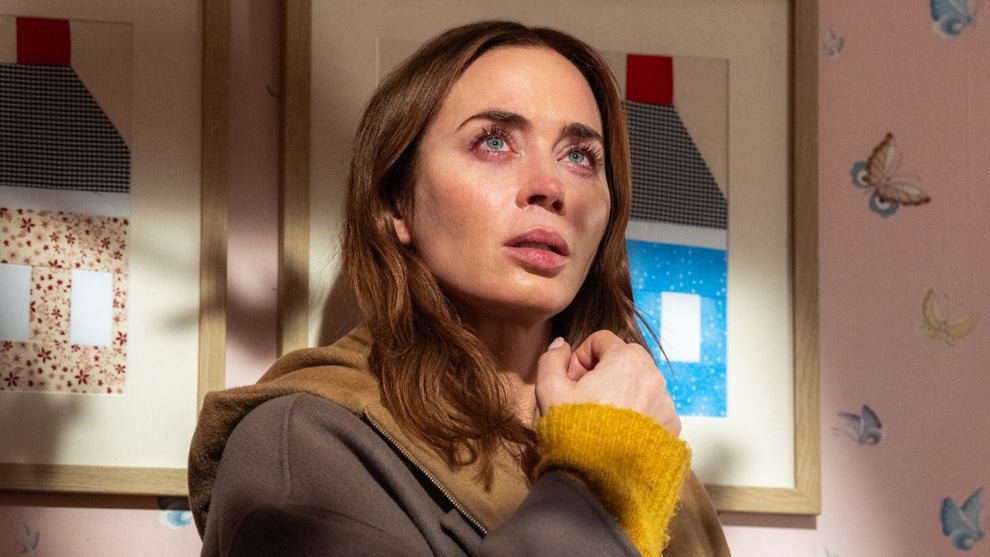
“Disclosure Day” is upon us.
Steven Spielberg’s latest, which follows a whistleblower (Josh O’Connor) and a TV weatherwoman (Emily Blunt) on a desperate quest to expose the truth about extraterrestrials to the entire world, is in theaters now. It was the #1 movie at the box office this past weekend, with an impressive $44 million in the United States.
And if you are one of the many who watched the movie on opening weekend, you probably have some questions – particularly about the ending. Thankfully, while discussing the film with screenwriter David Koepp, one of Spielberg’s closest collaborators and creative allies, we had time to breakdown some aspects of the ending of “Disclosure Day.”
We should first issue an extreme and explicit spoiler warning. Trust us, you don’t want this stuff disclosed until after you see “Disclosure Day.”
The Device
Koepp said the biggest hurdle involving the rod-like artifacts recovered from downed UFOs, which become key tools for both Colin Firth’s villainous head of the Wardex corporation and for O’Connor and Blunt while they are on the run, was simply naming them.
“You just wanted something that didn’t sound corny, didn’t sound hard to figure out, you didn’t want something that then had to be addressed in dialog to explain what it meant. I was referring to it in the script as the Device, and Steven said, ‘Well, that’s what it is. Why don’t they just call it that?’” Koepp explained. “They can’t call it the mysterious space wand and they don’t really understand fully what it does. It is a device, so yeah, let’s call it that. It’s like when you find your title in the description in the script, you’re like, Oh, well, that’s what it should be called.”
As for what the Device did – or could do – that was baked into the screenplay too.
“It’s great because it’s allowed to be mysterious. We don’t understand it. We know it does certain things. The primary one, in terms of the story, is being able to look in another place, or look at the world through someone else’s eyes, which ties into the dark side of empathy, which is what the movie is all about,” Koepp said. “Letting it do a couple other things was great fun, but we were comfortable not understanding it fully, because the characters don’t.”

“Listen…”/The Cut to Black
One of the things we were most curious about was if the script always ended with a cut to black. Why were we curious about this? Well, because Spielberg movies so infrequently cut to black – they usually fade to black, oftentimes after a prolonged sequence with some gorgeous plate photography. In fact, since “Jurassic Park” in 1993—Spielberg and Koepp’s first collaboration—only four Steven Spielberg films have ended with a cut to black: 2022’s “The Fabelmans,” 2018’s “Ready Player One” and 2017’s “The Post,” with one, 2011’s “The Adventures of Tintin,” featuring an iris in.
Koepp said that, from the first draft, the cut to black was present, as was the final word of the script (and now, the movie) – “Listen.”
“When I was writing the last scene in the first draft, I got to the last scene, and I wrote the first word. I knew what I wanted the first word of what she said to be, because it has a lot of meaning. She’s saying not only listen, because space guy told me a lot of interesting stuff, but she’s also saying listen to one another. The script is about empathy, but also it’s the first word of a lot of Hebrew prayers, and it’s the first word of ‘Slaughterhouse-Five’ by Kurt Vonnegut,” Koepp explained. “The first sentence is, ‘Listen, Billy Pilgrim has come unstuck in time.’ And I just love the word ‘listen.’ I wrote the word, and then I just wrote a period and lifted up my hands, because I realized when one word says everything you want to say, you should stop talking.”
As for what the alien told Blunt, Koepp says he knows exactly what the creature said but wouldn’t reveal it. (O’Connor told a reporter that he also knows what the alien said.)
When we asked if it would ever be revealed, Koepp joked, “Is there money in it?”

Other Aliens
While the aliens depicted in “Disclosure Day” are primarily the little grey aliens that we have read about in countless tales of abduction (and resemble, to some degree, the guys at the end of Spielberg’s own “Close Encounters of the Third Kind”), Koepp did say that there were likely other kinds of alien visitors to the planet – and to the world of “Disclosure Day” – given how different some of the ships and technology are in the montage towards the end of the film.
And did we really think Colman Domingo would only know some grey aliens? We bet he’s encountered a whole bunch of outer space freaks.
Watching Television
Part of what makes “Disclosure Day” so bold and so emotionally satisfying is its climax. Blunt takes part in a news broadcast where she shares decades of secrets with the entire world. (An unspecified military skirmish, between Russia, the United States and Korea, has been quietly simmering in the background of the movie and we see troops on all sides stop to watch their phone.)
It’s tricky because much of that climax is people watching news footage as the various pieces click into place – Firth’s baddie shows up at the television station in Kansas and attempts to shut down the broadcast, Domingo’s character gets the alien (who had escaped Wardex facilities years earlier) into place, O’Connor races to upload all the footage.
“It was something that was hard, and they’re watching so many different things, and you have to decide which things … directing that control room sequence at NBC was a feat of concentration and projection into the future, because the footage [Spielberg] was going to put up didn’t exist, except in his head and a little bit in the script, but we were continually reworking it, but deciding what screen was up, how big, and which one would have prominence in any given shot … That there was a massive shuffling act.”
