
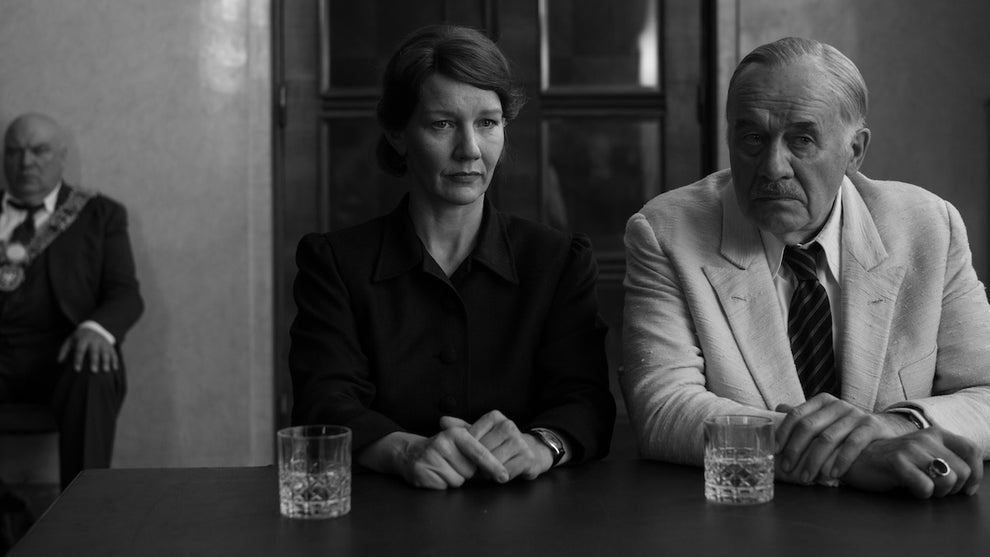
Any movie fan reasonably conversant with international cinema would know exactly where they were within a few minutes of being dropped into a screening of “Fatherland,” which premiered in the main competition at the Cannes film Festival on Thursday. They’d see the luminous black-and-white cinematography, the boxy frame and the European setting and know they’re in Pawel Pawlikowski-land.
Though the style has distinct echoes of the poetic austerity of Robert Bresson and Carl Theodor Dreyer, Pawlikowski has made it his own in recent years, most notably with the Oscar-winning “Ida” in 2013 and then with “Cold War” in 2018. Both films were elegant black-and-white stories shot in a nearly square aspect ratio and set in Western and Central Europe that was still haunted by the wreckage of World War II, an event that figured heavily in the Polish director’s own family. Both were lyrical and quietly gripping, two of the most distinctive films to come out of the region in the last decade and a half.
You could say that “Fatherland” is more of the same, using black-and-white photography and the Academy aspect ratio to follow German writer Thomas Mann and his daughter Erika as they travel across a fractured Germany in 1949, when the defeated country had been partitioned into East and West and become a central battleground in the Cold War.
Running a welcome 82 minutes, a nice change at a festival whose competition includes five films of more than two-and-a-half hours, “Fatherland” isn’t as revelatory or as wrenching as “Ida” and it feels smaller than “Cold War”; it’s more of a chamber piece, a snapshot of a few days in which a two people grapple with personal loss, artistic and political divides and a looming question for Germans in the aftermath of World War II: “Where is my home now?”

It’s also a showcase for the gifted German actress Sandra Hüller, who has been something of a Cannes MVP over the last decade. She was dazzling in “Toni Erdmann” in 2016 and then in the one-two punch of “Anatomy of a Fall” and “The Zone of Interest” in 2023 – and now, on the heels of her supporting role in the certified hit “Project Hail Mary,” “Fatherland” is driven by the conflicts that play out beneath and sometimes break through her Germanic stoicism.
The story is based on a trip that German writer and Nobel laureate Thomas Mann (“Death in Venice,” “Doctor Faustus”) made to a divided Germany only four years after the end of the war. He accepted an award in honor of the 18th century writer Johann Wolfgang von Goethe in Frankfurt, in West Germany, and in Weimar, in the Soviet-dominated East Germany, with both sides eager to claim him as one of their own.
Erika Mann doesn’t want to accompany her father on a trip back to the homeland she now shuns, and neither does her brother Klaus, whose book “Mephisto” was banned in the 1930s for its anti-Nazi stance. On the eve of the trip, Klaus kills himself with an overdose of sleeping pills, but Thomas (Hanns Zischler, “Kings of the Road,” “Munich”) insists they go, and Erika agrees to bury her grief and her hatred for post-war Germany. (She buries it most of the time, with a couple of significant exceptions.)
The Germany that Mann considered home until he fled the Nazis in 1933 is long gone, replaced by two different attempts to claim the German heritage. In Frankfurt, crowds cheer wildly and the entertainment at a reception in Mann’s honor is a big band fronted by longtime Pawlikowski actress and muse Joanna Kulig, who sings one song, whistles another and shakes maracas on a third; in Weimar, it’s nothing but children’s choirs and military choruses singing with exhausting precision.
Both sides, though, want to consider Mann one of their own. The West Germans (and the American CIA agent who’s tagging along) are hoping he’ll embrace capitalism, while the East Germans want to persuade him that his idol Goethe would have agreed with Karl Marx. “They need him as an ornament,” snaps Erika in disgust.
Asked where he feels his home is at a press conference in Frankfurt, Mann can only shrug. “I am an American citizen, but I am a German writer,” he says. “My home is in California, but where I belong is a much more difficult question.”
As usual for Pawlikowski and his regular cinematographer, Łukasz Żal, the artful style of the film comes in its framing. A typical Pawlikowski/Żal image positions the characters in the bottom half of the nearly square frame; the opposite of panoramic shots, they are dominated by the space that hangs over the characters’ heads, physically and psychically.
In some settings, the framing can look grand; in others, particularly when the film moves to the gray environs of Weimar, the dirty walls sporting photos of prominent Soviets are simply oppressive.
But there’s a haunted, ravaged beauty to the film, particularly in the homestretch when Thomas is given an official tour of the room in which Goethe died while Erika wanders through an overgrown and forgotten sculpture garden with a blank expression.
By the time Thomas and Erika end up in a crumbling church where a lone organist sits in the choir loft playing Bach (the only music Klaus could listen to near the end of his life), the movie whips up a mixture beauty and decay, love and death, genius under the specter of madness and a sense of peace despite the uneasy weight of history. It’s a perfect Pawlikowski cocktail.