
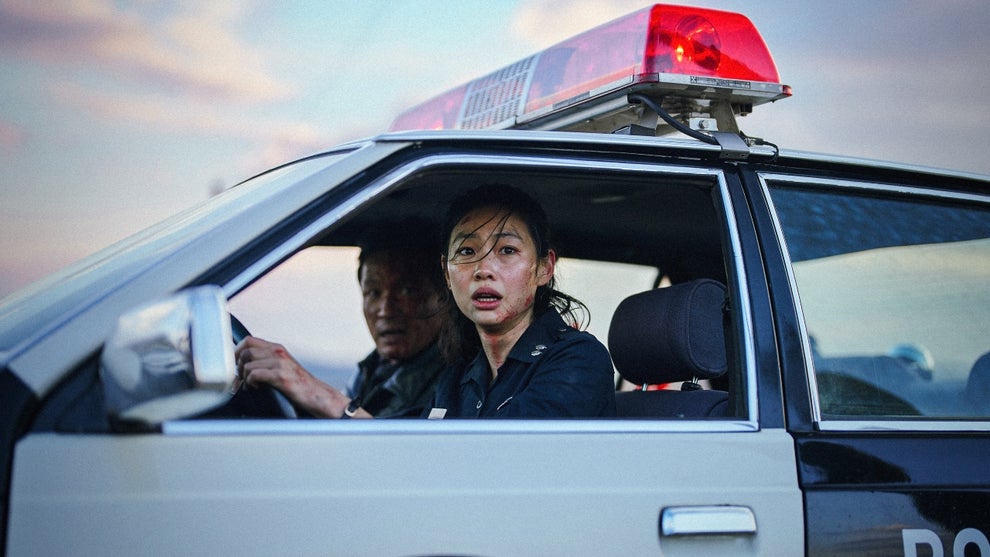
“Hope” is here.
The epic sci-fi spectacle, about an alien invasion that comes to a small South Korean town called Hope Harbor, arrived at the Cannes Film Festival earlier this year, where it received a divisive response. Some heralded it as a breathless new classic (our own reviewer called it “all-time great new action”) while others dinged it for what they considered slack pacing and iffy visual effects. (IndieWire’s David Ehrlich’s pan was particularly withering.)
Now, a few months later, with the Cannes response in the rearview and Neon opening it on 1,500 screens (the widest release for a Korean-language movie since “Parasite” in 2019), “Hope” is ready for global dominance. The movie, a whirling, gonzo extravaganza unlike anything you’ve ever seen before, follows several characters – a headstrong chief of police (Hwang Jung-min), a rookie cop (Jung Ho-yeon), an elderly man (Im Hyun-sik), an oddball taxidermist (Eum Moon-suk) and some hunters in the woods – as they attempt to track and stop the rampaging monsters.
It’s also probably worth mentioning that Michael Fassbender, Alicia Vikander and Taylor Russell play the creatures.
The movie is full of unbelievable set pieces, as intricate and dazzling as any Hollywood spectacular, and builds to a climax both mystifying and electrifying – a cosmic punchline that had our audience chuckling in disbelief.
Writer/director Na Hong-jin, whose last film was 2016’s witchy horror epic “The Wailing,” said that he has been thinking about “Hope” for about 10 years.
“I’ve slowly been chipping away and working at it – whether it came to the design of the film, adapting the script or even like looking at locations, it’s been a slow and steady process throughout those years,” Na told TheWrap via his translator.
When crafting “Hope,” Na said that he was influenced by several of his favorite films – the Coen Brothers’ “Fargo” and “No Country for Old Men,” David Fincher’s “Zodiac” and the work of William Friedkin – and you can see all of those in the final film, even if they’ve been remixed and chopped up and turned inside out. (He said he was also influenced by popular anime “Robotech,” for the way the creatures have a habit of transforming.)
In fact, “Hope,” with its disparate influences, feels like it could have been several movies – one with the cops following the monsters in the town, another with the hunters in the woods, perhaps a third with a taxidermist that might be a key to the entire invasion.
“I thought about these different sequences, obviously from the beginning, all tied together and interconnected. However, the taxidermy scene is an idea that I came up with towards the end, and it was after watching some Spielberg films and really getting a lot of inspiration that we needed a scene like this to tie the film together,” said Na.
The first hour of “Hope” is particularly jaw-dropping. It’s the chunk of the movie that even those who weren’t totally on board can agree was a highlight. Na said that in order to accomplish the sequence, with its astounding production design and attention to detail, they had to shoot over the course of two primary shooting blocks, taking up about a month total.

“The first time was it was half-destructed, and then the second time it was completely destroyed,” said Na.
The village where they shot the scene, he said, is “a primary hub of kimchi and cabbage distribution.” “We had to shoot before and after their big production season,” Na said. Not that stopping and coming back was a big deal. As Na explained, “We were everywhere throughout the production.”
We wondered how Na keeps track of the particulars of these massive action set pieces – it’s a wonder to watch them unfold and to see how Na orients the viewer, either in the middle of the woods or in a densely populated village center.
“I write the scripts myself and in that process, I add all these aspects of details that I want to include in the sequences themselves; you could almost say that the script is like a floor plan for how the structure and the devices of how these long action sequences are going to work,” Na said. “There is a feeling that is already included in the script writing process, and also the storyboarding process is incredibly meticulous and long for me. By the time that process is over, I would say all the shots in order are in my mind, and because of that, it’s not particularly difficult… I would say all the shots have been downloaded into my brain.”
The choice to choose recognizable, non-Korean actors as the monsters (“Manhunter” standout Cameron Britton, who also appeared in Bong Joon-ho’s “Mickey 17,” also plays a monster) is a fascinating decision. This is a movie set in a small town near the DMZ, with signs warning to keep an eye out for northern spies (and to keep an eye out for northern landmines) – an alien invasion is something that is on everyone’s mind. When the monsters show up, there are villagers who are armed to the teeth. They’ve been waiting for this moment. Well, not exactly this moment. But you get the idea.
Na said he made the choice to cast stars in the roles of the monsters after thoughtful deliberation. He was studying different monster movies and realized that he had to make a choice to either cast professional actors or “specific motion-capture actors.”
“But the story of ‘Hope’ continues beyond what you see in this film itself into possible sequels, so the choice of going with professional actors seemed to be more apt because there is a greater story than what is shown,” said Na. “It evolves and there is much more emotional and meticulous acting that is necessary for these creatures.”

Na thought, Which actor would be great for these creatures? Who should that be? Vikander came to mind. “I thought she would be incredibly fitting. She was really happy and accepted the role,” Na said. And sure enough, Fassbender, her husband, came along for the ride too. Fun fact: they play an on-screen “couple” for only the second time (the first was in 2016’s “The Light Between Oceans”).
As for the further “Hope” installments, Na has previously said that the sequel is already written. “I would say that what you see here that is the middle part of the narrative, and what the story that comes next, of course, is when night falls – from the nighttime into when daybreak happens,” said Na.
But of course, the only thing scarier than an alien invasion is snippy film festival reviews. Na said that after the Cannes screening, he shortened the runtime by four minutes. There were two sequences that he reorganized and cut down, along with abbreviating a scene where one of the creatures’ bodies is moved in preparation for a truly outrageous alien autopsy sequence.
“The story structure I think has gotten a lot clearer and more certain. We didn’t want to go to Cannes with too simple of a film, but afterwards we were like, Okay let’s take out these parts, which is why we’re at the current cut that we’re at now,” Na said. “I think the current version is much better. I think it really lays out the narrative structure very clearly.”
One scene that hasn’t been altered from Cannes is one of its funniest and oddly most edge-of-your-seat, as a villager recounts attempting to go to the bathroom in the woods, while he notices the alien creatures.
“That is the scene that has survived the longest within the script from the very first rendition of it. It’s gone through countless evolutions, and I would say that this scene was the reason for making this movie,” Na said. The scene is risky – it’s a lengthy sequence dependent primarily on dialogue. And it sparked much debate during the editing process. But Na was adamant.
“I really thought that if we were to throw the scene away, it would shorten the screen time down to two-hours-and-20-minutes. But I protected it at all costs,” said Na.
Why was it so important?
“It poses the most fundamental question of the film, which is, what really is humanity and the human creature from an astronomical perspective? I really wanted this sequence to convey the metaphor of the human and create a clear sense of what I was trying to say with this,” said Na.
“It explores the form of the human, what it means to be primitive, these symbols, and the continuous evolution of the human itself within the context of the world. I wanted there to be an exploration of what is intuitive about human nature, what is absolutely necessary or even true, and it is really an exploration of memory that is twisted and all these aspects of humanity that I really find interesting.”
Na said that he doubts that the “Hope” sequel will be the next on his agenda.
“I’ve been working on ‘Hope’ for so long that I need a quick break from it before ‘Hope 2.’ I think I’m going to shoot something a little bit quick and dirty in the interim, something that’s very violent and dark,” Na said, based on an original screenplay that he wrote during the pandemic.
That’s right – Na is committed to keeping “Hope” alive.
“Hope” is now playing in theaters.
