
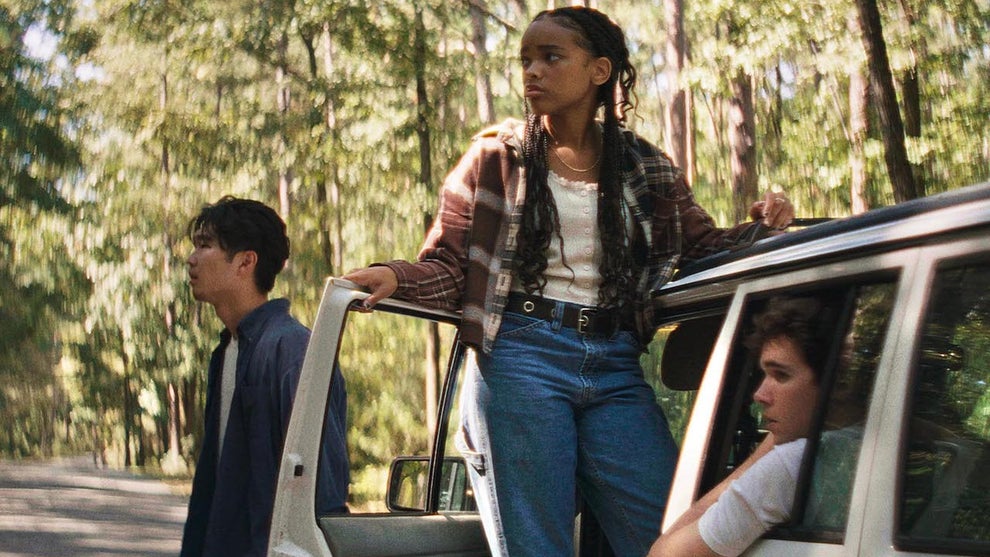
Let’s face it: We are not OK.
Horror movies have a beautiful — and beautifully nasty — way of reflecting our anxiety back at us. That’s how you know they’re working. Horror filmmakers aren’t just trying to reach the audience, they’re trying to scare the audience. So it’s in everyone’s best interest, artistically and financially, to keep track of what’s keeping everybody up at night.
There was an illuminating and lucrative wave of ultraviolent, ultra-cynical horror films in the 2000s (“Saw,” “Hostel”), a response to the vulnerability Americans felt after 9/11, and our culture’s violent, ugly response to suddenly feeling vulnerable. The found footage genre (“Paranormal Activity,” “Unfriended”), besides being inexpensive, finally boomed when a whole generation started carrying cameras around in their pockets and living online in videos which will, one day, be the only evidence we existed at all.
Alexander Ullom’s beguiling directorial debut “It Ends” is a vital entry in the latest horror zeitgeist, which tunes into a younger generations’ sense of futility. What, after all, is the point of living if our futures came pre-ruined, and are unresponsive to our desires and actions? We seem to have fallen through the cracks of the world, a la “Backrooms,” lost and forgotten. Bodily autonomy can be ripped away at any moment by mediocre, sexist men wielding too much power — politics by way of “Obsession’s” One Wish Willow — who view other people as property to be hoarded and maintained.
If we have no power to change our lives, to protect ourselves, or build a better future, what are we supposed to do? Just keep going like nothing’s wrong? “It Ends” finds a simple, miserable metaphor to having nothing to live for but still being expected to live. Four friends drive down a road chosen for them by a supposedly trustworthy GPS system — a tidy example of our malaise about the corporate takeover of every aspect of existence, even our sense of direction — and they just keep driving. The road never ends, there’s nowhere to turn, and if they stop long enough to try to solve their problems they’re swarmed by desperate, violent strangers begging to be saved.
After all, our heroes may not have hope but at least they have a car. In this economy we should be so lucky. But the car never runs out of gas and its passengers have been robbed of their basic human desires. They no longer need to eat or sleep. Their sex drives have vanished. They can try to amuse themselves along the way, to fill their days with routine and art and the occasional primal scream. But when all that fails to distract them, there is only a long, monotonous road ahead. And that road turns up as soon as we wonder if we should settle down, as though a future of pointless tedium is all that lies ahead and we may as well get used to the idea now.
At least, that’s one theory. James (Phinehas Yoon) becomes obsessed with solving the puzzle in “It Ends,” searching for patterns, for meaning, for loopholes, driving himself mad with the idea that anything means anything and there’s some way to emerge from his journey victorious. Tyler (Mitchell Cole), a stalwart veteran who broke up with his girlfriend just because she wanted to take him to a pumpkin patch, isn’t built for extended human interaction. Day (Akira Jackson) recently tried to end her own life and Fisher (Noah Toth) is prone to panic attacks. How will these sensitive souls handle a perpetual, heartless grind?
“It Ends” is terrifying. It’s not brutal. There’s a good chance these kids are dead already so threatening their mortality doesn’t mean much. Like Gooseworx’s heartbreaking “The Amazing Digital Circus,” Alexander Ullom’s film accepts the possibility that our lives cannot be changed, so what matters is either how we live them or why we decide to give up. Either way we are the company we keep. The road leads to nowhere but we’re all along for the ride.
“It Ends” makes us wonder whether living is worth the trouble and if giving up has its merits. God damn, that’s disturbing. Ullom may be equating “giving up” with self-harm but that’s only one interpretation. People abandon hope in all kinds of ways. We turn our backs on our dreams. We settle for circumstances which could be worse because trying to improve them is exhausting. In “It Ends” — a title which could be a promise or an omen — extracting yourself from a pointless existence is the same as accepting it.
Watching Alexander Ullom’s “It Ends” is to watch a generation wander a world where they affect nothing, live in constant fear or denial, and — in one way or another — come to terms with their plight. It’s profoundly troubling and all the more powerful for its simplicity. It’s not just something to do while we keep on going and going and going, until for one reason or another we stop. It asks big questions, the questions that are worth pondering. What is the meaning of it all? Or is the wondering the point all along? And if so, is wondering worth the bother?

The Best Movies of 2026 So Far